
Lieferung heute & morgen

Qualitätsgarantie

Willkommens-Angebote freischalten: KOSTENLOSE Lieferung | Bis zu 80 % RABATT | Kostenlose 30-Tage-JoyPlus-Testphase
App herunterladen
By the Joybuy Product Recommendation OfficerUpdated July 29, 2026
A room with excessive echo can disrupt concentration in a home office, ruin a movie night in the living room, or degrade the quality of audio recordings. A wooden acoustic panel promises to solve this problem while also serving as a stylish design feature. However, the market is flooded with products whose actual performance often falls short of expectations.
Many buyers invest in panels that are visually appealing but do little to reduce reverberation. To help you make an informed decision, we will highlight the most common pitfalls and the critical quality features to look for.
The selection can be overwhelming. Many products focus on aesthetics but neglect their core function: sound absorption. Watch out for these two common problems:
To ensure your acoustic panel is both functional and durable, you should check three technical aspects before making a decision.
The most important component for sound absorption is the felt behind the slats. A high-quality wall-mounted sound absorber uses a backing made of high-density polyester felt.
The slats are not only responsible for the design but also influence the acoustics through sound reflection and diffusion.
The installation method has a significant impact on the panels' effectiveness.
Based on the quality criteria mentioned, we have selected a few products from our range that are suitable for different applications.
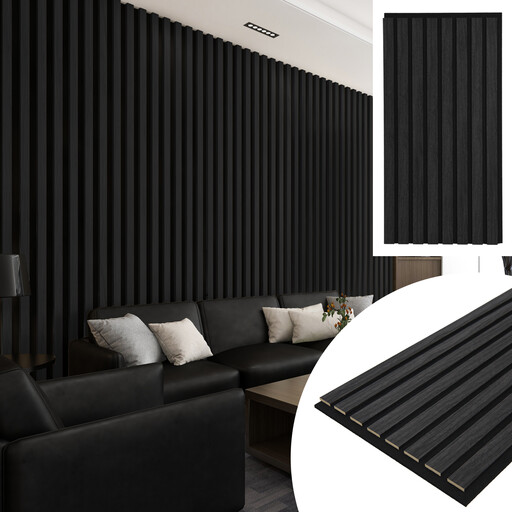
Why This Fits Their Persona: Ideal for users who want to blend modern aesthetics with a tangible acoustic improvement without a large initial investment. The set of 4 is perfect for creating an accent wall in a living room or bedroom.
This panel uses a dense felt backing that effectively absorbs sound, rather than just being decorative. The 3D slat structure breaks up sound waves, avoiding the flat, ineffective surface of purely decorative boards.
The combination of a modern grey oak design and simple installation with adhesive strips makes it an accessible DIY solution for reducing echo in living spaces.
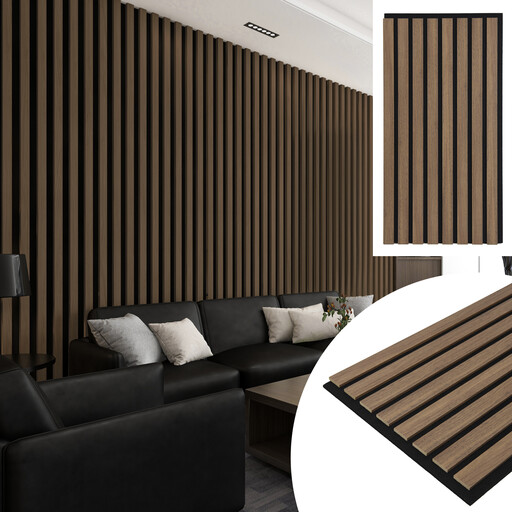
Why This Fits Their Persona: For home office users, podcasters, or content creators for whom clear acoustics are critical for work. The dark walnut finish creates a professional and focused atmosphere.
This panel relies on a real wood veneer and a dense felt backing to deliver measurable acoustic performance. It is designed as a functional sound absorber, not just a decoration.
The combination of absorption (felt) and diffusion (3D slats) improves speech clarity on calls and in recordings by minimising distracting reflections.
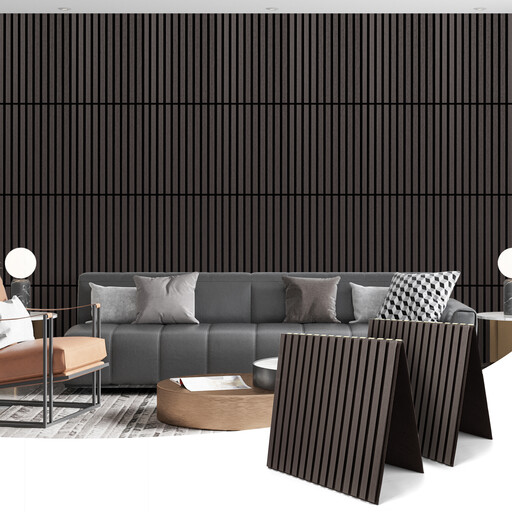
Why This Fits Their Persona: Suitable for covering larger wall surfaces in open-plan living areas, hallways, or conference rooms. The foldable design facilitates transport and storage if the space is used flexibly.
With a large format of 120x60 cm per panel, a significant absorption area is created. This avoids the mistake of installing too few or too small panels, which often results in a barely perceptible effect.
An efficient solution for large-scale treatment of reverberation. The high-density polyester fibre core ensures solid acoustic performance in larger rooms.
Proper installation is crucial for the final result. While many panels come with adhesive strips, a permanent and acoustically optimised installation often requires additional tools.
For installing acoustic panels and other woodworking projects, we've curated a selection of tested tools to make your job easier.
Yes, most acoustic panels can be customised by a DIYer. The wood slats can be trimmed with a fine-toothed saw (e.g., a Japanese saw or a mitre saw). The felt backing is easiest to cut with a sharp utility knife. Always work from the back to ensure a clean cut edge on the felt.
A general rule of thumb is that covering about 25–30% of the wall surface on one or two adjacent walls is sufficient to achieve a noticeable reduction in reverberation. Start with the wall opposite your primary sound source (e.g., speakers or workstation) and the adjacent wall.
A gap from the wall, created by mounting on battens, significantly increases absorption performance, especially at lower frequencies. The air gap acts as an additional resonator. If this space is filled with sound-absorbing material like mineral wool, the effect can be further optimised. This method is recommended for professional applications such as in recording studios or home cinemas.