
Lieferung heute & morgen

Qualitätsgarantie

Willkommens-Angebote freischalten: KOSTENLOSE Lieferung | Bis zu 80 % RABATT | Kostenlose 30-Tage-JoyPlus-Testphase
App herunterladen
As a Joybuy Product Recommendation Officer, I see every day how wooden acoustic panels transform spaces. They can turn an echoey home office into an oasis of focus or give a living room a modern, warm atmosphere. But the market is flooded with products whose promises don't always match reality. Many buyers invest in stylish wooden wall cladding that looks modern but remains acoustically ineffective.
This guide reveals the three most common pitfalls when buying acoustic panels and explains the crucial parameters you need to look for to make an informed decision.
Before you invest in a new acoustic wall, you should be aware of the typical problems that can lead to disappointment and unnecessary expense.
To avoid these pitfalls, focus on three verifiable technical features. These determine the acoustic performance as well as the durability and safety of your panels.
An effective acoustic panel is more than just a wooden slat. It's a system of three layers:
The installation method is a critical criterion that depends on your living situation and your DIY skills.
Here are three recommendations tailored to different needs and use cases.
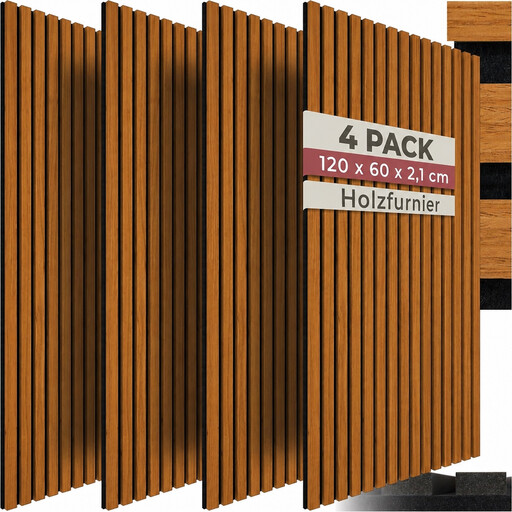
Why This Fits Their Persona: Ideal for anyone wanting to create a stylish accent wall without altering the building's structure. The modular set of 4 is perfect for smaller areas, and the walnut finish adds a sophisticated touch to any room.
The product description explicitly mentions the option of drill-free installation with adhesive, which bypasses the "Installation Dead-End" for renters. Its construction with an MDF core and acoustic felt prevents the "Looks-Only" trap.
Combines a high-end wooden slat wall aesthetic with proven sound absorption. The modular set allows for flexible design.
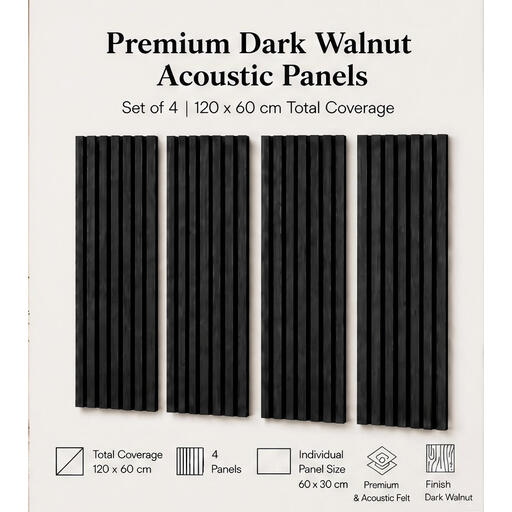
Why This Fits Their Persona: Perfect for targeted acoustic optimisation, e.g., behind a monitor, to improve speech clarity in video conferences. The modern grey oak finish blends unobtrusively into professional environments.
This panel is made from low-VOC materials, directly addressing the "Material Hazard". The construction is designed for acoustic performance in office environments.
Focuses on reducing distracting noise and echo to create an acoustically balanced environment for focused work.

Why This Fits Their Persona: For those who want to cover an entire wall or larger areas, such as in a home cinema or music room. This set offers extensive coverage at 3.6 m? and ensures a uniform appearance.
Buying a large set from a single batch avoids the colour and texture variations that can occur when purchasing multiple smaller packs. It provides a consistent solution for a large-scale acoustic wall.
Large, versatile set for extensive projects. The light oak acoustic panel finish creates a bright and modern atmosphere.
We have compiled a complete, up-to-date list of products that fully meet these strict selection criteria and German safety regulations.
It's important to distinguish between sound absorption (room acoustics) and sound insulation (soundproofing). Wooden acoustic panels are primarily designed for sound absorption. They reduce reverberation and echo within a room, which improves sound quality and speech clarity. However, they are not an effective solution for blocking noise from outside (e.g., from neighbours) or preventing your own noise from escaping. That requires structural soundproofing measures.
Completely covering all walls is rarely necessary. A good rule of thumb is to cover about 15–25% of a room's wall surface. Start with the wall opposite the main sound source (e.g., speakers, your desk). Treating two adjacent walls can also be very effective at minimising standing waves. Modular sets allow you to start with a smaller area and expand if needed.
Yes, this is usually possible. Most panels can be cut to fit around sockets, light switches, or room corners. The felt backing can be easily cut with a sharp utility knife. For the wooden slats themselves, a fine-toothed saw (such as a Japanese saw or a mitre saw) is recommended to achieve clean, splinter-free edges. Always measure carefully and work slowly.