
Lieferung heute & morgen

Qualitätsgarantie

Willkommens-Angebote freischalten: KOSTENLOSE Lieferung | Bis zu 80 % RABATT | Kostenlose 30-Tage-JoyPlus-Testphase
App herunterladen
Wooden acoustic panels combine wall décor with the potential to reduce echo indoors. They’re often used in home offices, video-conferencing rooms, living spaces, music rooms and recording studios. However, an attractive slatted design doesn’t automatically mean you’re choosing the right acoustic solution.
Before you buy, check the panel construction, dimensions and installation method. The tips below can help you avoid common mistakes when buying wooden slat panels.
Sound-absorbing wall panels can reduce reflections within a room, helping to minimise distracting echoes, for example. However, they won’t automatically stop sound travelling into adjoining rooms. Effective noise insulation usually requires additional building work, such as decoupled wall structures, insulation materials or doors with suitable seals.
3D wooden slat panels with narrow gaps look decorative, but effective sound absorption usually depends on a backing designed for the purpose. Acoustic felt or another absorbent layer can play an important role. A purely decorative wooden covering without an absorbent layer may still reflect a lot of sound.
A single panel may be enough for a small section of wall, but in a home office or studio, the results depend on the area covered and the room’s acoustics. Furniture, curtains, rugs and bookcases also affect the outcome. Before ordering, measure the wall, doors and windows carefully, and plan the layout you want.
Look for a combination of MDF core, wood veneer or decorative finish, and acoustic felt. The MDF core provides a stable backing board, while the slats create the finished look. An absorbent backing is particularly important if you’re looking for acoustic panels for a home office, voice recording or video calls.
If a product is described as having ‘low emissions’ or ‘low VOC levels’, check whether the seller explains these claims or supports them with documentation. The products featured here are listed as having an MDF core with low VOC levels and a felt backing. This is a product feature, not a general guarantee of indoor air quality.
Don’t judge the size by the number of panels alone. The total area is what matters:
These figures make it easier to plan an accent wall or a larger sound-absorbing wall covering. For a studio, also consider where your speakers, microphones and listening position will be.
Depending on the product, acoustic panels designed for wall mounting can be glued or screwed in place. Adhesive avoids drilling holes, but it needs to be suitable for both the wall surface and the panel’s weight. If you rent, check in advance whether the adhesive can be removed without leaving residue. Suitable screws and wall plugs are an option for a more permanent fix.
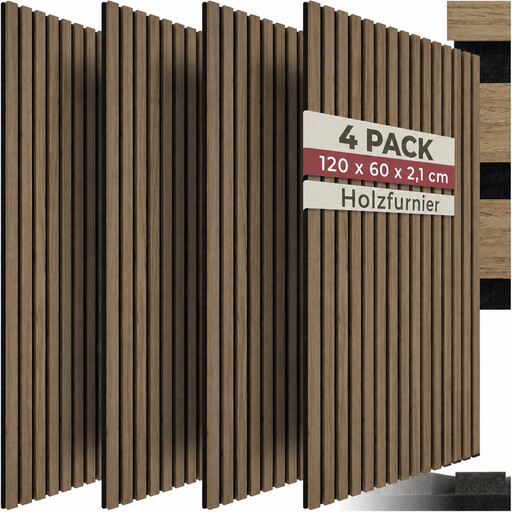
Why it suits this need: The set covers 0.72 m², making it a practical choice for gradually treating smaller sections of wall, such as behind a desk or on a video-call backdrop.
The total coverage and the number of panels—four—are clearly stated. The MDF core and acoustic felt are listed as components, rather than the product relying on its slatted appearance alone.
Four panels, each measuring 60 × 30 cm, with a dark walnut finish and two installation options: adhesive or screws.

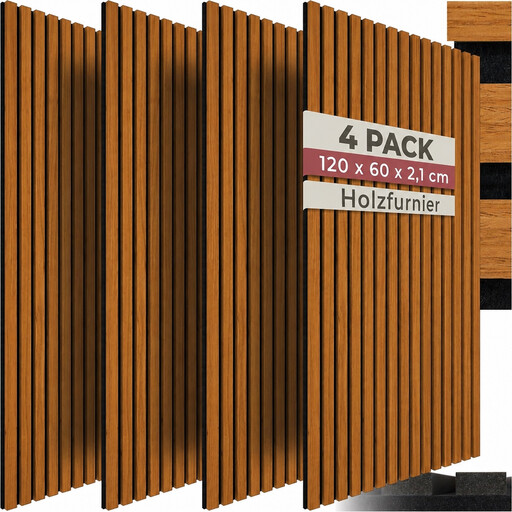
Why it suits this need: With coverage of 3.6 m², this set is well suited to larger feature walls in living spaces, home offices or meeting rooms where you want a consistent look.
The generous set coverage is specified as 20 panels measuring 600 × 60 cm in total. This makes it easier to check how much material you need against your wall measurements before ordering.
Oak finish, MDF core, acoustic felt and 20 modular panels, each measuring 60 × 30 cm.
Why it suits this need: The modular format is a good option for musicians, podcasters and anyone setting up a small recording space who wants to treat specific areas where sound reflects.
The set isn’t presented as a way to soundproof an entire room. Its clearly defined coverage makes it easier to target sections of wall where echo is most noticeable.
Walnut veneer, 0.72 m² of coverage, acoustic felt backing and flexible installation with adhesive or screws.
Before installation, make sure the wall is dry, clean and sturdy. If you’re using adhesive, it’s a good idea to test it in an inconspicuous spot first. For screw fixing, choose wall plugs suited to the surface. Keep the gaps between panels even for a neat, consistent slatted finish.
In a studio or a room with significant echo, start by identifying the problem areas. Opposing hard walls, ceilings and corners are often acoustically important. Rugs, curtains and furniture can complement the effect of wall panels, but they won’t replace them.
We’ve put together a complete, regularly updated list of products that meet these strict selection criteria and fully comply with the safety regulations in force in the EU.
It depends on the size of the room, its surfaces and the effect you’re looking for. First, calculate the wall area you want to treat and compare it with the total coverage of the set. If there’s a lot of echo, it may help to combine panels on several walls with textiles and furniture.
They can generally be installed using adhesive. Whether this is suitable depends on the wall covering, the weight of the product and the terms of your tenancy agreement. Before buying, check whether the adhesive can be removed without causing damage.
Their lifespan depends on factors including material quality, installation, humidity and physical wear. MDF panels should be kept dry and protected from prolonged exposure to high humidity. Proper installation and careful cleaning can help them last longer.