
Lieferung heute & morgen

Qualitätsgarantie

Willkommens-Angebote freischalten: KOSTENLOSE Lieferung | Bis zu 80 % RABATT | Kostenlose 30-Tage-JoyPlus-Testphase
App herunterladen
Wooden acoustic panels combine attractive wall design with the potential to reduce unwanted reflections in a room. They’re used in home offices, living rooms, gaming rooms, home cinemas, studios and conference rooms. However, not every decorative wall panel is suitable for every acoustic need.
Before you buy, it’s important to distinguish between sound absorption within a room and sound insulation between adjoining rooms. Wooden slat acoustic panels can affect sound reflections and reverberation, but they’re no substitute for structural sound insulation against noisy neighbours or traffic.
Terms such as ‘Noise Reduction’ or ‘Echo Control’ only describe the intended use. More useful information includes the absorption class, the sound absorption coefficient αw or test results in line with relevant standards. Without these figures, it’s difficult to compare the acoustic performance of different products.
A 0.72 m² set may work well as an acoustic feature, for a small speaker area or to cover a limited reflection zone. It may not be enough for a larger living room, studio or office. So, plan in advance which wall or ceiling area you want to treat.
With 3D acoustic panels, it’s not just the visible wood finish that matters. The MDF core, felt backing, slat depth and fixing method are all important too. Panels with acoustic felt may absorb sound in a room differently from thin, solid decorative panels. Also check whether adhesive mounting is suitable for your wall, or whether you’ll need screws or wall plugs.
Many sound-absorbing wall panels consist of an MDF backing with a wood veneer and felt backing. The veneer mainly determines the appearance, whether you choose walnut acoustic panels, oak or grey oak. The felt backing is part of the acoustic construction, but shouldn’t be mistaken for complete sound insulation.
The products featured here are listed as having an MDF core with wood veneer and acoustic felt. Some are also described as using low-emission or ‘low-VOC’ materials. Check these details in the relevant product description and the manufacturer’s information.
Individual panels measuring 60 × 30 cm provide different total coverage depending on the size of the set:
The quantity you need depends on the size of the room, its furnishings and how much coverage you want. When choosing acoustic panels to reduce echo, it’s often worth starting with highly reflective surfaces opposite speakers, microphones or your workstation.
An adhesive solution may be a good option for rented homes, provided the surface is suitable. Before installation, check the wallpaper, plaster, paint and strength of the wall. For a permanent fixing, use screws and suitable wall plugs. When installing panels on the ceiling, take particular care to check the weight, surface and fixings.
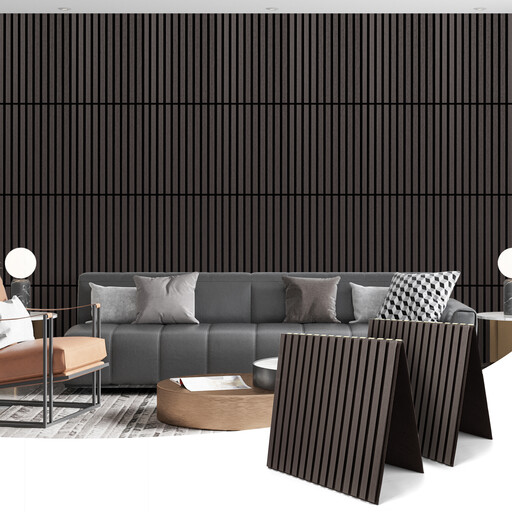
Why it suits this need: The two foldable panels, each measuring 120 × 60 cm, offer a straightforward solution for a home office, gaming room or a single section of wall.
The stated total size makes it easier to plan coverage. The foldable, interlocking design is made for tool-free wall installation.
Two large 120 × 60 cm panels, walnut veneer and a foldable design.
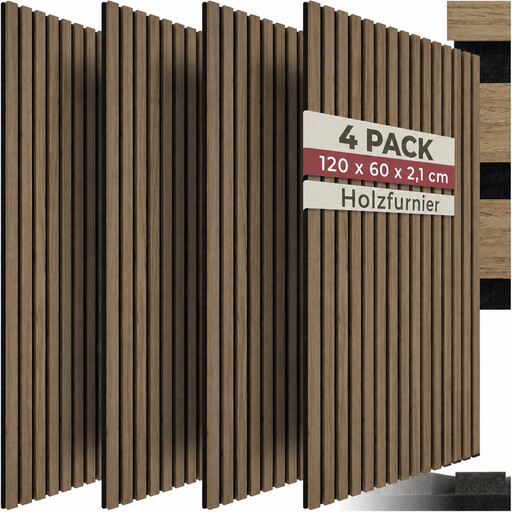
Why it suits this need: This set combines vertical 3D slats, dark walnut veneer and acoustic felt for a defined feature wall in your home office or studio.
The product details clearly specify the materials and total coverage. This makes it easier to compare the set with larger options and check it against your wall measurements.
Four panels covering 0.72 m² in total, with an MDF core, walnut veneer and felt backing.
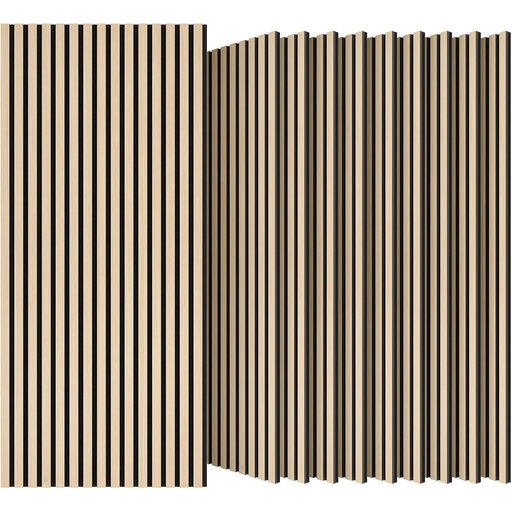
Why it suits this need: This large set is for anyone looking to create a consistent finish across a studio, podcast area, conference room or longer feature wall.
The coverage is clearly stated as 3.6 m². This reduces the risk of needing to plan for several undersized sets in a larger room.
20 panels, each measuring 60 × 30 cm, with oak veneer, an MDF core and acoustic felt.
We’ve put together a comprehensive, regularly updated list of products that meet these strict selection criteria and the safety regulations in force in the EU.
For acoustic panels in a home office, treating a specific area behind or beside your desk is often enough if your main aim is to improve the clarity of phone calls and video meetings. In a studio or podcast room, you should also consider the microphone position, speakers, windows and hard flooring.
A practical approach:
Decorative acoustic panels can enhance a room, but they won’t solve every noise problem. Low-frequency bass, impact noise and sound travelling through walls may require other structural measures.
It depends on the size of the room, its furnishings and the result you want. Start with the areas where sound reflects directly. A small set may be enough for a compact workspace, while a studio or conference room will need more coverage.
Some models are listed as suitable for walls or ceilings. However, the surface, weight and fixings are all important. Only use a ceiling installation method that’s suitable for your existing structure, and check the manufacturer’s instructions.
Lifespan depends on material quality, installation, humidity, UV exposure and physical wear. An MDF core with veneer and felt backing should be installed in a dry place and protected from high levels of moisture. Before buying, check the care instructions, dimensions and material specifications.