
Lieferung heute & morgen

Qualitätsgarantie

Willkommens-Angebote freischalten: KOSTENLOSE Lieferung | Bis zu 80 % RABATT | Kostenlose 30-Tage-JoyPlus-Testphase
App herunterladen
Distracting echoes, reverberant video calls or unclear voice recordings can often be improved with targeted wall treatments. Wooden acoustic panels combine a decorative wall finish with sound-absorbing properties. However, not every decorative wood panel is automatically suitable for improving acoustics.
Before you buy, avoid these three common pitfalls:
When choosing wood-slat acoustic panels, consider the complete construction. A decorative veneer surface mainly affects the appearance. Factors that influence acoustic performance include:
Look for clear information on material thickness, backing material and installation. If you simply want decorative wood wall cladding, you may need a different product from someone looking to reduce echo in a home office or improve voice recordings.
Phrases such as ‘Noise Reduction’, ‘Echo Control’ or ‘Sound Absorbing’ describe a product feature, but they are no substitute for a technical rating. Where available, look for details such as the sound absorption coefficient, absorption class or an NRC rating. These figures should be based on a recognised testing method.
Without this information, it is difficult to assess the actual performance. Treating just part of a wall may be enough to change the acoustics in a living room or home office. For a recording studio, podcast room or home cinema, a more comprehensive plan that considers the ceiling, corners, floor and existing furniture is a better approach.
Always assess an acoustic panel set by its wall coverage, not just the number of pieces. Each panel in the products below measures 60 × 30 cm. Four panels cover 120 × 60 cm, or 0.72 m². A set of 20 panels covers 3.6 m².
Before you buy, use this checklist:
The term 3D acoustic panels usually refers to the three-dimensional slat structure. It does not automatically indicate a particular sound absorption class.
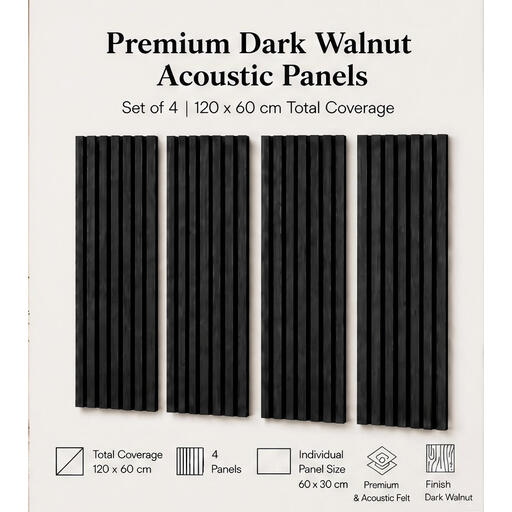
Why it suits this profile: The set covers 0.72 m², making it suitable for a single feature wall in a small home office, gaming room or living area. The grey oak finish works well with neutral décor.
The product description gives the dimensions of each panel, the total coverage, and details of the MDF core and acoustic felt. This makes it easier to assess how much coverage you’ll get before buying.
Four panels, each measuring 60 × 30 cm; MDF core with veneer and felt backing; according to the product details, they can be fitted with adhesive or screws.
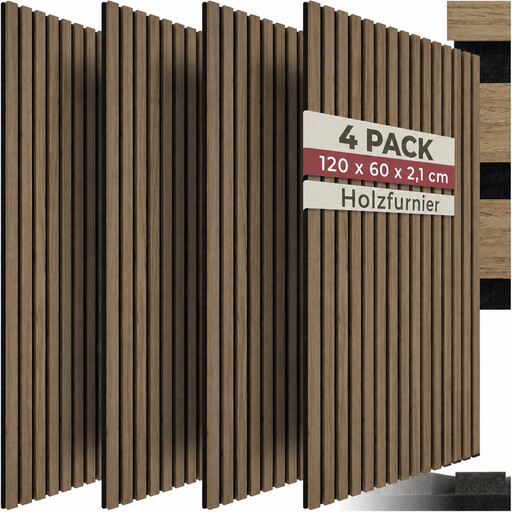
Why it suits this profile: The dark walnut finish is a good choice for smart home offices, living rooms or home cinemas where the acoustic panels are also intended to make a design statement.
The product information sets out the materials, dimensions and fixing options. That means you can make your choice based on more than just the veneer colour.
3D slat structure; dark walnut veneer; four panels covering a total of 0.72 m²; the supplier says they are suitable for home offices and studios.

Why it suits this profile: With 3.6 m² of coverage, this set is suitable for larger studies, podcast rooms, music spaces or a full-length feature wall.
The stated coverage helps you avoid ordering too few panels. According to the product description, they can be fitted with adhesive or screws.
20 panels, each measuring 60 × 30 cm; 3.6 m² of total coverage; oak veneer, MDF core and acoustic felt, according to the product details.
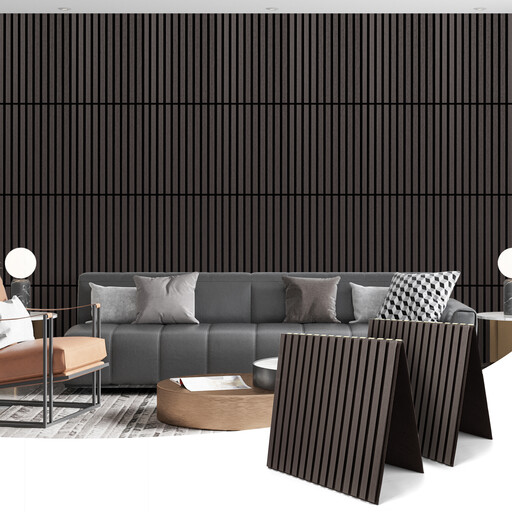
Why it suits this profile: The foldable design, with two panels measuring 120 × 60 cm, is a flexible option for a home office, podcast set-up, gaming room or changing room layouts.
The product description explains the folding and connection system, as well as the tool-free installation. Before using adhesive, check that it will stick to your wall covering and whether it could leave marks.
Two large panels, each measuring 120 × 60 cm; foldable design; walnut veneer; the supplier says they are designed for tool-free wall mounting.
We’ve put together a complete, regularly updated list of products that meet these strict selection criteria and fully comply with the safety regulations in force in the EU.
For an even effect, don’t treat only the most visible wall. The wall behind your desk, the opposing reflective surface or the area behind your microphone can often make a difference. A rug, curtains and shelving can also help scatter or absorb reflections.
When installing your panels:
Their main purpose is to improve room acoustics by helping to reduce sound reflections and reverberation within the room. Effective sound insulation against noise from neighbours, on the other hand, requires building work to the walls, ceiling, floor or doors.
It depends on the size of the room, its surfaces, furnishings and how you use it. A set covering 0.72 m² can work as a small feature in a compact workspace. For larger rooms or regular voice and audio recording, a 3.6 m² set or a tailored coverage plan may be more suitable.
Their lifespan depends on material quality, humidity, UV exposure, the wall surface and how they are installed. A dry indoor environment, secure fixing and careful cleaning all help them last. Check with the relevant manufacturer for any official lifespan information.