
Lieferung heute & morgen

Qualitätsgarantie

Willkommens-Angebote freischalten: KOSTENLOSE Lieferung | Bis zu 80 % RABATT | Kostenlose 30-Tage-JoyPlus-Testphase
App herunterladen
Distracting echoes in your home office, voices reverberating during podcasts or an unsettled sound in your gaming room: wooden acoustic panels can reduce sound reflections from hard walls while also serving as decorative wall panelling. However, products vary considerably in terms of construction, installation and actual coverage.
If you choose based solely on colour and 3D appearance, you will often overlook important details. Three common purchasing misconceptions are particularly relevant:
Before buying, you should establish what acoustic problem you actually need to address. For conversations, video calls or recordings, the main aim is usually to reduce echo and control reverberation. Effective noise insulation against neighbours in a home office, on the other hand, requires structural measures such as adding wall mass, sealing gaps or using a decoupled construction.
The following guidelines apply to typical uses:
With classic 3D wood panels, the visible slats often consist of a wood veneer surface on an MDF core. A felt backing provides the sound-absorbing layer. The key factor is not just the appearance, but the complete layer structure.
Look out for:
A smooth PVC panel with a raised wood grain pattern may be suitable as decorative wall panelling, but it is not automatically a sound-absorbing panel. According to the product description, the Commomy set is made from PVC and EVA, measures 30 × 30 cm per piece and is intended for smooth, clean surfaces. It is therefore primarily suitable for wall decoration.
The required area is often underestimated. A set of four panels, each measuring 60 × 30 cm, covers a total of 0.72 m², according to the product information. A set of 20 panels of the same individual size covers 3.6 m². These figures make it easier to compare the cost per square metre and the visual impact realistically.
First measure the area you want to cover and allow for a small amount of wastage. A partial area may be sufficient for a small home office. In an acoustic panel studio or around a podcast recording area, several reflection points are often treated.
Adhesive versions are appealing for rented homes, but they require a smooth, stable and dust-free wall. Check in advance whether the adhesive is compatible with the paint, wallpaper or plaster. Damage-free removal cannot be guaranteed on every surface.
Screws provide permanent fixing when used with a suitable wall and the correct wall plugs. For heavy or large elements, you should take the weight, load-bearing capacity and installation instructions into account. Folding acoustic panels may be easier to position because of their format, but they also require secure wall fixing.
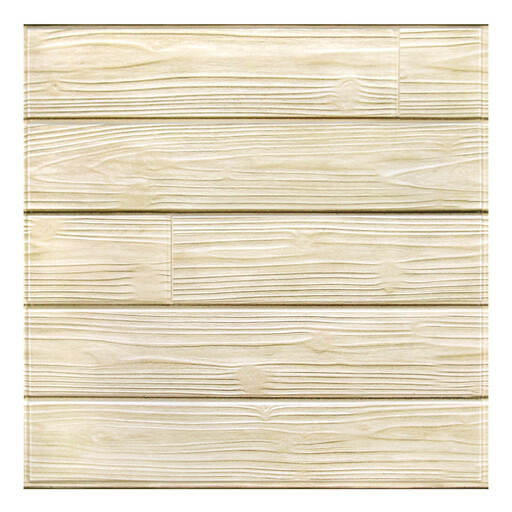
Why this product suits this profile: The set contains ten lightweight, flexible panels measuring 30 × 30 cm, with a self-adhesive backing. It is suitable for small decorative areas and straightforward DIY projects.
The product description explicitly states that the simulated wood grain is made from PVC and is not real wood. This makes it easy to assess the material choice before buying.
PVC/EVA construction, 3D texture, water-resistant surface according to the product description, and installation without additional tools.
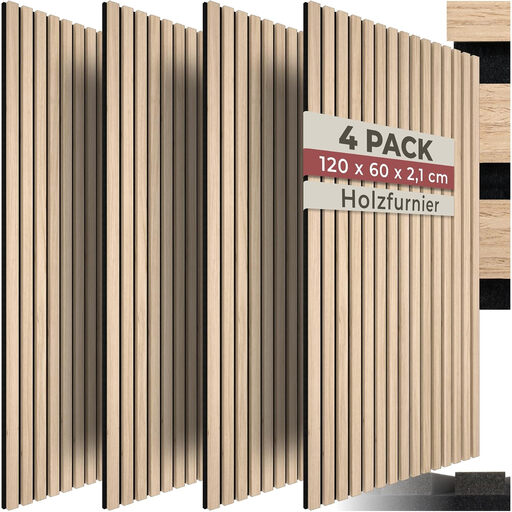
Why this product suits this profile: The combination of an MDF core, oak veneer and acoustic felt pairs a structured 3D slat design with a designated absorption layer.
The coverage is clearly specified as 120 × 60 cm, or 0.72 m². Adhesive installation and screw fixing are also described as separate options.
Four modules measuring 60 × 30 cm each, oak veneer, MDF core and acoustic felt according to the product information; suitable for home offices, studios and meeting rooms.
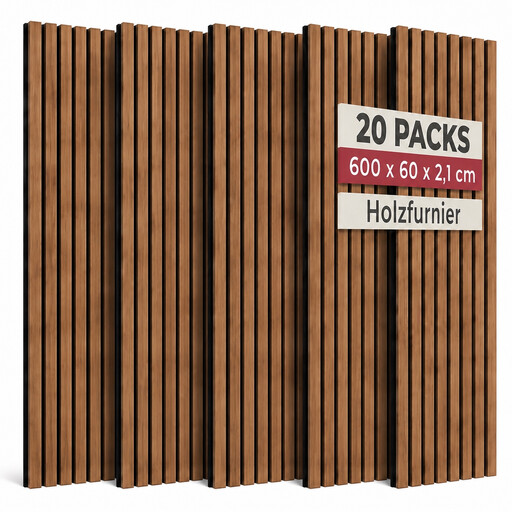
Why this product suits this profile: This large set is suitable for users who want to treat several reflective surfaces in a studio, podcast area, gaming room or larger living space.
With 20 individual modules and a total area of 3.6 m², the coverage is clearly stated. This makes planning easier than buying several small, mismatched sets.
20 panels measuring 60 × 30 cm each, walnut veneer, MDF core and felt backing according to the product description; can be installed with adhesive or screws.
We have compiled a complete, regularly updated list of products that fully meet these strict selection criteria and the safety regulations applicable in the EU.
With self-adhesive wall panels, you should also consider removal. According to the PVC set’s product description, heat may help when removing them; however, the adhesive could still damage paint or wallpaper. This does not guarantee residue-free removal.
This depends on the size of the room, its furnishings and the level of reverberation. In a small room, start with a targeted area behind or beside the desk. To achieve a greater effect, treat several reflection points. The total stated coverage of the set is what matters, not just the number of individual pieces.
First and foremost, they absorb sound reflections within your own room, which can make the room sound calmer. Genuine sound insulation against noise from neighbours generally requires structural measures. Acoustic wall panels should therefore not be confused with complete soundproofing.
Their service life depends on the material, installation, humidity, UV exposure and mechanical stress. MDF and veneer panels should be installed in a dry environment and cleaned carefully. With PVC or EVA panels, follow the relevant guidance regarding heat sources, moisture and the substrate. Always check the product information and installation instructions before buying.