
Lieferung heute & morgen

Qualitätsgarantie

Willkommens-Angebote freischalten: KOSTENLOSE Lieferung | Bis zu 80 % RABATT | Kostenlose 30-Tage-JoyPlus-Testphase
App herunterladen
Whether you’re setting up a home office, living room, gaming room or recording space, hard surfaces such as glass, concrete, laminate and painted walls reflect sound. This can create echo and reverberation, and make video calls or recordings sound unclear. Wooden acoustic panels can reduce these reflections on selected wall surfaces while also serving as decorative wall coverings.
It’s worth taking a closer look before you buy, though. Not every panel with a wood-effect finish is an effective acoustic solution. The construction, dimensions, installation and intended use all matter.
Wood-slat acoustic panels are primarily designed to improve the acoustics of a room. They absorb some of the sound energy that hits them, which can reduce reverberation and distracting reflections. That doesn’t mean they’ll completely block out your neighbours, traffic noise or voices coming through the wall.
So, for a home office where video calls sound echoey, sound-absorbing wall panels are a different solution from structural soundproofing. If you’re dealing with significant outside noise or impact sound, you may need additional measures such as seals, heavy curtains or a professionally designed wall structure.
3D acoustic panels with vertical slats look decorative, but their performance depends on the whole construction. Factors to consider include:
A plain MDF or solid wood panel without an absorbent backing is more likely to reflect sound than absorb it. So don’t just look for the word ‘acoustic’ — check the specific layers and dimensions listed.
A small set of 4 may be enough for treating a specific spot or creating a decorative feature wall. You’ll need more panels to cover a larger wall. Before buying, check:
If details about adhesive strength, surface compatibility or removal are unclear, you risk damaging your walls or ending up with an uneven finish.
Many modern wall panels have an MDF core, with a wood veneer or decorative finish to create the look. A felt backing can help absorb sound. According to the product descriptions, the slatted panels featured here have an MDF core, a wood veneer and an acoustic felt backing.
If you’re looking for oak acoustic panels, you’ll get a light, relatively neutral finish. Walnut acoustic panels look darker and create more contrast. The colour you choose won’t automatically change the room’s acoustics; it’s mainly a matter of interior style.
If a product is described as ‘low VOC’, check the manufacturer’s detailed information, safety data and guidance on indoor use. This label alone isn’t proof of any medical or health benefit.
One panel in the selection below measures 60 × 30 cm. According to the product details, four panels cover 120 × 60 cm, or 0.72 m². The set of 20 is listed as covering 600 × 60 cm, or 3.6 m².
These figures can help you work out how many panels you’ll need. Allow extra for possible cuts, gaps and spare pieces for the edges. For a neat, uniform finish, align the slats as precisely as possible.
Acoustic panels for adhesive installation are generally suitable for smooth, clean and stable surfaces. Before fitting them, remove dust, grease and any loose paint. Adhesion may vary on textured wallpaper, porous plaster or delicate wallpaper.
Screws are another option for a permanent fixing. Before drilling, check for cables and pipes, and consider the wall material and panel weight. If you’re renting, it’s a good idea to test the fixing in an inconspicuous spot first. Don’t assume that an adhesive described as ‘damage-free’ will leave absolutely no marks without checking.
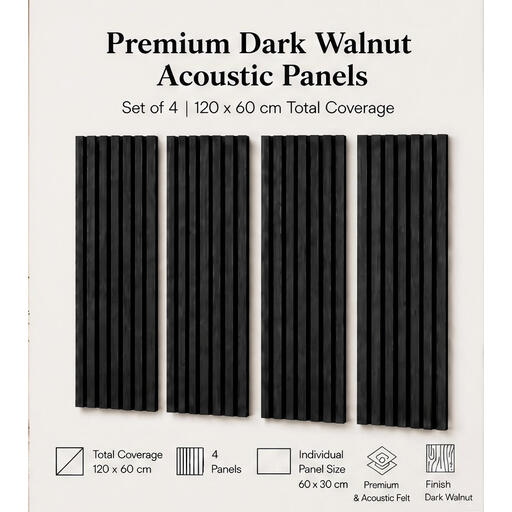
Why this product suits this profile: According to the product details, the set of 4 covers 0.72 m², making it suitable for a small feature area in a home office, living room or gaming room.
The clearly stated set size and panel dimensions make it easier to plan coverage and avoid ordering an uncertain quantity.
MDF core, Grey Oak finish, felt backing and modular layout, according to the product description.
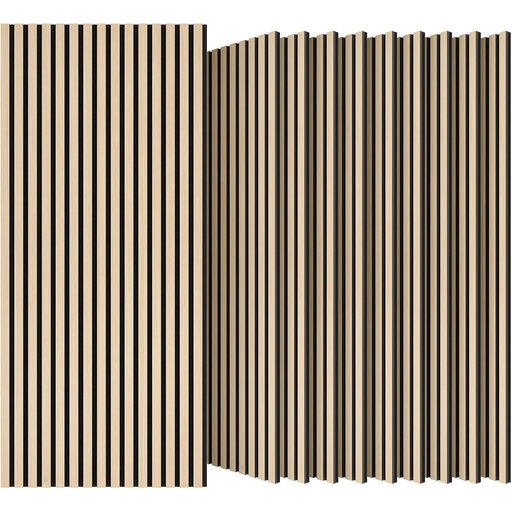
Why this product suits this profile: This set is a good choice if you want to create a larger, continuous feature in a studio, office or living space.
The stated total coverage of 3.6 m² makes it easier to plan than a set with no coverage information.
20 panels, oak veneer, MDF core and acoustic felt; according to the product description, they can be installed with adhesive or screws.
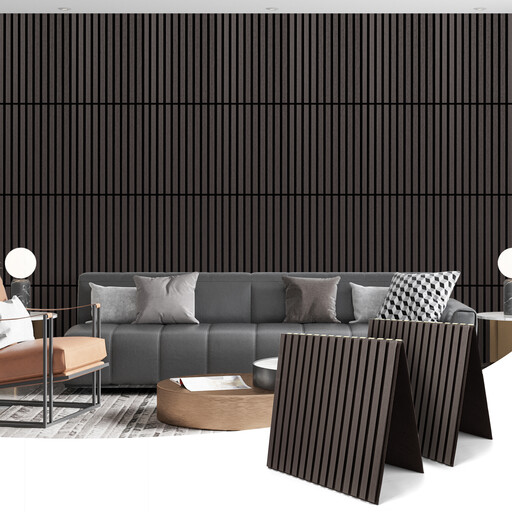
Why this product suits this profile: These two foldable 120 × 60 cm panels are designed for podcasters, streamers and anyone who needs a larger, flexible surface.
The foldable design and stated dimensions make this product easier to plan around when recording in different setups.
Two panels, walnut veneer, foldable design and, according to the product description, tool-free installation.
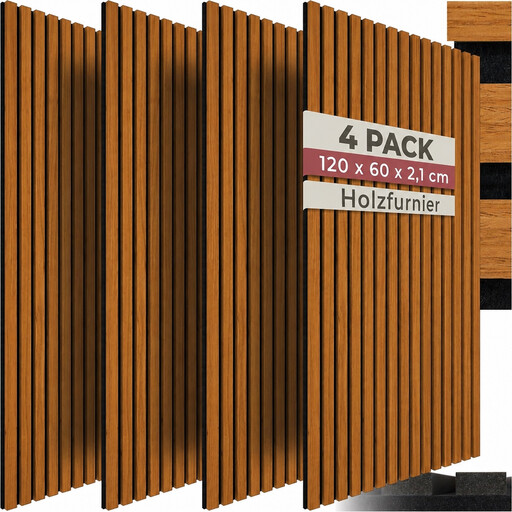
Why this product suits this profile: The walnut finish is ideal for a darker feature, while the set of 4 covers a manageable area.
The stated coverage of 0.72 m² helps you estimate realistically how many panels you’ll need for individual wall areas.
Walnut veneer, MDF core, acoustic felt and two possible installation methods, according to the product description.
We’ve put together a complete, regularly updated list of products that meet these strict selection criteria and fully comply with the safety regulations in force in the EU.
For acoustic panels to reduce echo, positioning matters more than spreading them around at random. Useful locations often include:
If the whole room is echoey, don’t put all the panels in just one corner. Treating several reflective surfaces can give you a more even result. In a studio, you should also consider speaker placement, the listening position and the shape of the room. Wooden panels aren’t a substitute for a complete room acoustics plan.
They can reduce reflections and reverberation if they cover a sufficiently large area and have a suitable absorbent backing. Their effectiveness depends on the size of the room, its furnishings, the distance from the wall and how they’re installed. They’re no substitute for structural soundproofing when noise is travelling through a solid wall.
It depends on the wall area and the room’s acoustics. According to the product details, a set of 4 covering 0.72 m² is suitable for a smaller feature area. For a larger wall, a set of 20 covering 3.6 m² may be a better choice. Measure the area you want to cover, allowing for windows, doors and any cuts.
Their lifespan depends on material quality, installation, humidity and physical wear. Keeping them in a dry indoor environment, fixing them securely and regularly removing dust with a dry cloth can help preserve them. Always follow the care and installation instructions for the product.