
Lieferung heute & morgen

Qualitätsgarantie

Willkommens-Angebote freischalten: KOSTENLOSE Lieferung | Bis zu 80 % RABATT | Kostenlose 30-Tage-JoyPlus-Testphase
App herunterladen
Echo, reverberation and distracting reflections are not just problems in recording studios. Hard floors, smooth walls and large windows can also affect the acoustics in a home office, living room, gaming room or home cinema. Wooden acoustic panels combine visible wall cladding with a sound-absorbing surface.
However, not every decorative panel is automatically suitable for improving a room’s acoustics. Three common buying misconceptions often lead to disappointing results:
Many 3D wood-slat acoustic panels consist of an MDF core, a wood-effect finish or veneer, and a felt layer on the back. The slats create the decorative texture, while the felt can absorb incoming sound energy and soften reflections.
So look beyond the colour of the wood and check the entire panel construction. A purely decorative wooden board without an absorbent backing performs differently acoustically from a slatted panel with a felt backing.
The suppliers of the products featured here list an MDF core with wood veneer and acoustic felt. However, the available product information does not specify absorption values such as αw or test results to DIN EN ISO 354. If you’re fitting out a recording studio with precise acoustic requirements, ask the supplier separately for this documentation.
Measure the wall before placing your order. According to the product information, a set of four panels, each measuring 60 × 30 cm, covers a total area of 120 × 60 cm or 0.72 m². This is suitable for a small section of wall behind a desk or a specific reflection point.
According to the supplier, a set of 20 panels of the same individual size covers 3.6 m². This gives you enough to create a larger feature behind a desk, on a media wall or in a recording room.
Allow extra for offcuts, gaps at the edges and your chosen layout. A continuous surface will look different from individual panels installed with gaps between them. To reduce echo, it also matters where the first sound reflections occur in the room.
Self-adhesive acoustic panels are a useful option for rented homes because you won’t need to drill. Even so, check the following first:
Screws may provide a more secure fixing for long-term use, but you’ll need suitable wall plugs and a sturdy wall. Wood-based materials and felt should not be exposed to high humidity for long periods. For bathrooms or unheated rooms, follow the relevant manufacturer’s guidance.
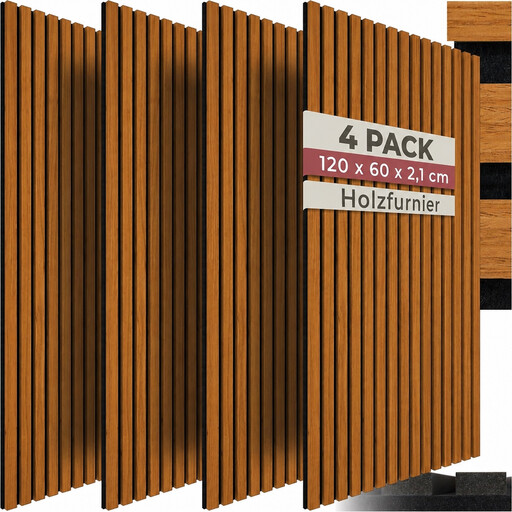
Why it suits this profile: This compact set covers 0.72 m², making it a good choice for a single section of wall, such as behind a desk or speaker setup.
The stated coverage and dimensions of the four individual panels make it easy to see exactly how much you’re getting before you buy.
MDF core, walnut effect and acoustic felt; the supplier says the panels can be fitted with adhesive or screws.
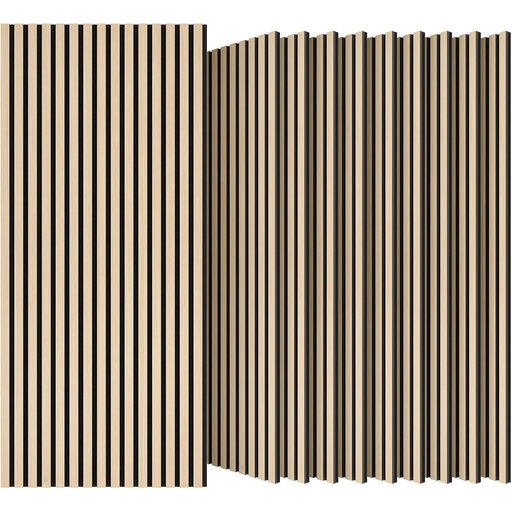
Why it suits this profile: This set is designed to cover a larger, continuous section of wall, making it a good fit for a living room, conference room or studio.
With 20 individual panels and stated coverage of 3.6 m², it’s easier to work out how many you need than with sets where the size is unclear.
Oak effect, MDF backing, felt reverse and modular panels measuring 60 × 30 cm each, according to the product description.
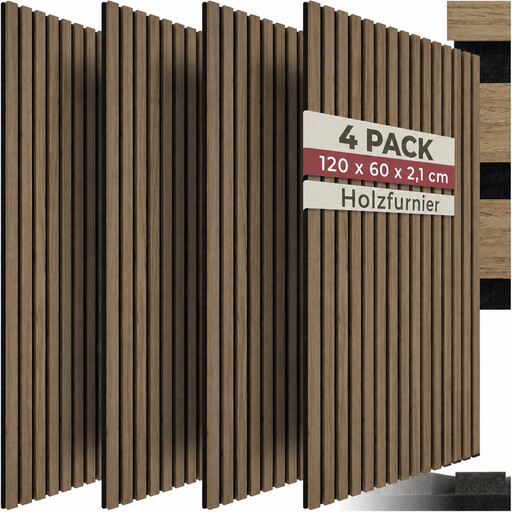
Why it suits this profile: The grey oak effect pairs well with neutral workspaces and tech setups, while the compact format is ideal for targeted installation.
The product description gives both the individual panel dimensions and the total coverage, rather than relying on appearance alone to indicate size.
Four panels, covering 0.72 m², with adhesive or screw fixing according to the supplier.
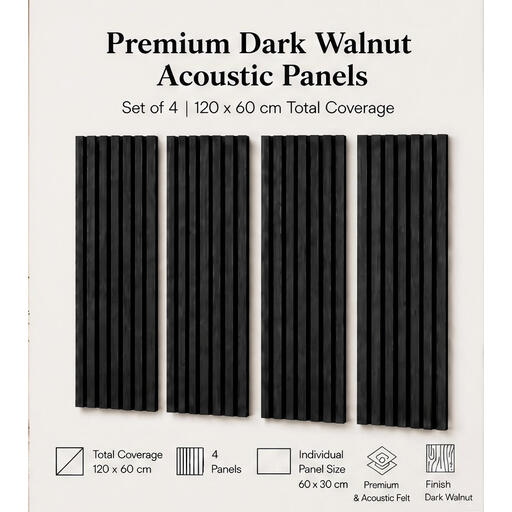
Why it suits this profile: The dark walnut effect makes a striking feature behind monitors, speakers or a home cinema wall.
The clearly stated set size helps you avoid mistaking a decorative feature wall for a complete room treatment.
Dark walnut effect, acoustic felt and four modular panels covering a total of 0.72 m², according to the product information.
We’ve put together a complete, regularly updated list of products that meet these strict selection criteria and fully comply with the safety regulations in force in the EU.
Clean the surface carefully with a dry or slightly damp cloth, provided the product instructions allow it. Avoid prolonged exposure to high humidity and direct heat sources. Before installation, check briefly for damaged slats, loose areas of felt or unevenness.
For a home office, targeted coverage on the wall behind your workspace or opposite your desk is often enough. In a recording studio or podcast room, however, you should plan the layout around the room’s dimensions, speaker positions and desired reverberation time. Noise-reducing wall panels, in the everyday sense of the term, are no substitute for doors, independent wall linings or insulation structures designed to prevent sound transmission.
They can reduce reflections from hard surfaces and, as a result, make reverberation in the room less noticeable. Their effectiveness depends on the panel construction, area covered, installation gap and room size. They do not normally provide complete sound insulation against noise travelling through walls or ceilings.
It depends on the room’s volume, furniture and wall area. As a starting point, work out the area you want to cover in square metres and compare it with the stated coverage of each set. A set covering 0.72 m² is suitable for a small accent or reflection area; larger rooms may need more than one set.
When used indoors in dry conditions, installed correctly and cleaned gently, wood-based panels can last for a long time. However, it’s not possible to give a general lifespan. The key factors are the quality of the adhesive, exposure to moisture and physical wear on the slats.