
Lieferung heute & morgen

Qualitätsgarantie

Willkommens-Angebote freischalten: KOSTENLOSE Lieferung | Bis zu 80 % RABATT | Kostenlose 30-Tage-JoyPlus-Testphase
App herunterladen
Wooden acoustic panels combine decorative wall styling with the potential to reduce sound reflections and reverberation indoors. They can be useful in home offices, podcast rooms, gaming rooms, home cinemas and studios. However, not every product with a wood-effect finish will automatically make a room sound noticeably better.
Before you buy, it’s important to distinguish between sound absorption, sound insulation and decoration alone. The criteria below can help you assess marketing claims and choose wooden acoustic panels that suit your space.
Acoustic panels absorb some of the sound energy that hits them, which can reduce reflections and echo. However, they won’t automatically stop noise from travelling through a wall into a neighbouring flat. Effective wall sound insulation depends on factors including the wall construction, its mass, any gaps and the adjoining building elements.
If you’re expecting a significant reduction in noise reaching your neighbours, you’ll usually need a more comprehensive building solution. In many cases, wooden panels are primarily a way to improve the acoustics within a room.
A single set may look large in product photos, but it might cover only a limited area of wall. So check:
For example, the modular products described here can be arranged as four panels measuring 60 × 30 cm each, covering an area of 120 × 60 cm. That’s 0.72 m². According to the product details, a set of 20 panels covers 3.6 m².
“Tool-free installation” doesn’t mean that every surface is suitable without preparation. Surfaces for adhesive must be clean, dry, sound and as flat as possible. If you live in a rented property, check in advance whether adhesive strips or mounting glue could damage the wall when removed.
For screw installation, choose wall plugs and fixings to suit the wall material and panel weight. Ceiling installation has additional requirements to ensure everything is securely fixed.
Many wood-slat acoustic panels have an MDF core, a wood-effect or wood-veneer surface, and a felt backing. The slats create a textured finish, while the backing can help absorb sound. Look for a clear description of the materials, and check whether the surface is real wood, veneer or decorative film.
Options such as walnut acoustic panels, oak acoustic panels or grey acoustic panels can be chosen to complement your existing furniture and flooring. However, the colour description alone tells you nothing about acoustic performance.
The 120 × 60 cm acoustic panel format can be a practical choice for a compact feature wall. Smaller 60 × 30 cm modules offer more flexibility in how you arrange them. For a home office, a limited area behind your desk or on the opposite wall may be enough. A larger, carefully distributed area may work better in a studio or home cinema.
Positioning matters: hard, parallel surfaces on opposite walls can encourage reflections. So panels shouldn’t be placed based on appearance alone.
Claims such as “Noise Reduction” or “Echo Control” shouldn’t be taken to mean a specific reduction in decibels unless there’s a verifiable test report with details of the measurement conditions. For professional spaces, information about the sound absorption class or absorption coefficient may be relevant. If these figures aren’t available, base your choice primarily on the construction, coverage, installation method and intended use.
The product details below are based on the manufacturer or retailer descriptions provided for each item. They are not a guarantee of medical or building-acoustic performance.
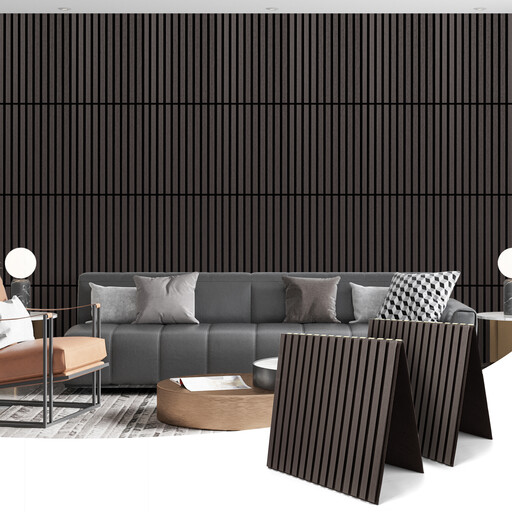
Why this product suits this profile: This two-piece set is suitable for a compact feature wall in a home office, podcast room or gaming room. The stated size of 120 × 60 cm per panel makes it easier to plan the area you need.
The product description specifies the format, the two-piece set and its foldable, interlocking design. This makes it easier to estimate the area you need before buying.
According to the product details: walnut wood surface, two panels measuring 120 × 60 cm and a foldable design.
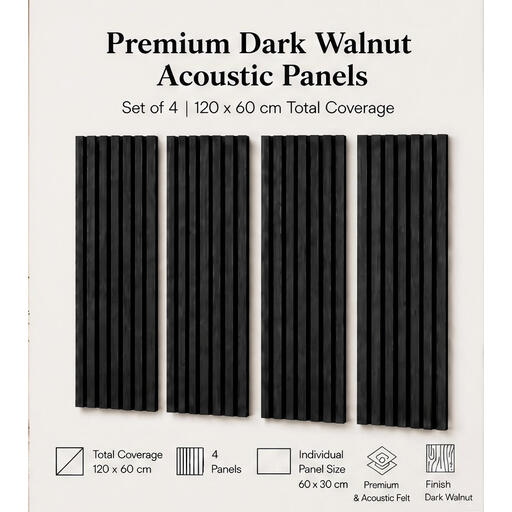
Why this product suits this profile: The combination of an MDF core, grey oak effect, 3D slats and felt backing suits customers looking to bring acoustic benefits together with a well-defined wall finish.
The description specifies four individual panels, each measuring 60 × 30 cm, with a total coverage of 0.72 m². This makes it easier to calculate the area than with products described as decoration alone.
According to the product details: MDF core, acoustic felt, grey oak veneer effect and installation options using adhesive or screws.
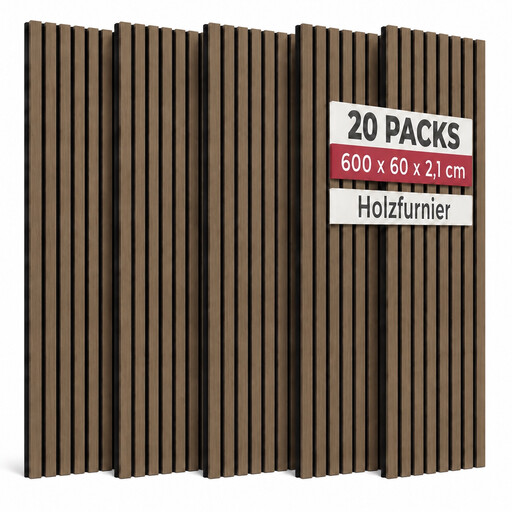
Why this product suits this profile: With stated coverage of 3.6 m², this set is designed for larger wall sections in a studio, home cinema, conference room or frequently used home office.
The larger set reduces the risk of needing to plan for several small packs to cover one continuous area, potentially with variations between batches or unnecessary gaps.
According to the product details: 20 modules measuring 60 × 30 cm each, MDF with a walnut effect and felt backing, covering a stated total area of 3.6 m².
We’ve put together a complete, regularly updated list of products that meet these strict selection criteria and the safety regulations in force in the EU.
Measure the wall before you order, and mark the positions of sockets, light switches and any uneven areas. With slatted panels, you should also consider the direction of the slats: vertical lines can make walls look taller, while horizontal arrangements create a different effect in the room.
For better acoustics, an even spread of panels is often more effective than placing them in one purely decorative spot. In particular, in a home office or podcast room, covering areas opposite hard desk surfaces and walls can help reduce unwanted reflections. For voice recording, you should also consider microphone position, distance from the wall and the furniture in the room.
No. Depending on the room, the area covered and the materials used, they can reduce reflections and reverberation. You shouldn’t expect them to eliminate these completely in every case. Carpets, curtains, furniture and panel positioning also affect the result.
It depends on the room size, wall areas and the acoustic result you’re looking for. A first step might be to cover an area behind or beside your workspace. Calculate the actual coverage in square metres rather than relying on the number of panels shown in product photos.
Many models can be glued or screwed in place, according to their product descriptions. Before installation, however, check that the surface is suitable and consider any damage that might occur when removing them. If you have delicate wallpaper or freshly painted walls, it’s best to test an inconspicuous area first.