
Lieferung heute & morgen

Qualitätsgarantie

Willkommens-Angebote freischalten: KOSTENLOSE Lieferung | Bis zu 80 % RABATT | Kostenlose 30-Tage-JoyPlus-Testphase
App herunterladen
Wooden acoustic panels combine a decorative wall covering made from visible wood slats with a practical way to reduce unwanted sound reflections. They can be suitable for a home office, living room, gaming room, home cinema or small studio. Before you buy, though, it’s worth taking a closer look at the construction, coverage and installation.
Many products make broad claims about “Noise Reduction” or “professional acoustics”. That doesn’t automatically mean your neighbours outside the room will hear less. Acoustic panels mainly improve room acoustics: they can reduce sound reflections and reverberation in the room. Proper soundproofing of a wall usually requires additional building work.
Sound-absorbing wall panels take in some of the sound energy that reaches them. This can change reverberation and make speech sound clearer in the room. On their own, they’re usually not a complete solution for impact noise, noisy neighbours or sound passing through a thin wall.
If your aim is to reduce echo, focus on the room’s acoustics. If you want to limit sound passing into other rooms, you’ll also need to consider the wall construction, gaps, mass and decoupling.
A set of four panels with a total area of 120 × 60 cm covers just 0.72 m². That may work well for a specific reflection point behind a desk or microphone, but it won’t cover a large feature wall.
Before ordering, measure the wall’s width and height, and decide where you want the panels to go. According to the product details, 20 panels measuring 60 × 30 cm each provide coverage of 3.6 m².
Many 3D wood-slat acoustic panels have an MDF core, a decorative wood veneer or wood-effect surface, and a felt backing. This isn’t necessarily a drawback, but it should be taken into account when choosing a product. The key points are the materials used, the quality of the edges, the weight and whether the wall is suitable for installation.
Claims such as “low-emission” or “Low-VOC” are, in the first instance, statements made by the manufacturer or retailer. Check whether detailed test reports, emissions classifications or product documentation are available.
Start by working out how much area you need to cover:
For a home office or gaming room, treating the wall opposite your desk or behind your screen is often enough. In a studio or home cinema, you’ll need to consider several reflection points. Covering every wall isn’t necessary in every room and could make the acoustics too dead.
A typical panel consists of:
Acoustic panels with a felt backing are particularly worth considering when the slats are designed to leave gaps, with absorbent material visible or effective between them. Also check the edges, the weight and the recommended fixing method.
Adhesive fixings can be handy in rented homes, but removing them may damage wallpaper or paint. So don’t assume that “residue-free” means damage-free. Test the adhesive on an inconspicuous area first and follow the manufacturer’s instructions.
Screw fixing is usually more permanent, but you’ll need suitable wall plugs and should check the wall construction. Ceiling installation requires extra care to ensure the ceiling can support the panels and that they’re securely fixed. For wall-mounted acoustic panels, the surface should be dry, clean and as even as possible.
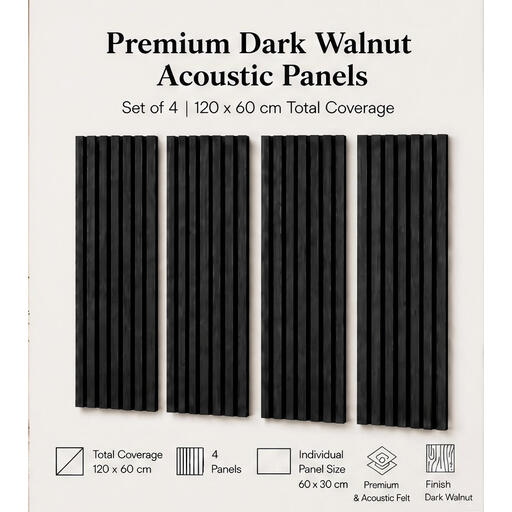
Why this product suits this profile: According to the product details, the set covers 0.72 m², making it suitable for a single wall area in a home office, living room or small recording room.
The number of panels and the coverage area are clearly stated. This makes it easier to check before buying whether you’re planning a feature area rather than covering a whole wall.
Four panels, each measuring 60 × 30 cm, with an MDF core, Grey Oak finish and felt backing, according to the retailer.

Why this product suits this profile: With a stated coverage area of 3.6 m², this set is designed for a larger feature wall in a studio, home cinema or living area.
The larger set makes it less likely that you’ll underestimate the coverage you need. The area stated also makes it easier to plan by the square metre.
20 panels, each measuring 60 × 30 cm, with an MDF core, oak finish and acoustic felt, according to the product description.
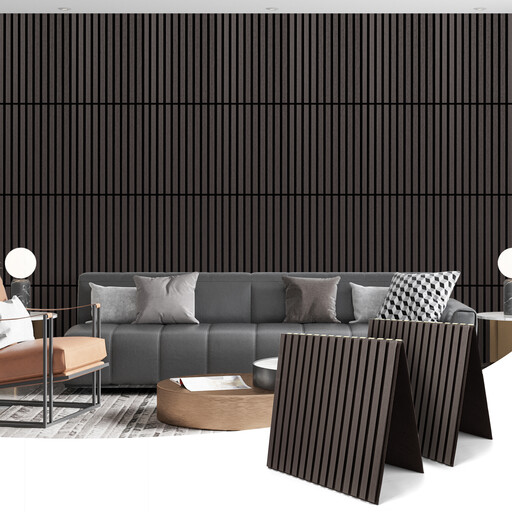
Why this product suits this profile: Two foldable panels, each measuring 120 × 60 cm, are well suited to podcasting, streaming and gaming spaces where a flexible layout is useful.
The product description gives the dimensions and explains the folding design. This makes it easier to plan the wall space you’ll need before installation.
Two large panels, walnut veneer according to the retailer, and a foldable, interlocking design.
We’ve put together a complete, regularly updated list of products that meet these strict selection criteria and fully comply with the safety regulations in force in the EU.
Depending on the product, you can use mounting adhesive, double-sided adhesive strips or screws. First, check the wall material, panel weight and manufacturer’s instructions. Residue-free removal isn’t guaranteed in rented homes. Testing a small area first can help prevent damage.
Their lifespan depends on the quality of the MDF, the veneer, moisture, UV exposure and how they’re fixed in place. Sturdy panels can last for many years in dry indoor spaces. Avoid direct exposure to water, major temperature fluctuations and installation on damp walls.
They can reduce reflections and reverberation in specific areas, but they’re no substitute for a complete acoustic plan. For recording, you should also consider speaker placement, microphone distance, room shape, bass frequencies and additional absorbers. The same applies to acoustic panels for a home office: careful placement is usually more effective than covering every wall without a plan.