
Lieferung heute & morgen

Qualitätsgarantie

Willkommens-Angebote freischalten: KOSTENLOSE Lieferung | Bis zu 80 % RABATT | Kostenlose 30-Tage-JoyPlus-Testphase
App herunterladen
A wooden baby playpen can create a defined play area for everyday use. To ensure your purchase does not become impractical after just a few months, however, you should consider more than colour and design. The key factors are dimensions, height adjustment, castors, playpen insert, weight limit and intended period of use.
A playpen measuring 100 x 100 cm sounds spacious. In practice, the frame, side panels and insert can reduce the usable area. Before buying, you should therefore compare the stated lying or play area with the complete external dimensions. Also check whether the model will fit through doorways, around furniture and in the intended location.
A playpen with castors is easier to move, but can slide if used incorrectly. Castors should have brakes and be locked when the playpen is being used in a stationary position. If there is no information about braked castors or secure positioning, the product description is incomplete. The playpen should also not be placed near windows, radiators, cords or furniture that the child could use to push themselves up.
Depending on the design, a playpen with an insert provides a padded play surface or textile side protection. However, additional mattresses, cushions and soft bedding can create risks of entrapment or suffocation. Only use components specified by the manufacturer and follow the care instructions. A washable insert is particularly practical, but it does not replace regular checks of the frame and fastenings.
A 100 x 100 cm playpen provides a square area and can often be positioned easily against walls or in a corner of a room. A hexagonal playpen uses space differently: depending on its diameter, the shape can create more room for movement in the centre, but may require more space around it.
Measure the available area, including door openings and walkways. In smaller homes, a folding playpen may be a sensible choice. When doing so, check the folded dimensions, which should be significantly smaller than the assembled size in the product data. A compact folded size is only useful if the folding mechanism locks securely and can be operated without excessive effort.
For a sturdy wooden playpen, the following points are particularly relevant:
A stated standard describes requirements for product characteristics and testing. It is not a substitute for correct assembly and adult supervision. Before each use, check that the playpen is fully assembled and that the base is securely locked.
An height-adjustable playpen can make lifting your baby in and out easier, provided that the highest position is used only as specified by the manufacturer. As your child becomes more mobile, the base must be lowered. For many of the models listed here, the maximum load is 15 kg; depending on the design, the stated age range is from birth to approximately 24 months.
“Playpen up to 24 months” is not a fixed guarantee of use for every child. The decisive factors are always the weight limit, the instructions for use and the child’s stage of development. As soon as a child attempts to climb out, it may be necessary to stop using the playpen regardless of their age.

Why this product suits this profile: The rectangular 75 x 100 cm play area is suitable for households looking for a more compact solution than a 100 x 100 cm model. The stated folded dimensions of 70 x 10 x 5 cm make storage easier.
The product data lists the external dimensions, folded dimensions, castors, two height settings and a weight limit of 15 kg. This makes it easier to assess the space required and usage limits before buying.
Two-position height-adjustable base, castors and folding construction; suitable up to 24 months or 15 kg according to the product information.
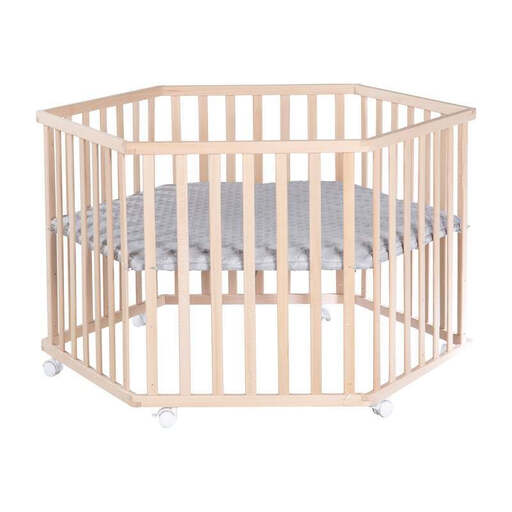
Why this product suits this profile: This hexagonal playpen combines a solid beechwood frame with a padded, washable insert. The shape and approximate diameter of 121 cm should be considered in advance to ensure it suits your room layout.
Three base positions accommodate different stages of development. The six castors have brakes, while the textile insert is removable and washable at 30 °C.
Solid beechwood, three height positions, six braked castors and a washable insert; stated in accordance with DIN EN 12227:2010-12.

Why this product suits this profile: The square 100 x 100 cm area provides a clearly defined footprint for larger living spaces. Its features are designed for regular use in the living room or nursery.
The three height positions mean the playpen is not suitable for just one short phase. Four braked castors make it easier to move, while the insert can be washed at 30 °C.
100 x 100 cm play area, solid beechwood, three base positions, four braked castors and a textile insert; maximum load 15 kg.
We have put together a complete, regularly updated list of products that fully meet these strict selection criteria and the safety regulations applicable in the EU.
This depends on the manufacturer’s information and the features of the individual model. According to the product data, some models in this selection are intended from birth to approximately 24 months. Safe assembly, the correct base position and direct adult supervision are essential. A playpen is not a substitute for an unsupervised sleeping environment.
The period of use is not determined by age alone. Some of the models mentioned have a maximum load of 15 kg, with approximately 24 months given as a guide. Use should be stopped as soon as the child attempts to climb out, pulls themselves up strongly on the edge or the product is damaged.
Castors are practical if you want to move the playpen around your home. However, they should always have working brakes. When your child is playing, the castors must be locked as specified in the instructions for use. A model without castors may be sufficient for a permanent location; for frequent repositioning, braked castors are a useful feature.