
Lieferung heute & morgen

Qualitätsgarantie

Willkommens-Angebote freischalten: KOSTENLOSE Lieferung | Bis zu 80 % RABATT | Kostenlose 30-Tage-JoyPlus-Testphase
App herunterladen
A wooden or bamboo chopping board can be used in the kitchen for chopping, food preparation and serving. However, attractive product photos and general marketing claims don’t automatically help you choose the right one. Three details often cause problems after purchase: a work surface that’s too small, an unsuitable thickness or care instructions that don’t match the product.
Terms such as ‘sustainable’, ‘antibacterial’ or ‘particularly durable’ shouldn’t be considered in isolation either. What matters are the specific measurements, the construction and the cleaning instructions. Compare these details to find a chopping board that’s better suited to your household.
A compact board measuring around 20 × 15 cm is suitable for herbs, fruit or small amounts of cheese. But this surface can quickly feel cramped when preparing family meals, bread, vegetables or meat. A large chopping board measuring around 40 cm or more gives you more room to work and is less likely to need repositioning during use, but it also needs more storage space.
A chopping board with a handle is easy to carry and hang up. However, the handle can take up extra space when you store the board in a drawer. Before buying, consider whether you’ll mainly keep it on the worktop, on a wall or in a kitchen cupboard.
For the products covered here, prolonged soaking and cleaning in the dishwasher are not recommended. Water, heat and strong cleaning products can warp, dry out or damage wood and bamboo. So a smooth surface doesn’t necessarily mean the board is maintenance-free.
A bamboo chopping board is made from a fast-growing natural material and is often sold as a lightweight, stable option. However, construction can vary: boards made from multiple pieces, glued designs and single-piece products all have different properties.
A walnut wood chopping board has a natural, darker appearance. Depending on its shape, it can also be used as a serving board or cheese board. Walnut wood needs particular care: protect it from direct sunlight, high temperatures and naked flames, and make sure it dries thoroughly.
Claims such as ‘antibacterial’ or ‘hygienic’ shouldn’t be seen as a substitute for good kitchen hygiene. After use, clean the board with warm water and mild washing-up liquid, then dry it thoroughly. Stop using it if you notice deep cracks or splinters.
These three simple guidelines can help you choose:
Thickness affects weight and stability. A board that’s 26 mm thick will generally be heavier than a slim 8.5 mm model, but may sit more securely on the worktop. The actual weight still matters: you should be able to lift and clean a very large board safely.
A round chopping board can often double as a serving surface for bread, cheese or charcuterie. Rectangular models usually make more efficient use of space on a straight worktop. A chopping board set with several sizes can be handy if you want to prepare different ingredients separately or use the boards for different serving tasks.
Extra trays and bowls, such as those included with a chopping board with storage trays, can help keep things organised. But they also add more pieces that need to be cleaned and dried thoroughly.
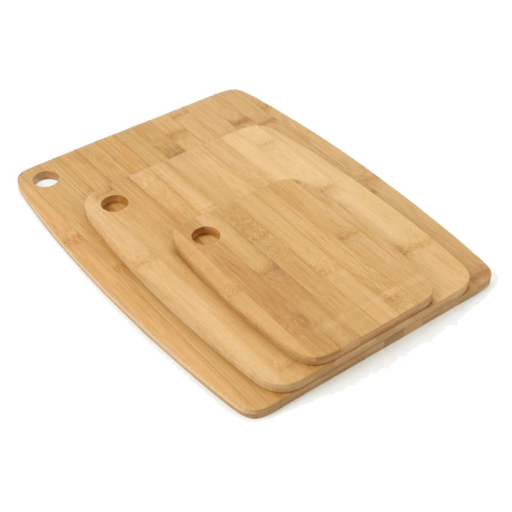
Why it suits this profile: Three rectangular boards measuring 20 × 15 cm, 30 × 23 cm and 38 × 28 cm cover a range of food preparation and serving tasks.
The choice of sizes reduces the risk of using a board that’s too small or oversized for each task.
Three bamboo boards in different sizes, with the added option of using them as serving boards or tablet plates.
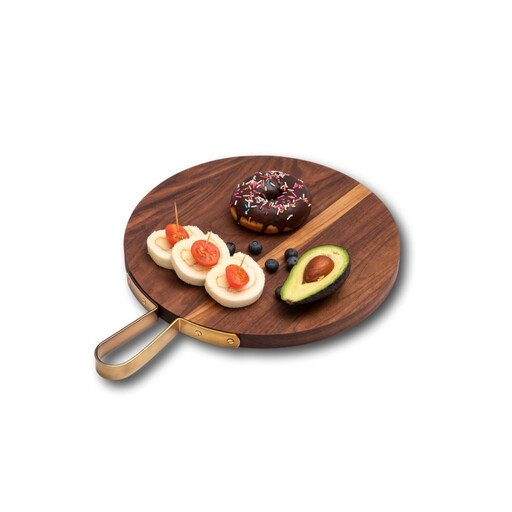
Why it suits this profile: This round walnut board measures 31 cm in diameter and is 20 mm thick. Its long handle makes it easy to carry or hang up.
The listed measurements make the usable surface area and thickness clear, rather than relying on a vague claim about quality.
Walnut wood, a 31 cm diameter, 20 mm thickness and a round shape for chopping and serving.
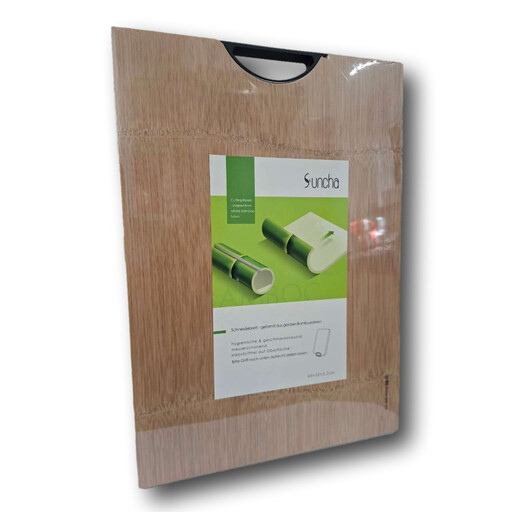
Why it suits this profile: The 45 × 32 cm surface and 26 mm thickness offer plenty of room for larger food preparation jobs, bread or serving platters.
The specific thickness and dimensions help you avoid choosing a board that’s too light or too small for larger jobs.
Solid bamboo, a 45 × 32 cm work surface, 26 mm thickness and an integrated handle for carrying, hanging or serving.
We’ve put together a complete, regularly updated list of products that meet these strict selection criteria and fully comply with the safety regulations in force in the EU.
A board around 30 to 40 cm long is versatile enough for everyday kitchen tasks. Families who regularly prepare larger quantities may prefer a large chopping board measuring 45 cm or more, as long as they have enough worktop and storage space.
Its lifespan depends on the material, thickness, how often it’s used and how well it’s cared for. Storing it dry, keeping it out of the dishwasher and replacing it promptly if it cracks or warps can help extend its useful life. It’s not possible to give a reliable lifespan that applies to every board.
Bamboo grows relatively quickly, while different types of wood have varying origins and production processes. To make a fair assessment, consider the material, origin, manufacturing process and expected lifespan. The word ‘sustainable’ alone doesn’t tell you everything you need to know about a product.