
Lieferung heute & morgen

Qualitätsgarantie

Willkommens-Angebote freischalten: KOSTENLOSE Lieferung | Bis zu 80 % RABATT | Kostenlose 30-Tage-JoyPlus-Testphase
App herunterladen
Wooden blocks for children may seem straightforward at first glance: a few blocks, a box and you’re done. However, differences in age suitability, materials, edges, number of pieces and play concept can make all the difference when buying. If you focus only on a large number of pieces or bright colours, you may end up with a set that quickly becomes confusing or is not suited to your child’s stage of development.
This guide explains which details really matter before buying wooden toys, construction toys and stacking toys. The selection of products by the Joybuy Product Recommendation Officer matches different sets to suitable user profiles, without making educational claims beyond what the respective product details support.
Although having lots of pieces can allow children to build larger structures, it also increases the effort required for sorting and storage. For beginners, 22 to 100 wooden blocks can be sufficient, depending on the play concept. What matters is whether the shapes can be combined in versatile ways and whether suitable storage is provided.
Colours and animal motifs often appeal directly to children. However, they do not replace information about the materials, workmanship or age suitability. For wooden blocks for children aged 3 and over, parents should look for smoothly finished edges, clear age recommendations and warnings about small parts.
A set for children aged 12 months and over is not automatically the right choice for a three-year-old. Similarly, a wooden construction set with functionally sharp parts may only be intended for older children. The age recommendation is therefore a safety and selection criterion, not merely a marketing detail.
Untreated pine wood, as specified for the KAPLA set, leaves the natural surface visible. For coated or coloured blocks, pay attention to information about the surface finish and care requirements. The following points are also important:
For products intended for the EU market, markings such as CE and references to the toy safety standard EN 71 may also be relevant. Always check the specific details directly on the product page, packaging or instructions for use.
Several of the products mentioned here contain small blocks. According to the product information, the KAPLA set is intended for children aged 3 and over and carries a warning about small parts that may be swallowed. The 51-piece balancing game is likewise specified as suitable for children aged 3 and over, with adult supervision recommended.
Children under 3 should not be given sets that carry an explicit warning of this kind. With younger children, it is also important to ensure that blocks are not put in the mouth or used for chewing.
Not every wooden toy is suitable for the same environment:
Compact packaging and a consistent storage routine are practical in smaller homes. If you regularly build large structures, however, look for an expandable system.
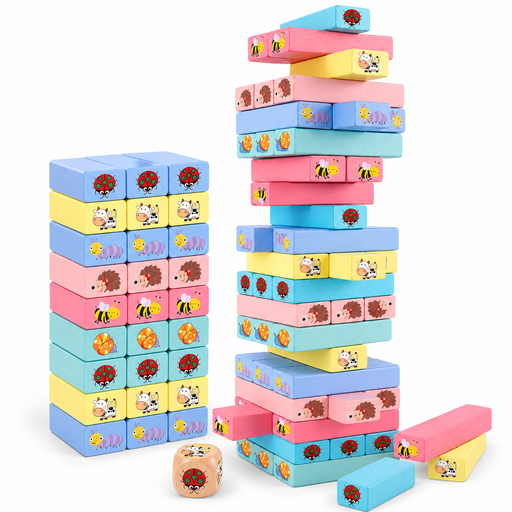
Why this product suits the profile: This set combines 51 wooden pieces with animal motifs and a die. It is suitable for families looking for a manageable balancing game to play at home or on the go.
The number of pieces is clearly stated, while the play concept is also described in terms of stacking, sorting and balancing. This makes it clearer before buying how the set is intended to be used.
51 pieces, a die and animal motifs; according to the product information, suitable for children aged 3 and over. Adult supervision is recommended.
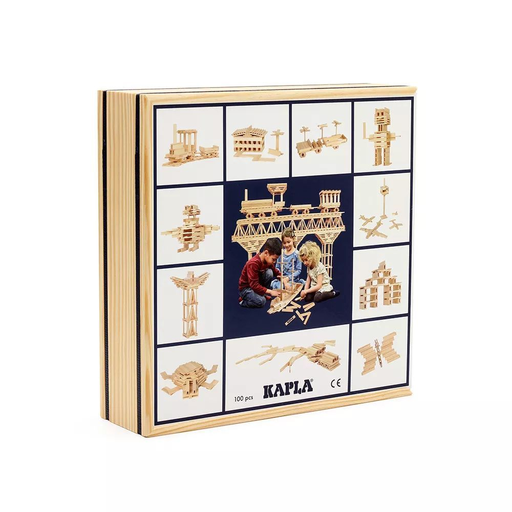
Why this product suits the profile: The box contains 100 precisely crafted, cuboid-shaped blocks made from untreated pine wood, along with a wooden box with a sliding lid. This suits households where open-ended construction and tidy storage are equally important.
The uniform cuboid shape makes the construction concept easy to understand. The packaging dimensions of 25 × 25 × 4 cm and the box with sliding lid make it easier to plan your storage space.
100 blocks made from untreated pine wood, a wooden storage box and, according to the product information, suitable for children aged 3 and over. Expansion sets are available separately.
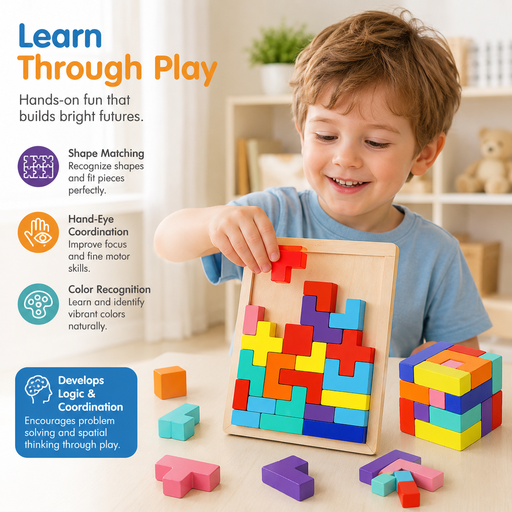
Why this product suits the profile: This wooden Tetris puzzle combines pattern-building with logical thinking. It is a good choice for families looking for structured indoor activities alongside open-ended building.
The product description names the specific play concept rather than relying solely on general educational claims. Before buying, check the stated pack size and note that the colour or design may be selected at random.
Puzzle and pattern activities in one compact set; according to the description, it is suitable for family time and indoor play. The colour or design may be selected at random.
We have put together a complete, regularly updated list of products that fully meet these strict selection criteria and the safety regulations applicable in the EU.
A dedicated play area on the floor or a low table makes building easier. For children aged 3 and over, parents can start by suggesting simple activities: lay out a row, stack a tower or build a bridge between two objects. The child can then begin creating their own shapes.
With a balancing game, short rounds are often more suitable than aiming for a fixed result. During open-ended construction play, photos of completed structures can serve as keepsakes, without requiring the child to copy a template exactly. After play, check the pieces for damage and store them somewhere dry.
Suitable sets are those whose manufacturers explicitly state that they are suitable for children aged 3 and over and warn about small parts that may be swallowed. The blocks should be intact, free from splinters and easy to grip. A minimum age of 3 is specified for both the KAPLA set and the 51-piece stacking game.
This depends on the play concept and the space available. A set containing around 20 to 50 pieces may be enough for first stacking and sorting games. For larger towers, bridges and open-ended structures, 100 uniform blocks offer more ways to combine them. However, a large number of pieces is only useful if there is a proper storage system in place.
Their lifespan depends on the type of wood, workmanship, storage and handling. Regardless of the set, parents should regularly check for cracks, splinters, deformation and loose components. Damaged pieces should be removed from the play area. Storing the blocks in a dry place and cleaning them with a soft, slightly dry cloth will help keep them in good condition.