
Lieferung heute & morgen

Qualitätsgarantie

Willkommens-Angebote freischalten: KOSTENLOSE Lieferung | Bis zu 80 % RABATT | Kostenlose 30-Tage-JoyPlus-Testphase
App herunterladen
Wooden building blocks let children enjoy free play while stacking, sorting and building. But choosing the right set isn’t always easy for parents and family members. Many sets look similar in product photos, yet differ significantly in their age recommendations, piece sizes, materials and play value.
Three common buying pitfalls are particularly likely to lead to the wrong choice:
So choosing the right set starts with checking the product information you can verify, rather than its colour or theme.
For wooden toys for children aged 12 months and over, the manufacturer’s age recommendation should match what’s actually included in the set. Large, easy-to-grip shapes are generally more suitable for first attempts at stacking than delicate pieces. If a product contains small parts that could be swallowed, it should only be used as directed by the manufacturer and under adult supervision.
The term building blocks for babies is sometimes used quite broadly by retailers. What matters isn’t the label, but whether:
Even with age-appropriate sets, damaged, cracked or loose pieces should be removed straight away.
The number of pieces alone isn’t a measure of quality. A 22-piece set can be easier to manage for first stacking games, while 50 or 51 pieces offer more ways to build towers and rows, or play balancing games. A variety of geometric shapes is especially useful in educational construction toys.
Look for a combination of:
This makes for creative building toys that aren’t limited to a single pre-set figure. Stacking, matching and balancing can also bring hand-eye coordination and fine motor movements into play. This doesn’t mean the toys have any therapeutic or medical benefits.
For wooden toys, the material should be specified as clearly as possible, for example, beech or pine. It’s also useful to check guidance on cleaning, indoor use and how to inspect the toy for damage. The product description should also clearly identify the manufacturer or responsible person.
For buyers in Germany, the following points are particularly useful to check:
It’s also important to check whether the wooden blocks are designed to be handled frequently, and whether their surfaces are dry, smooth and free from visible chips. Store toys in a dry place and don’t leave them exposed to water, heat or sharp objects for long periods.
The products below vary in their age recommendations, contents and ways to play. The details are based on the product information provided. Check the latest information on each product page before buying.
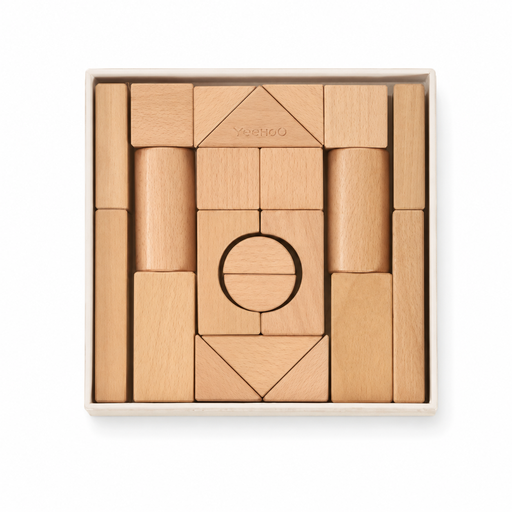
Why this product suits this profile: According to the product information, this 22-piece set is suitable for children aged 12 months and over. It offers a manageable introduction to stacking, sorting and playing together.
The age recommendation of 12 months and over is clearly stated. The guidance still calls for adult supervision and checks for cracks, missing pieces or damage.
22 pieces, a woodland theme and plenty of ways to combine them. Ideal for first attempts at matching shapes and quantities, as well as parent-and-child play.
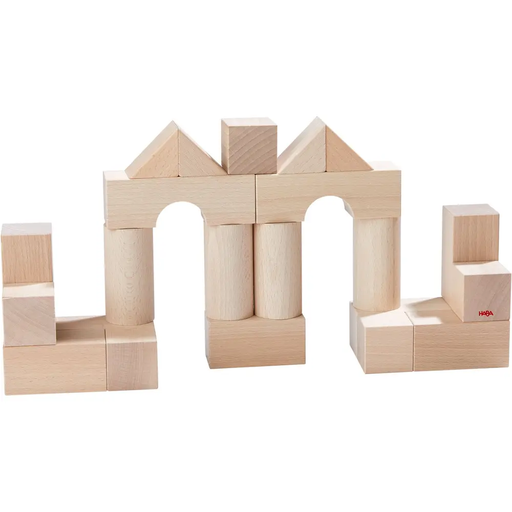
Why this product suits this profile: According to the product information, this starter set is made from beechwood and includes a range of basic shapes for open-ended building.
The product information specifies the material, the breakdown of pieces and an age recommendation of 12 months and over. The warning about small parts should still be observed.
6 cubes, 10 cuboids, 4 triangles, 2 bridges and 4 round columns. According to the description, the set can be combined with other HABA building block sets.
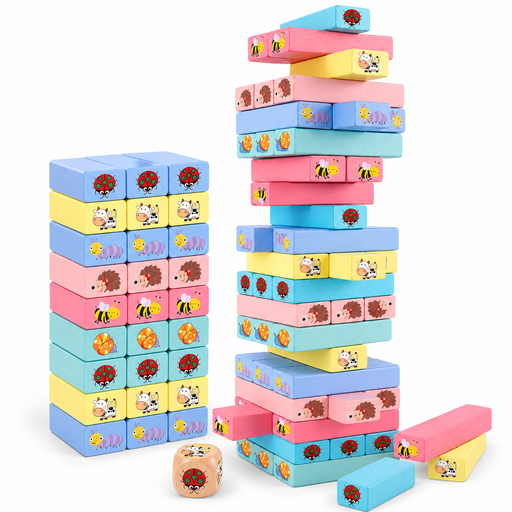
Why this product suits this profile: According to the product information, this set is for children aged 3 and over. It’s a good choice for families who want to combine stacking, balancing and games with rules.
The age limit of 3 and over and the warning about small parts that could be swallowed are clearly stated. This makes it clear that the set is not suitable for babies.
51 pieces with animal designs, plus a die. Use them for sorting and building, or for a balancing game at home or on the go.
We’ve put together a complete, regularly updated list of products that meet these strict selection criteria and fully comply with the safety regulations in force in the EU.
Wooden building blocks don’t need complicated setup and won’t add ongoing battery costs to your day-to-day routine. To help them last as long as possible:
A set with lots of shapes and colours can make a lovely birthday present for children, as long as you take the child’s age, available space and supervision arrangements into account.
It depends on the set. Products approved for children aged 12 months and over may be designed for first stacking and grasping games. However, always follow the warnings and consider the size of the pieces and the recommended level of supervision. Sets for children aged 3 and over shouldn’t be given to younger children.
A manageable set of around 20 to 30 pieces is often enough for a first introduction. Different shapes offer more ways to play. Sets with 50 pieces or more give older children, or those building together, extra ways to combine the pieces, but they also need more storage space.
Picking up, stacking and sorting the pieces brings movement, hand-eye coordination and spatial awareness into play. However, when choosing toys that support the development of fine motor skills, always make sure the building blocks are suitable for your child’s age and offer them without putting pressure on performance.