
Lieferung heute & morgen

Qualitätsgarantie

Willkommens-Angebote freischalten: KOSTENLOSE Lieferung | Bis zu 80 % RABATT | Kostenlose 30-Tage-JoyPlus-Testphase
App herunterladen
A wooden cake stand can make a cake, slices of cake or desserts stand out on a laid table. However, your buying decision should not be based solely on its rustic appearance. For households, home bakers, cafés and catering businesses, the key considerations are dimensions, load capacity, surface treatment and care.
“28 cm” usually refers to the diameter of the entire surface area. If the stand has a raised rim, decorative edge or irregular shape, the actual usable surface may be smaller. Before buying, you should therefore check:
A 28 cm cake stand is often suitable for medium-sized cakes and gateaux. For particularly tall decorations or wide cake plates, leaving more space from the edge of the table may be sensible.
A wooden cake stand may be made from acacia wood, bamboo, solid wood, engineered wood or a coated surface. These materials differ in weight, moisture resistance and care requirements. For example, a product description containing “Vintage Wood Effect” initially indicates a wood-look finish, but does not on its own reveal the precise material composition.
If you prefer a natural grain, look for the specific wood type stated in the product details. For coated or treated surfaces, information about the protective finish and intended use is also important.
A tall dessert stand creates an eye-catching display on a buffet, but shifts the centre of gravity upwards. With heavy cakes, children around the table or frequent repositioning, a wide base may be more important than extra height. The surface underneath should be level; slippery tablecloths can affect stability regardless of the material.
For a wooden cake plate, you should distinguish between food being placed directly on the surface and using a serving plate or cake board in between. For direct contact with food, buyers should follow the manufacturer's instructions regarding intended use. In the EU, materials that come into contact with food are subject, among other things, to the general requirements of Regulation (EC) No 1935/2004. Without specific information from the manufacturer, it is not permissible to make a blanket statement about suitability.
Natural wood can absorb moisture. Cream, fruit toppings and liquids should therefore not be left on the surface for extended periods. If you are unsure, a suitable cake board can reduce contact with the wood.
A substantial weight can help when positioning the stand, but it is no substitute for a specific load-capacity rating. Pay attention to:
With multi-part pastry stands or buffet stands, the individual tiers should have sufficient clearance. This keeps cupcakes, glasses and small desserts visible and allows them to be removed without knocking against one another.
Wooden stands should generally not be put in the dishwasher unless the manufacturer expressly permits this. The usual method is to clean them with a soft, slightly damp cloth and then dry them thoroughly. Soaking, abrasive cleaners, wire wool and harsh cleaning products can damage the surface and grain.
Some untreated or oiled wooden surfaces can occasionally be treated with food-safe mineral oil or a suitable wood-care product, in accordance with the manufacturer's instructions. The stand should be stored somewhere dry and well ventilated, away from heat sources and direct sunlight.
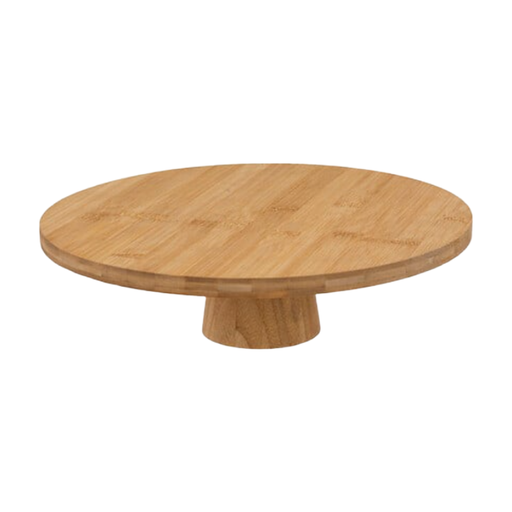
Why this product suits this profile: With a diameter of 28 cm and a height of 8 cm, it offers clearly defined dimensions for cakes, pastries and desserts in the home.
The precise dimensions avoid an unclear size specification. The care instructions explicitly recommend using a damp cloth and avoiding the dishwasher and soaking.
Bamboo construction, 28 cm diameter, 8 cm height and a stated weight of 0.8 kg.

Why this product suits this profile: Acacia wood with a visible natural grain complements rustic table settings, afternoon tea or carefully considered cake presentation.
The diameter and height are specified as 28 cm and 9 cm respectively. The instructions recommend drying it immediately, cleaning it gently and protecting it from heat.
Acacia wood, 28 cm diameter, 9 cm height and a product weight of 0.673 kg.

Why this product suits this profile: The four-piece set is suitable for tiered buffets, weddings, catering displays, cafés and changing dessert arrangements.
The four different heights improve visibility without the need for one particularly tall column. The combination of wooden surfaces and metal bases is clearly described.
Four square risers with 15 × 15 cm wooden surfaces and heights of approximately 6.6 to 17 cm.
Before laying the table, place the wooden stand on a level, dry surface. With multi-piece sets, check that all elements are fully supported and do not wobble. Particularly for a wedding or buffet, the setup should first be checked without any food on it.
Direct heat from pots, pans, hotplates or candles can discolour, warp or damage wood. A cake stand is also not automatically suitable as a chopping board. It is better to cut the cake on a separate board or serving plate.
If you are planning versatile cake presentation, you can combine a round cake plate with a tiered stand, dessert stand or several small pastry stands. This makes it easy to arrange different heights and portion sizes clearly.
We have put together a complete, regularly updated list of products that fully meet these strict selection criteria and the safety regulations applicable in the EU.
This depends on the surface and the manufacturer's instructions. Cream and fruit fillings should not be left directly on untreated wood for extended periods. Remove liquids as soon as possible and, if necessary, place the cake on a suitable board.
A soft, slightly damp cloth is usually sufficient. The cake stand must then be dried thoroughly. Avoid the dishwasher, soaking, abrasive cleaners and harsh cleaning products unless the manufacturer specifies different care instructions.
It is not possible to give a general fixed lifespan. This depends on the type of wood, workmanship, load, moisture and care. Cracks, splinters, mould or unstable joints are reasons to stop using the stand to present food.