
Lieferung heute & morgen

Qualitätsgarantie

Willkommens-Angebote freischalten: KOSTENLOSE Lieferung | Bis zu 80 % RABATT | Kostenlose 30-Tage-JoyPlus-Testphase
App herunterladen
A wooden chopping board may seem straightforward at first glance. In practice, however, the material, thickness, surface and care routine determine whether your kitchen board remains stable in everyday use or quickly becomes impractical. Home cooks, families and hosts should therefore look beyond appearance alone.
As a Joybuy Product Recommendation Officer, I filter product information according to clear, verifiable criteria. Three common purchasing misconceptions stand out:
Technically speaking, bamboo is not a conventional wood, but it is used in much the same way for chopping boards. The surface is generally dense and even. Bamboo products should include clear information about the material, dimensions and care requirements. A bamboo chopping board is not automatically more sustainable: factors such as its origin, processing, adhesives and service life also play a role.
Beech offers a light, understated appearance and is often used for classic kitchen boards. Walnut and acacia have darker or more contrasting grain patterns, making them suitable as serving boards or cheese boards too. The grain is a natural feature, so slight variations in colour and texture are possible.
For knives, a slightly yielding, smooth cutting surface is generally preferable to very hard materials such as glass or stone. It is also important that the surface has no deep cracks, splinters or pronounced uneven areas.
For everyday chopping of vegetables, fruit and bread, sizes of around 34 × 24 cm or 38 × 26 cm are easy to handle. If you regularly prepare several ingredients at once, a large chopping board measuring approximately 45 × 30 cm or more can be beneficial. There should still be enough room on your worktop to work safely.
Thickness affects both stability and weight:
A butcher’s block for more forceful chopping should sit securely and have a sufficiently robust construction. Not every decorative wooden board is suitable for very hard blows. The manufacturer’s stated intended use remains the deciding factor.
A chopping board with a juice groove can catch liquid when cutting juicy fruit, roast meat or vegetables. However, the groove is only useful if it is sufficiently wide and fully enclosed. It does not automatically prevent every spill onto the worktop, and on some models it can make thorough cleaning more difficult.
A chopping board with a handle is easier to carry from the preparation area to the table and can also be used as a serving board. For everyday preparation, the handle should not reduce the usable cutting surface.
A reversible design can be practical, particularly if one side is intended for raw food and the other for vegetables or bread. This separation must be maintained consistently at home, and the board should be cleaned after every use.
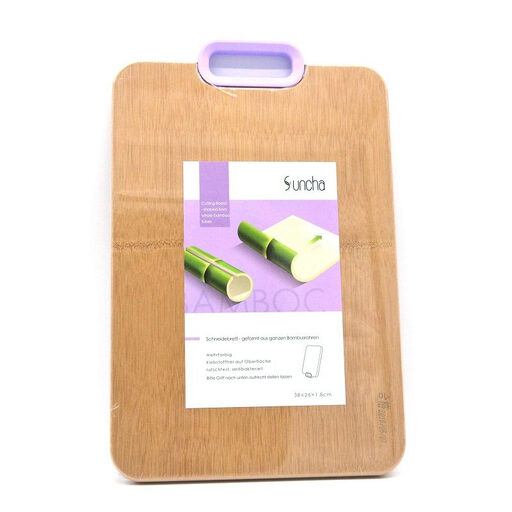
Why this product suits the profile: The size is easy to handle for everyday preparation, while the integrated handle makes it easier to carry. The specifications state bamboo as the material and a thickness of 18 mm.
The dimensions and material are clearly stated. The handle is functional, without making claims about an especially large format.
Compact size, 18 mm thickness and integrated handle for the kitchen and table.

Why this product suits the profile: The generous size provides plenty of space for preparing several ingredients. The integrated juice groove and reversible design are useful for households that want to combine chopping and serving.
The product data explicitly states the dimensions, thickness, juice groove and hand-wash instructions. This allows you to assess the actual care requirements before buying.
45 × 30 cm, reversible design and juice groove for liquids.

Why this product suits the profile: Three sizes allow separate use for vegetables, meat, bread or cheese. Handles and juice grooves make it easier to switch between preparation and serving.
The three stated sizes prevent you from having to use a board that is too small or overloaded for each task. Care involves hand washing.
Three sizes, integrated handles and juice grooves; suitable as a kitchen board and charcuterie board.
We have put together a complete, regularly updated list of products that fully meet these strict selection criteria and the safety regulations applicable in the EU.
Proper cleaning has a greater impact on service life than decorative promises. Follow these points:
A separate breakfast board or serving board for bread, cheese and fruit can extend the service life of your main chopping board. This prevents a decorative cheese board from also being used for raw meat products.
For individual ingredients, a length of around 30 to 38 cm is often sufficient. Families and frequent users can choose a size of approximately 45 × 30 cm or more. The important thing is that the board sits securely and that there is still clear worktop space around it.
There is no reliable way to give a fixed service life. It depends on the type of wood, construction, use, knife pressure, moisture and care. Regular drying, gentle cleaning and replacing a damaged board in good time all help to extend its useful life.
Only if the manufacturer explicitly states that it is suitable. Hand washing is recommended for the bamboo boards featured here. Heat, water and prolonged exposure to moisture can cause cracks, warping or surface damage.