
Lieferung heute & morgen

Qualitätsgarantie

Willkommens-Angebote freischalten: KOSTENLOSE Lieferung | Bis zu 80 % RABATT | Kostenlose 30-Tage-JoyPlus-Testphase
App herunterladen
A wooden chopping board may seem straightforward at first glance. However, details such as the material, thickness, care instructions and intended use determine whether a kitchen board remains practical day to day. Focusing solely on an attractive wood grain or a particularly cheap multi-pack often means overlooking important features.
This buying guide explains what households, home cooks and frequent users in the UK should look out for. The selection is based on clear product data and different kitchen situations – not on vague advertising claims.
Wood and bamboo are natural materials, but they still need suitable cleaning and drying. According to the product information, many models are not dishwasher-safe and should not be left in water for long periods. If a board is regularly soaked or stored while damp, it may warp or develop cracks.
Before buying, therefore, check the specific care instructions. A bamboo chopping board or a board made from beech, walnut or acacia is not automatically suitable for every cleaning method.
A large chopping board provides more room for vegetables, bread or dough. However, it is not just the length and width that matter, but also the usable surface once space taken up by a handle or juice groove has been deducted. For example, a 45 × 30 cm board is used differently from a narrow model with a long handle.
Also check whether the board sits securely on the worktop and fits in a drawer, cupboard or sink.
A chopping board with a juice groove can catch liquid when cutting fruit, vegetables or meat. For bread, cheese or rolling out dough, however, a juice groove is not essential, as it reduces the flat usable surface. A handle is also handy for carrying and hanging the board, but it can take up space while chopping.
If you are looking for a sustainable chopping board, do not rely solely on terms such as “eco-friendly”. Specific information about the material, origin, manufacture, care and intended use is more meaningful.
A compact board is often sufficient for a single breakfast or small quantities of ingredients. For everyday cooking, formats from around 30 cm in length are more practical, provided the usable surface is large enough. A wooden chopping block should sit securely and be thick enough to withstand firmer chopping movements.
As a guide:
A juice groove is useful for juicy foods, but it should be sufficiently wide and finished all the way around. A reversible board can make it easier to separate different foods if the two sides are clearly assigned to different uses. However, this does not replace thorough cleaning.
A chopping board with a handle is easier to move from the work area to the table. Check whether the handle is easy to reach and whether it reduces the usable surface.
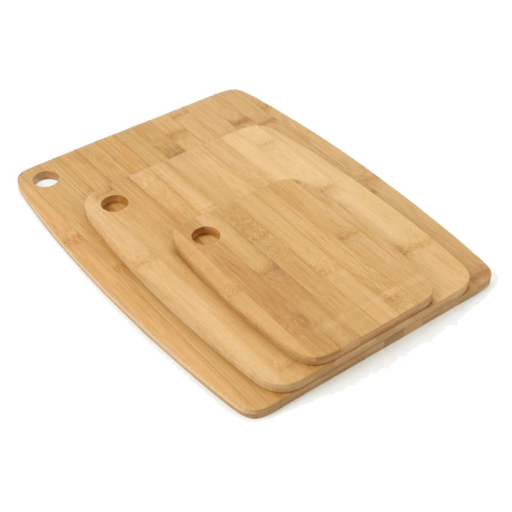
Why this product suits this profile: The set contains three rectangular boards measuring 20 × 15 cm, 30 × 23 cm and 38 × 28 cm. This provides different sizes for both small and larger preparation tasks.
The graduated sizes mean you do not have to use one oversized or unsuitable board for every task. According to the product description, the boards can also be used for serving.
Three sizes, bamboo construction and combined use as a chopping or serving board.

Why this product suits this profile: The large format provides a clearly defined work surface. The product details specify a juice groove, reversible design and a thickness of 1.9 cm.
The precise dimensions and specified juice groove make it easier to assess suitability than a purely descriptive listing without technical details.
45 × 30 cm, juice groove and reversible design; according to the product details, it is intended for chopping and serving.

Why this product suits this profile: The set offers three formats up to 16 × 11.5 inches. Juice grooves and integrated handles are designed for preparation, carrying and serving.
The sizes, hand-washing requirement and regular care instructions are stated explicitly. This allows you to compare the space required and care involved before buying.
Three boards, juice grooves and handles; the largest board is specified as 16 × 11.5 inches and 1.5 inches thick.
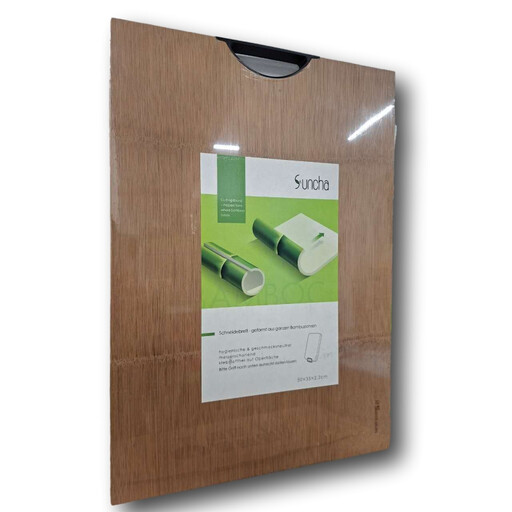
Why this product suits this profile: Measuring 50 × 35 cm and 2.6 cm thick, this bamboo board is designed to provide a large work surface. According to the product description, it is also suitable for rolling out dough and preparing pasta.
The precise thickness and large format help you avoid choosing a board that is too thin or too small for extensive preparation.
Large, 26 mm-thick bamboo surface with integrated handle; hand washing and thorough drying are recommended.
A wooden board should be cleaned after every use with warm water and mild washing-up liquid, then dried immediately. Avoid:
Some manufacturers recommend occasionally treating the surface with food-safe maintenance oil. If the board develops deep cracks, mould, severe warping or splinters, stop using it. Using separate boards for bread, vegetables and raw animal products can further improve kitchen organisation.
We have put together a complete, regularly updated list of products that fully meet these strict selection criteria and the safety regulations applicable in the EU.
Beech, walnut and acacia are common materials for wooden chopping boards. Bamboo is also widely used. Alongside the type of wood, the construction, thickness, surface and care instructions are important. The material alone does not provide a blanket guarantee that a board is suitable for every kitchen.
Its lifespan depends on daily use, cleaning, drying and care. Regular soaking, dishwasher cycles and heat can affect its shape and surface. If cracks, splinters or mould appear, replacing the board is advisable.
There is no universally applicable answer in favour of one material. For hygienic use, thorough cleaning, complete drying and separate boards for different food groups are particularly important. Always follow the care instructions provided by the relevant manufacturer.