
Lieferung heute & morgen

Qualitätsgarantie

Willkommens-Angebote freischalten: KOSTENLOSE Lieferung | Bis zu 80 % RABATT | Kostenlose 30-Tage-JoyPlus-Testphase
App herunterladen
A wooden chopping board should stay stable while you prepare food, provide enough workspace and be easy to keep clean without complicated care. In practice, however, three common buying mistakes in particular can lead to unnecessary expense: assuming a large surface automatically means greater stability, prioritising eye-catching extra features over the material and care instructions, and failing to distinguish clearly between suitability as a chopping board and as a serving board.
This guide explains which details actually matter before buying a wooden kitchen chopping board. Our selection is based on clear product data such as material, dimensions, weight, handles and juice grooves.
A large chopping board provides more room for vegetables, bread or several ingredients. However, thickness and weight are also important. A long, thin board can move more easily on a smooth worktop than a more compact model with a sturdier construction.
Before buying, check:
A chopping board with a juice groove can catch liquid when cutting juicy fruit, vegetables or roast meat. However, the groove reduces the usable completely flat surface. A chopping board with a handle is easier to carry and use as a serving board, but the handle can take up space during larger chopping tasks.
Neither a bamboo chopping board nor a board made from walnut or beech should generally be soaked or cleaned in the dishwasher unless the product information expressly permits it. Water, heat and prolonged exposure to moisture can encourage warping or cracking.
Standard care includes:
A walnut wood chopping board stands out with its darker colour and natural grain. The Suncha models listed are made from walnut wood and are intended for general chopping and food preparation. Beech wood offers a lighter appearance; the Suncha beech board measures 34 × 24 × 2.2 cm.
Bamboo is often available as a solid or laminated material. The WMF bamboo board measures 45 × 30 × 1.9 cm and features a juice groove. The Suncha bamboo model measures 50 × 35 × 2.6 cm and has a handle. The material description alone is not enough, however: you should also consider the thickness, construction and care instructions.
For occasional chopping, a format of around 30 × 20 cm is often sufficient. Families and keen home cooks generally benefit from more workspace. A board around 40 to 50 cm long can be useful for bread, large vegetables or preparing several ingredients at once. Make sure the board will still fit comfortably in your sink or cupboard, or stand upright on a shelf.
A wooden serving board should have an attractive surface and a shape that is easy to carry. Boards with handles or a round shape are ideal for cheese, bread and small appetisers. A heavier wooden butcher’s block, on the other hand, is particularly useful when chopping requires pressure and a stable support surface. The exact suitability depends on the information provided by the individual manufacturer.
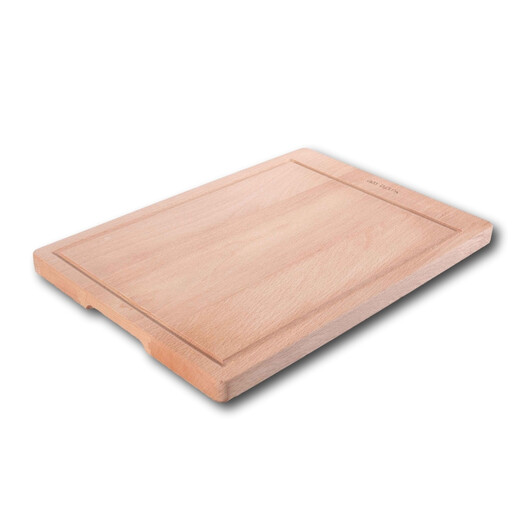
Why this product suits the profile: Measuring 34 × 24 × 2.2 cm, it offers a manageable work surface for everyday use without taking up too much storage space.
The clearly stated dimensions make it easier to compare the board with your available worktop space. The care instructions expressly recommend hand washing and immediate drying.
Beech wood, 2.2 cm thickness and a natural wood grain; suitable for chopping, dicing and food preparation.

Why this product suits the profile: The generous size combines a juice groove with a reversible design, making it suitable for a range of preparation and serving tasks.
The product details clearly state the dimensions, material and hand-washing requirement. This allows you to check before buying whether it suits your usual care routine.
45 × 30 × 1.9 cm, integrated juice groove and reversible use according to the product description.

Why this product suits the profile: Three sizes cover a range of tasks, from chopping small ingredients to serving cheese or bread.
The different sizes mean you do not have to use an oversized board for every task. According to the product information, all boards are intended for hand washing only.
Three-piece set, juice grooves and integrated handles; largest board measures 16 × 11.5 Zoll.
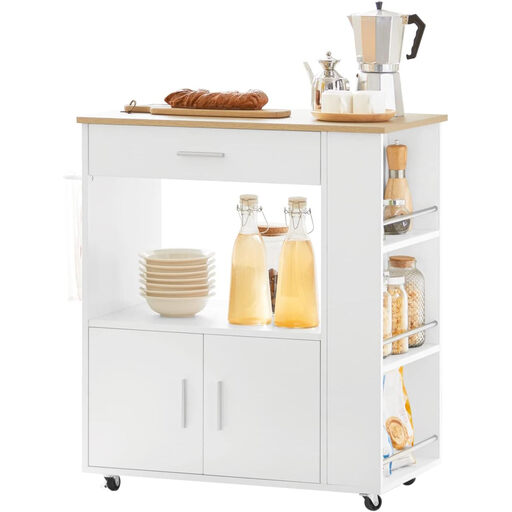
Why this product suits the profile: This mobile kitchen island complements a chopping board with extra worktop space, a drawer, cupboard and side shelves.
The dimensions of 82 × 46 × 88 cm and maximum load capacity of 75 kg make the space required and usage conditions clear.
Four castors, two of them with brakes, plus a drawer, cupboard and side shelves; material: E1 particle board.
We have put together a complete, regularly updated list of products that fully meet these strict selection criteria and the safety regulations applicable in the EU.
After cleaning, do not place the board flat on a damp worktop. Standing it upright allows air to reach both sides more effectively. You should also avoid direct sources of heat such as the hob, oven or naked flames. If you have a chopping board set, it is advisable to allocate the boards to specific tasks, for example one for bread and vegetables and another for other food preparation.
A board with cracks, splinters or noticeable warping should no longer be used for food. Also check the handles and edges regularly for damage.
Beech and walnut wood are common materials for kitchen boards. Bamboo is also widely available. Your choice should not be based on the type of wood alone; you should also consider thickness, size, construction and care instructions.
As a rule, wash it with warm water and mild washing-up liquid, then dry it immediately and leave it to dry completely in an upright position. Soaking and dishwasher cleaning are not recommended for the products mentioned here.
It is not possible to give a reliable fixed lifespan. This depends on daily use, moisture, heat, cleaning and care. Cracks, splinters, mould or severe warping are clear reasons to replace the board.