
Lieferung heute & morgen

Qualitätsgarantie

Willkommens-Angebote freischalten: KOSTENLOSE Lieferung | Bis zu 80 % RABATT | Kostenlose 30-Tage-JoyPlus-Testphase
App herunterladen
A wooden chopping board can be used for everyday cooking and serving. However, models vary considerably in terms of material, dimensions, care requirements and features. An attractive wood grain alone says little about how practical a board will be.
Terms such as “natural wood”, “solid” or “eco-friendly” have limited meaning without precise material details. Botanically speaking, a bamboo chopping board is not made from wood, but from woody grass. The material is often processed into glued strips. With an acacia wood chopping board or a beech wood chopping board, the type of wood is named more clearly.
You should therefore look for:
A compact board is easy to store, but offers little space when chopping larger pieces of vegetables or meat. A large chopping board requires more storage space, but can be more practical when preparing several ingredients.
The shape should also suit how you plan to use it. A chopping board with a handle is easier to carry from the kitchen to the dining table. A chopping board with a juice groove can collect liquid around the edge. However, the groove is no substitute for hygienic cleaning and may require additional care with intensive use.
A board marketed as a serving board, cheese board or charcuterie board is not automatically suitable for every type of food preparation. Round boards with decorative grain are often designed for presentation. For everyday chopping and cutting, a sufficiently large, flat surface and stable footing are more important.
The type of wood affects appearance, weight and care requirements. A bamboo chopping board is generally relatively light and is often available in several sizes. This can be useful for households that want separate boards for herbs, bread, fruit or larger ingredients.
Acacia wood often features a striking, contrasting grain and works particularly well for serving. A beech wood chopping board usually has a more even appearance and can be integrated into a range of interior styles as a simple wooden kitchen board. Regardless of the material, check the surface for visible cracks, rough areas and poorly finished edges before buying.
For everyday food preparation, dimensions of around 30 × 20 cm or more are a practical starting point for many kitchens. A larger model measuring 40 × 28 cm provides more room to work, but needs a dedicated storage space. Thickness affects weight and stability. Particularly lightweight boards are convenient to carry, but may slide more easily on smooth worktops.
Also check whether the board can be used on both sides. A juice groove, handle or feet may restrict use to one side.
Wooden boards should generally be washed by hand with mild washing-up liquid and dried immediately. Prolonged soaking, high heat and the dishwasher can contribute to warping or cracking. Whether regular treatment with food-safe oil is recommended depends on the material and the manufacturer’s instructions.
For raw meat, fish, vegetables and bread, it may be useful to use several boards or a chopping board set. This makes food preparation easier to organise. Thorough cleaning after every use remains essential.
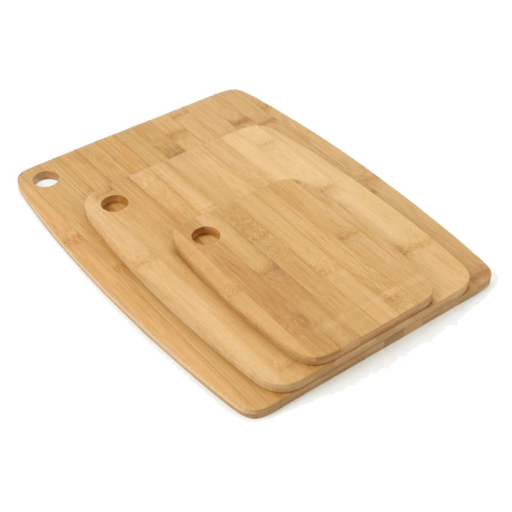
Why this product suits this profile: The set contains three rectangular boards measuring 20 × 15 cm, 30 × 23 cm and 38 × 28 cm. This provides different-sized surfaces for small and larger food preparation tasks.
The graduated sizes reduce the risk of using a board that is too small for every task. The boards can also be used for serving.
Bamboo construction, three sizes and low weight according to the product description.
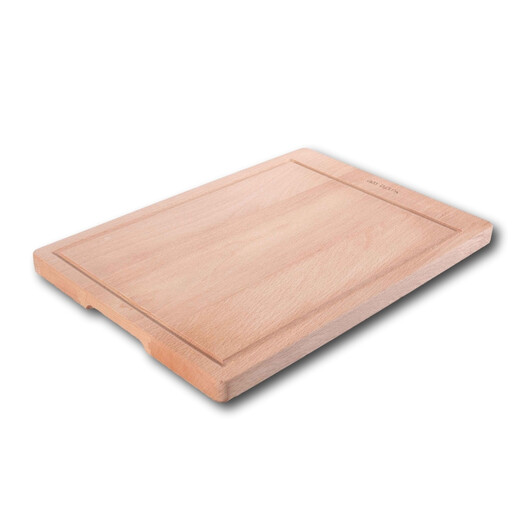
Why this product suits this profile: With its 34 × 24 cm working surface and 2.2 cm thickness, this beech wood chopping board offers clearly defined dimensions for regular kitchen use.
The stated dimensions and material make the choice clearer than a general description such as “wooden board”.
Stated beech wood construction, 2.2 cm thickness and care instructions specifying hand washing.

Why this product suits this profile: This set is aimed at households that need several sizes for preparation and serving. The boards measure 13 × 9.5, 14.5 × 10.5 and 16 × 11.5 inches.
Juice grooves and integrated handles are explicitly listed. This makes it easier to collect liquids and carry the boards.
Three sizes, juice groove, handle and stated hand-washing care instructions.
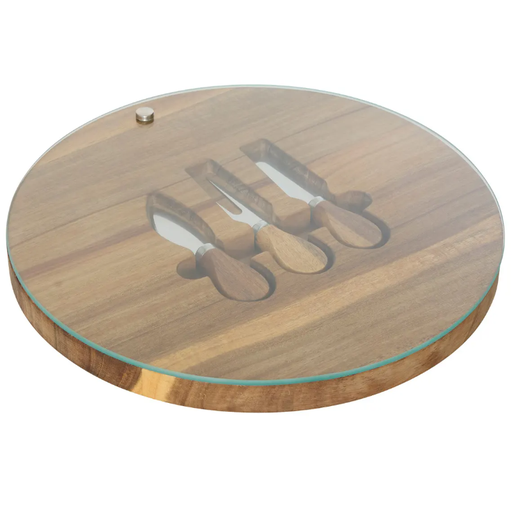
Why this product suits this profile: This round acacia wood board, with a diameter of 30 cm, is designed for arranging cheese, cold meats, fruit and snacks.
Its use as a serving board is clearly described. Buyers therefore will not expect a universal work surface for every cutting task.
Acacia wood, round 30 cm diameter surface and explicitly stated hand cleaning.
We have put together a complete, regularly updated list of products that fully meet these strict selection criteria and the safety regulations applicable in the EU.
That depends on how you intend to use it. Beech is a commonly used type of wood for kitchen boards. Acacia is often used for serving or cheese boards because of its distinctive appearance. Bamboo is a lightweight alternative that is frequently available as part of a set. More important than the name alone are smooth workmanship, suitable dimensions and clear care instructions.
It is not possible to give a reliable fixed lifespan. It depends on how often the board is used for cutting, pressure from knives, moisture, cleaning and care. Regular drying and avoiding the dishwasher can help maintain its usability. The board should be replaced for hygienic and practical reasons if deep cut marks or cracks appear.
Generally, no. Water, heat and prolonged exposure to moisture can cause wood and bamboo to warp or crack. The relevant information is the manufacturer’s guidance for the specific product. If no clear instructions are provided, hand washing followed by thorough drying is the safer approach.