
Lieferung heute & morgen

Qualitätsgarantie

Willkommens-Angebote freischalten: KOSTENLOSE Lieferung | Bis zu 80 % RABATT | Kostenlose 30-Tage-JoyPlus-Testphase
App herunterladen
A wooden chopping board is part of many keen home cooks’ everyday kitchen equipment. It is used for chopping vegetables, bread and herbs, can serve as a butcher’s block and, with the right shape, can even double as a wooden serving board. However, there is a wide choice available: walnut, beech, acacia and bamboo differ in dimensions, weight, care requirements and intended use.
If you focus only on appearance or an eye-catching product description, it is easy to overlook important details. Three common buying misconceptions occur particularly often:
A bamboo chopping board is lightweight, dimensionally stable and designed for everyday chopping tasks in many models. When buying bamboo products, the description should clarify whether the board is a solid, single-piece design or made from glued or cross-layered sections.
With a walnut chopping board, the dark grain and use as a kitchen or serving board are usually the main attractions. Natural wood may show variations in colour. This is a typical material characteristic and does not mean that every item will have exactly the same shade.
For knife care, a smooth surface that is sufficiently hard but not glass- or stone-like is important. Glass and very hard materials can affect a knife blade differently when chopping compared with wood or bamboo. Regardless of the material, the surface should be free from splinters and deep cracks.
A small kitchen board measuring around 30 × 20 cm is easy to store and suitable for fruit, vegetables or smaller preparation tasks. Families, larger ingredients and multi-stage preparation benefit from the extra space offered by a large wooden chopping board. However, boards measuring around 40 to 50 cm in length require a sufficiently large, level worktop.
Material thickness affects both weight and stability. Models measuring 17 to 26 mm thick are more stable for many tasks than very thin boards. A heavy butcher’s block is practical for more forceful chopping, but it also requires more storage space and is less convenient to clean.
A chopping board with a handle can be useful when carrying it from the worktop to the table or hanging it up. The handle should be designed so that it does not unnecessarily reduce the cutting surface. With longer handles, you should also take the overall dimensions into account.
A chopping board with a juice groove catches liquid when chopping juicy foods or carving meat. However, the groove does not replace separate food hygiene practices. If you prepare raw meat or fish, clean the board immediately afterwards and, where possible, use different boards or clearly separate sides. The product information for each model will also provide the relevant cleaning and drying instructions.
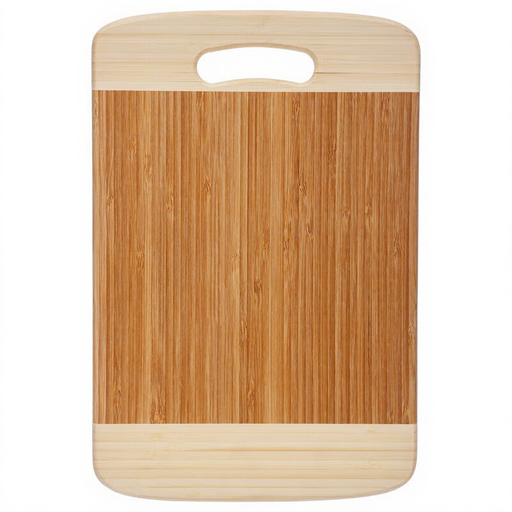
Why this product suits this profile: Its compact dimensions are ideal for smaller kitchens, single-person households and everyday preparation tasks. The integrated handle makes it easier to carry and store in a space-saving way.
The product information explicitly specifies hand washing and complete drying, and warns against soaking and using a dishwasher. This makes the care requirements clear before you buy.
30 × 20 cm, bamboo construction and an integrated handle; suitable for vegetables, fruit and general preparation tasks.
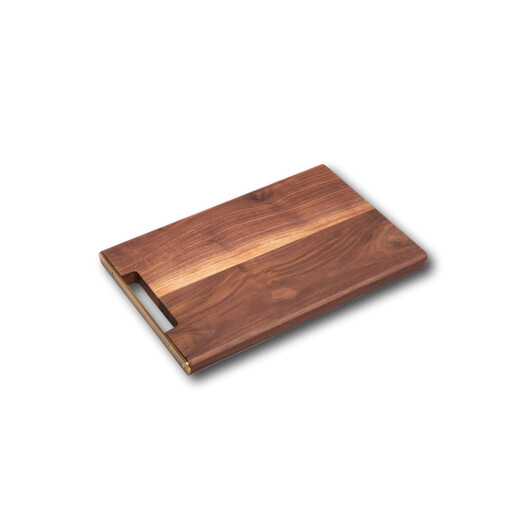
Why this product suits this profile: Walnut, a 20 mm thickness and a copper handle combine a defined size with an attractive appearance for both the kitchen and dining table.
The description lists the material, dimensions, weight and specific care instructions. This reduces the risk of choosing a decorative board without sufficient information about how to use it.
Walnut, 25 × 36 cm, 20 mm thickness and a weight of 1,3 kg; designed for chopping and serving.
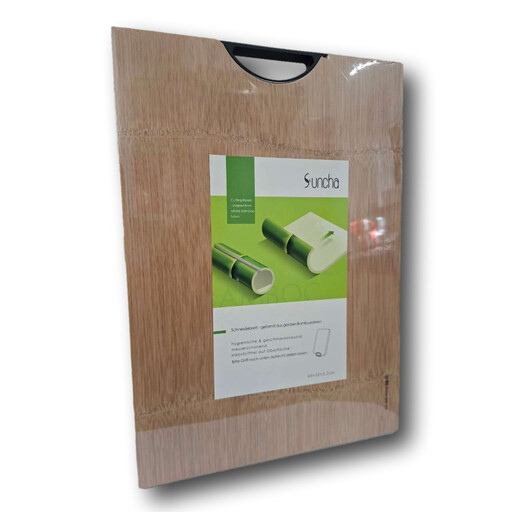
Why this product suits this profile: Its format is aimed at families and users who regularly prepare larger quantities of vegetables, bread or other ingredients.
The precise dimensions of 45 × 32 cm and the 26 mm thickness make the space required and construction clear. The hand-wash requirement prevents false expectations of quick machine cleaning.
Extra-large cutting surface, 26 mm thickness, integrated handle and use as a serving board for bread, cheese or cold cuts.

Why this product suits this profile: The reversible design allows the sides to be assigned for different purposes, for example raw animal products on one side and vegetables or bread on the other.
The juice groove, reversible construction and hand-wash instructions are clearly specified. This means important features are not merely suggested by the product’s appearance.
45 × 30 cm, juice groove, reversible sides and a bamboo surface; also suitable as a serving surface for bread and cheese.
The board’s lifespan depends heavily on how it is treated. Most wooden and bamboo boards follow these basic rules:
A wooden board used for vegetables and meat should be cleaned particularly thoroughly after contact with raw animal products. Separate boards or clearly separated sides can make kitchen routines easier to manage. A juice groove is a practical way of catching liquid, but it does not replace cleaning.
We have put together a complete, regularly updated list of products that fully meet these strict selection criteria and the safety regulations applicable in the EU.
For smaller preparation tasks, around 30 × 20 cm is often sufficient. Families and frequent users benefit from a length of 40 to 50 cm, provided there is enough space on the worktop. Before buying, you should also measure the cupboard compartment, sink and storage area.
There is no standard lifespan that applies in every case. Material thickness, daily use, knife technique and care all affect its condition. A board can remain usable for a long time if stored in a dry place and cared for regularly. Cracks, mould and severe warping are reasons to replace it.
Bamboo and walnut have different properties. Bamboo boards are often available in larger formats and can be a practical option for everyday kitchen tasks. Walnut offers a distinctive dark grain and is often suitable as a wooden serving board too. The crucial factors are the specific dimensions, construction and care instructions for each product.