
Lieferung heute & morgen

Qualitätsgarantie

Willkommens-Angebote freischalten: KOSTENLOSE Lieferung | Bis zu 80 % RABATT | Kostenlose 30-Tage-JoyPlus-Testphase
App herunterladen
A wooden chopping board may seem straightforward at first glance. In practice, however, the material, construction and care determine whether it remains stable in everyday use or quickly becomes uneven, cracked or impractical. For households, home cooks and design enthusiasts, it is therefore worth taking a closer look at the actual product specifications rather than relying on general advertising claims.
A small kitchen board for chopping takes up little storage space, but offers only a limited area when preparing vegetables or meat. A large chopping board is more comfortable to use, but can be difficult to store and clean in a small kitchen. The exact dimensions in centimetres are therefore what matter, rather than descriptions such as ‘XL’ or ‘compact’.
A thick wooden chopping board can sit securely on the worktop. Even so, wood and bamboo should generally not be left in water for long and usually do not belong in the dishwasher. Moisture can encourage warping, cracks or damage to the surface. If you are looking for a low-maintenance board, check the cleaning instructions before buying.
A wooden chopping board with a handle is easier to carry from the worktop to the dining table and can be hung up. However, a handle does not automatically reduce the weight and cannot replace a non-slip base. Grooves, trays or reversible designs are only useful if they suit the way you work.
A wooden chopping board offers a natural surface and, depending on its design, can be used for both chopping and serving. Walnut, beech and rubberwood differ in colour, grain, weight and construction. The specific surface treatment and build quality are just as relevant as the type of wood.
A bamboo chopping board is often dimensionally stable and has a distinctive, even grain. When choosing bamboo products, pay attention to details about their construction. According to the product description, the large Solid Bamboo model in the selection is made from a single piece of Moso bamboo and, at 26 mm, is comparatively substantial.
Plastic boards are often easy to clean, while stainless-steel boards can be particularly resistant to moisture. Both materials feel different from wood when chopping and may affect the knife blade more, depending on their design. A blanket statement about suitability is therefore not appropriate: how you use and clean the board, along with your personal priorities, are what really matter.
The following details are particularly important for everyday kitchen tasks:
A round chopping board can be well suited to serving bread, cheese or small dishes. For long ingredients and large quantities, a rectangular shape is usually more efficient.
An integrated handle makes the board easier to carry. With long handles, check whether the board will still fit in a drawer or kitchen cupboard. It is also important to have a sufficiently large working area beside the handle. For greater safety when chopping, a dry, non-slip mat may be useful.
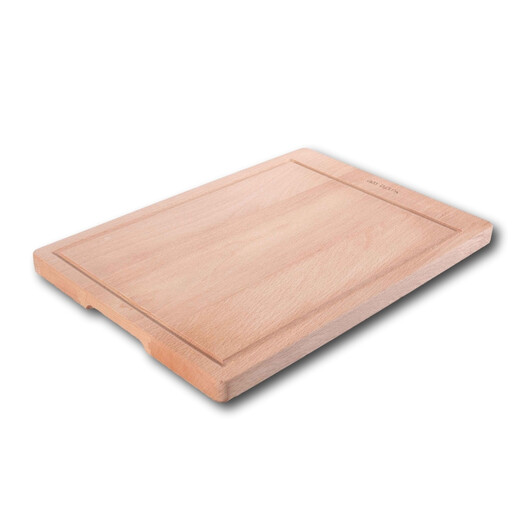
Why this product suits the profile: Measuring 34 × 24 × 2.2 cm, it offers a well-balanced surface for everyday preparation without taking up too much space. Beechwood and the natural grain complement a classic kitchen chopping board.
The product details specify the dimensions, material and clear care instructions. This makes it easier to assess its suitability than with advertising focused solely on size.
34 × 24 × 2.2 cm; beechwood; designed for chopping, dicing and mincing.
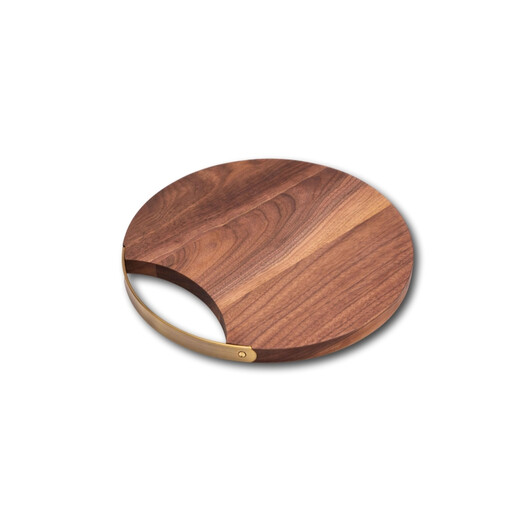
Why this product suits the profile: This round walnut chopping board combines a compact work surface with a shape that is also suitable for serving. It has a diameter of 31 cm and is 20 mm thick.
The dimensions and weight of 1.18 kg are specified. This allows you to check in advance whether the handle, surface area and handling are suitable for the intended use.
Walnut wood; round design with handle; 310 mm diameter and 20 mm thickness.
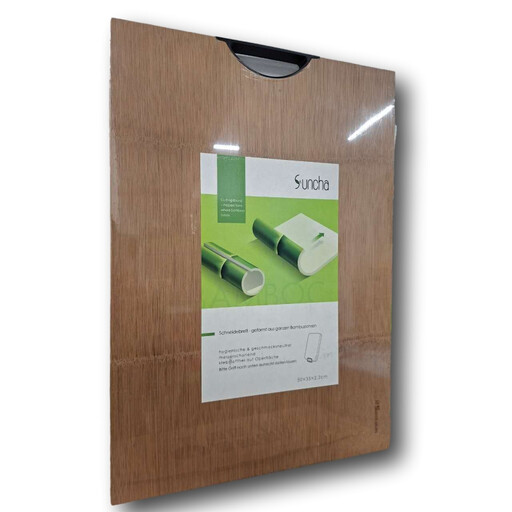
Why this product suits the profile: The 50 × 35 cm surface is suitable for extensive preparation, rolling out dough or working with multiple ingredients. The handle makes it easier to move the board.
The large surface is described with exact dimensions and a weight of 1.99 kg. This reduces the risk of buying a board that appears large but is actually impractical.
Moso bamboo according to the product description; 500 × 350 × 26 mm; suitable for chopping and dough preparation.
A wooden or bamboo board should be cleaned after use with warm water and mild washing-up liquid. Then wipe the surface and allow the board to dry completely, ideally standing upright. Prolonged soaking, harsh scouring products and the dishwasher can damage the material.
For raw animal products, it is advisable to use a separate kitchen board or clean the board thoroughly every time. The surface should be checked regularly for deep grooves, splinters, mould and warping. If the board is badly damaged, it should no longer be used. Some types of wood can also occasionally be treated with a suitable food-safe care oil; the relevant manufacturer’s instructions should always be followed.
A bread chopping board does not necessarily need to have the same properties as a board for meat or vegetables. Crumbs are easier to catch on a textured or sufficiently large surface. Round boards or models with handles are practical for serving, while a sufficiently deep and stable work surface is more important when chopping extensively.
We have put together a complete, regularly updated list of products that fully meet these strict selection criteria and the safety regulations applicable in the EU.
Beech, walnut and rubberwood are commonly used for kitchen boards. The type of wood affects the appearance, weight and feel of the surface. More important than the name alone are consistent construction, suitable dimensions and clear care instructions.
It is not possible to give a reliable fixed lifespan. This depends on the material, thickness, frequency of use and care. Drying the board after every wash, avoiding soaking and not using the dishwasher can help extend its service life. Cracks, severe warping or splinters are reasons to replace the board.
Generally not, unless the manufacturer expressly permits it. Heat, water and the lengthy cleaning cycle can warp or crack wood and bamboo. Before buying, check the instructions for cleaning and storage.