
Lieferung heute & morgen

Qualitätsgarantie

Willkommens-Angebote freischalten: KOSTENLOSE Lieferung | Bis zu 80 % RABATT | Kostenlose 30-Tage-JoyPlus-Testphase
App herunterladen
A wooden high chair for your baby needs to do more than just provide a raised seat at the dining table. As a parent, you’ll be thinking about safety, cleaning, how much space it takes up, and how long you can use it. At the same time, product descriptions aren’t always clear: terms like “grows with your child”, “sturdy” or “sustainable” don’t tell you much about how it actually performs day to day.
As Joybuy’s Product Recommendation Officer, I’ve filtered out the key details and highlighted what really matters when you’re buying. That way, you can avoid common mistakes and choose the right model for your home and family.
A high chair that grows with your child can be used through several developmental stages. What really counts, though, are the specific details: minimum age, seat height, footrest, harness system and maximum weight capacity. A chair with a weight limit of 70 kg isn’t automatically safe for a baby without extra restraints.
For babies from around 6 months, the high chair should only be used if your child can sit up steadily on their own, and if the manufacturer’s instructions explicitly allow it.
A high chair with a tray gives your little one their own surface for eating or playing. However, the tray won’t reliably stop them from slipping out or standing up. A high chair with a safety harness needs a suitable restraint system that’s correctly fitted. For small children, you also need direct supervision and a stable, level floor.
A wooden children’s high chair can be long-lasting if the surface, fixings and edges are designed for everyday use. But unsealed or hard-to-reach areas can be tricky to clean. Before you buy, check the care instructions, how well it resists moisture, and whether you’ll need to regularly check for cracks or loose joints.
First, check whether the model is listed as a baby high chair from 6 months. You’ll also want to look at:
The weight limit doesn’t just apply to safe use during babyhood. With a model that has a removable harness system, you’ll need to make the transition to later use once your child can safely get on and off by themselves.
A 3-point harness or 5-point harness can be part of the safety design. According to the product details, the harness should be used for small children, or until they can sit up independently. Check whether the harness is adjustable and removable, and whether the fixings need regular inspection.
Some models mention standards like EN 14988:2017+A1:2020 or EN 14988-1:2006+A1:2012. You should verify these in the product listing and the instruction manual. They don’t replace proper use and adult supervision.
For an FSC-certified wooden high chair, the FSC claim should relate to the specific product. According to the product details from hauck, the matching tray for Alpha+ high chairs is made from European, FSC-certified beech wood. For the roba Nature Up, the product details state 100% FSC-certified bamboo, but no certificate number is given in the information provided.
Dimensions also matter for British homes. A foldable high chair can be stored away compactly after meals. A permanently set-up, growing high chair should leave enough room to move around next to the dining table. Smooth surfaces that can be wiped clean with a damp cloth reduce the effort of cleaning, though you should avoid abrasive cleaners and prolonged soaking.

Why this product fits the profile: This wooden high chair is ideal for families who want a simple solution from 6 months and need space-saving storage. According to the product details, it arrives folded and can be set up without complicated assembly.
The foldable design addresses limited storage space. An integrated tray and a 3-point harness are included according to the product details; the harness must be correctly fastened every time you use it.
Foldable, approximately 59 × 58 × 78 cm when set up, and manufactured to EN 14988-1:2006+A1:2012 according to the product details.

Why this product fits the profile: The adjustable design is aimed at households that want a high chair to use through several developmental stages at the family table.
The usage period isn’t just vaguely described as “grows with your child”: according to the product details, it can be used from 6 months, has a removable tray and a weight capacity of up to 70 kg.
According to the product details: 100% FSC-certified bamboo, wipe-clean surfaces, 3-point harness system and standard EN 14988:2017+A1:2020.
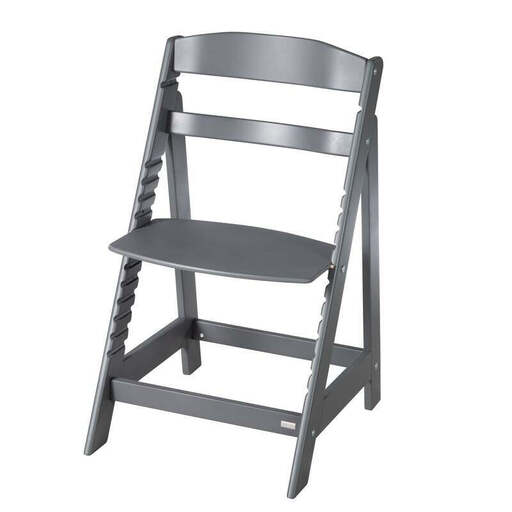
Why this product fits the profile: This model is suitable for families who want to adjust the seat and footrest, and later use the chair as a child’s or teenager’s chair.
The seat and footrests are height-adjustable and removable according to the product details. This means you can adapt the seating position, rather than being stuck with a fixed baby height.
Dimensions approximately 44.5 × 54 × 80 cm, weight 5.18 kg and a maximum load of 70 kg according to the product details. A removable harness system and accessories such as a matching feeding tray are available.
We’ve put together a full, regularly updated list of products that meet these strict selection criteria and the safety regulations in force across the EU.
A tray can be useful if you plan to use the high chair freestanding. For the roba Sit Up Flex, matching wooden feeding trays in anthracite or taupe are available according to the product details. For Hauck Alpha+ high chairs, FSC-certified wooden trays with raised edges are offered. Before buying, you’ll need to check compatibility with your exact high chair model.
For extra play and safety areas, you might consider a wooden baby walker or a wooden playpen. The wooden walker described is intended from 12 months according to the product details, has several activity areas, rubberised wheels and dimensions of 34.5 × 32.5 × 45 cm. A playpen should be chosen based on age, weight limit, floor heights and locking castors. The roba models mentioned have three floor heights and locking castors according to the product details.
Many models are intended from around 6 months according to the manufacturer. It’s also essential that your child can sit up steadily on their own. The specific age and usage information for each product takes priority.
That depends on the adjustment range, weight limit and construction. Models with a removable tray and height-adjustable seat and footrest can be used beyond the toddler years. A stated weight capacity of 70 kg describes the technical maximum, not necessarily every suitable use situation.
Food residue should be removed promptly with a slightly damp cloth. Don’t use abrasive cleaners and don’t soak wooden parts in water. Regularly check the harness, screws, joints, edges and the surface for any damage.