
Lieferung heute & morgen

Qualitätsgarantie

Willkommens-Angebote freischalten: KOSTENLOSE Lieferung | Bis zu 80 % RABATT | Kostenlose 30-Tage-JoyPlus-Testphase
App herunterladen
A wooden play kitchen is more than just a toy—it's a space for creativity, role-playing, and taking the first steps into the world of cooking. But the sheer number of options can be overwhelming. Many models look high-quality at first glance but quickly turn out to be a bad investment. Before you make a decision, it's crucial to understand the common pitfalls that often only become apparent after assembly or a few weeks of play.
As your Joybuy Product Recommendation Officer, I'm here to help you separate the wheat from the chaff. In this guide, I'll show you what really matters and how to find a durable and safe play kitchen for your child.
Many parents invest in a wooden play kitchen assuming they are getting a sturdy and long-lasting product. Unfortunately, the reality is often different. Watch out for these three weak points:
To avoid a costly mistake, you should check a few core features before making a decision. These objective parameters will help you assess a model's quality, independent of marketing promises.
The material is the heart of any wooden play kitchen. Pay attention to the following:
Features should enhance play value, not reduce durability.
The kitchen's dimensions are crucial for long-lasting fun. A play kitchen for ages 3 and up should have a worktop height that allows the child to play comfortably while standing. Some models are even height-adjustable and grow with your child, significantly extending their lifespan.
To make your decision easier, we have compiled a few products that are suitable for different needs and spaces.
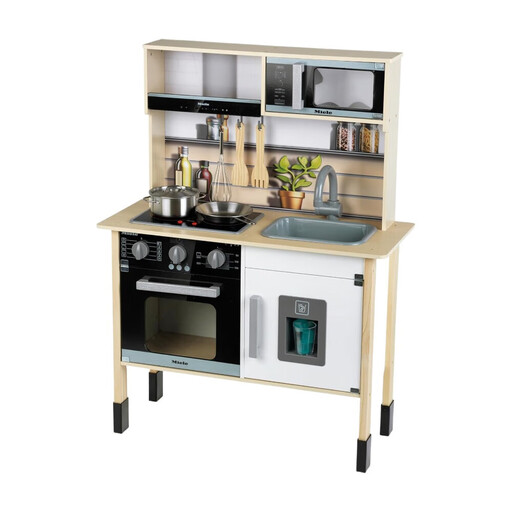
Why This Fits Their Persona: A well-balanced choice that combines the renowned Miele design with a solid MDF wood construction and appealing features like lights and sound, without being overwhelming. Ideal as a first fully-featured play kitchen.
The high-quality MDF wood construction ensures good stability and durability, unlike cheap particleboard. The proven design from Theo Klein and Miele stands for more reliable electronic components.
Offers a complete play experience right after assembly with an oven, microwave, and high-quality metal and wood accessories.
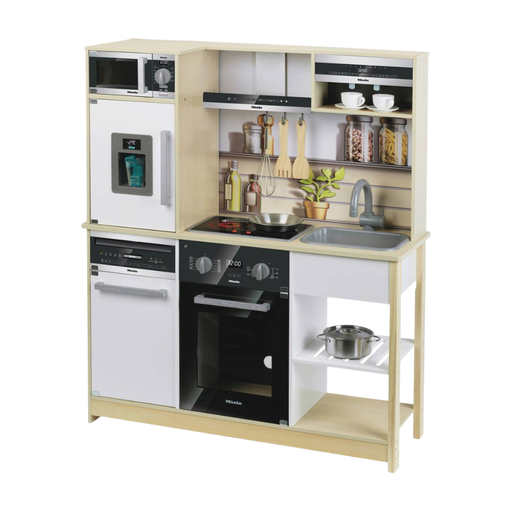
Why This Fits Their Persona: For families looking for a larger, more comprehensive play station where multiple children can play at the same time. It offers more appliances like an espresso machine and a refrigerator with an ice dispenser.
This is a stable piece of furniture, not a wobbly toy. Its size and construction from FSC-certified wood provide the necessary stability for energetic play, avoiding the instability of smaller, cheaper models.
Generous dimensions (83.5 x 30 x 101 cm) and extensive features for long-lasting and varied play.
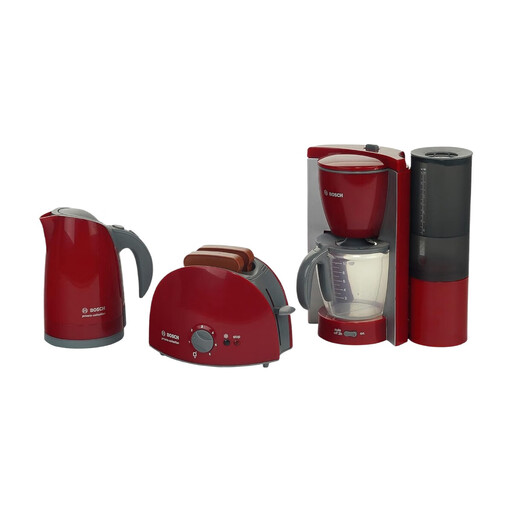
Why This Fits Their Persona: Ideal for anyone who already owns a base kitchen and wants to upgrade it with high-quality, branded accessories. The set focuses on the popular "making breakfast" play scenario.
Instead of buying a large kitchen with low-quality accessories, this set provides durable individual appliances. The mechanical toaster function is less prone to failure than cheap electronics.
Authentic Bosch design and realistic functions (water can be added to the coffee machine, mechanical toaster) ensure a believable play experience.
We have compiled a complete, up-to-date list of products that fully meet these strict selection criteria and German safety regulations.
Most manufacturers recommend their models as a play kitchen for ages 3 and up. At this age, children begin to develop complex role-playing games and imitate the actions of adults. The height of the work surface should be appropriate for the child so they can play comfortably and safely. For younger children, there are often smaller, floor-level play options or individual accessories.
Safety is the top priority. Look for a stable construction that cannot tip over. All edges must be rounded. Check if the product meets the European safety standard EN 71 for toys. This ensures that the paints and lacquers used are non-toxic and saliva-resistant. For models with electronics, the battery compartment should be securely screwed shut and inaccessible to children.
Caring for a wooden play kitchen is straightforward. Wooden surfaces should only be wiped with a slightly damp cloth and dried immediately to prevent the material from swelling. Do not use harsh cleaning agents. Removable sinks made of plastic or metal can usually be cleaned normally with water and mild dish soap. Regularly check all screw connections and tighten them if necessary.