
Lieferung heute & morgen

Qualitätsgarantie

Willkommens-Angebote freischalten: KOSTENLOSE Lieferung | Bis zu 80 % RABATT | Kostenlose 30-Tage-JoyPlus-Testphase
App herunterladen
A wooden play kitchen is more than just a toy. It's a space for creative role-play that fosters social skills and fine motor development. However, the market can be overwhelming, and not every model lives up to its promise. As a Joybuy Product Recommendation Officer, I'll help you identify the crucial features and avoid common buying mistakes, so you can find a durable and safe play kitchen for your child.
Many well-intentioned purchases turn out to be a poor choice after a short time. Watch out for these three typical problems to avoid disappointment:
To make an informed decision, you should evaluate three core parameters. These are the primary determinants of a play kitchen's durability, safety, and play value.
The foundation of any good play kitchen is its material. FSC-certified wood ensures that the material comes from responsibly managed forests. Look for solid construction, ideally from solid wood or high-quality, thick MDF panels. All edges should be carefully rounded to prevent injuries. The surface finish is also important: water-based, non-toxic tested paints are the safe choice for a child's toy.
The right size is essential for long-lasting fun. Measure the counter height of the kitchen and compare it to your child's height. A good counter height is roughly at the child's hip level. Some models offer a height-adjustable feature, making them a particularly sustainable investment as the kitchen "grows" with the child. This makes it an ideal gift for 3-year-olds that can still be used in the years that follow.
A simple wooden box quickly becomes boring. Interactive elements, like a wooden play kitchen with lights and sound on the hobs, significantly enhance realism and enjoyment. Also, check what play kitchen accessories are already included in the set. Pots, pans, and cooking utensils made of wood or metal are often higher quality and more durable than cheap plastic alternatives. Such a set enhances the role-playing toy experience right from the start.
Here are some recommendations tailored to different needs and living situations.

Why it's a great fit: Ideal for families looking for a long-lasting solution that grows with their child and is also suitable for siblings. The brand partnership with Miele ensures a realistic design.
The height-adjustable design solves the problem of incorrect counter height and significantly extends its usable life.
FSC-certified wood; hob with realistic light and sound effects; high-quality stainless steel and wood accessories included.

Why it's a great fit: Perfect for families with a garden or balcony. This mud kitchen is specially designed for outdoor use and allows for creative play with water, sand, and natural materials.
Instead of delicate electronics, it offers a robust, weatherproof construction of FSC-certified solid wood and a plastic tub that is easy to clean.
Encourages outdoor play; includes a water container with a tap and accessories; suitable for children from 18 months.
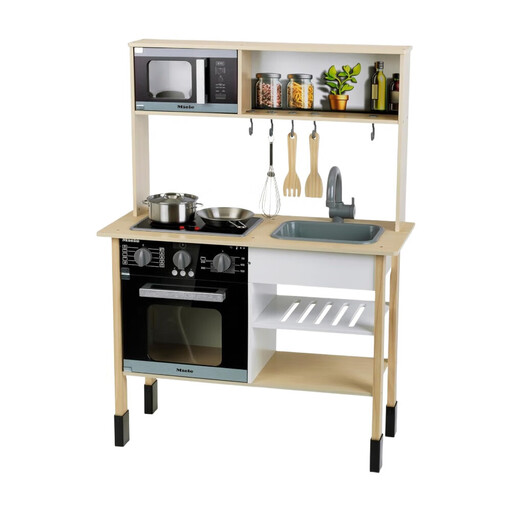
Why it's a great fit: With a width of just 70 cm, this Miele play kitchen fits into smaller children's rooms or living areas without sacrificing key features like a microwave and hob.
Despite its compact size, it offers a sturdy wooden construction and avoids the impression of a "cheap" toy through high-quality details and accessories.
Compact design; battery-powered hob with light and sound; removable sink for easy cleaning.
We have compiled a complete, up-to-date list of products that fully meet these strict selection criteria and relevant safety standards.
A wooden play kitchen is generally suitable for children from around 2 to 3 years old. At this age, children begin to imitate everyday activities through role-playing. Models with a low counter height or height-adjustable kitchens are well-suited for two-year-olds. Always pay attention to the manufacturer's age recommendation and ensure that no small, swallowable parts are accessible to children under 3.
Wooden surfaces should only be wiped with a slightly damp cloth and, if necessary, a mild detergent. Avoid using wet rags or harsh cleaners, as these can cause the wood to swell or damage the finish. Removable sinks made of plastic or metal can be cleaned separately with soap and water.
A classic play kitchen is designed for indoor use and imitates a real kitchenette, often with electronic features like lights and sound. A mud kitchen is intended for outdoor use. It is more robustly built, weatherproof, and designed for children to play with water, sand, soil, and leaves. It usually has a basin instead of a delicate sink and forgoes electronics.