
Lieferung heute & morgen

Qualitätsgarantie

Willkommens-Angebote freischalten: KOSTENLOSE Lieferung | Bis zu 80 % RABATT | Kostenlose 30-Tage-JoyPlus-Testphase
App herunterladen
A wooden play kitchen can provide hours of imaginative play, letting children recreate everyday situations. However, models vary considerably in size, materials, features and safety details. If you focus only on colour or the number of features, it’s easy to overlook important buying criteria.
A play kitchen with lights and sounds may look impressive at first glance. But extra modules, wide worktops or protruding accessories can quickly get in the way in a small bedroom. Before ordering, compare the kitchen’s overall dimensions with the space where you plan to put it.
Height matters too. A low play kitchen may suit younger children, while older children may benefit from a taller or height-adjustable model. Make sure the dimensions suit both the room and your child’s height.
Descriptions such as “complete play kitchen” don’t automatically mean that pots, crockery, play food or cutlery are included. So it’s worth checking the product description:
A large accessory set isn’t always the best choice if it means lots of small pieces that need sorting after playtime.
“Wood” can refer to different wood-based materials used in play kitchens, such as MDF or chipboard. So check the specific materials listed, the quality of the finish and the stability of the construction. For FSC-certified products, also check which parts the product information says are covered by the certification.
For use in a child’s bedroom, look for smooth surfaces, rounded edges, secure joints and a battery compartment that closes safely. Small parts can pose a choking risk for children under three. Always follow the manufacturer’s age recommendation and safety warnings.
Before buying, check the width, depth and height against the space available. A play kitchen with a hob and a separate sink will usually take up more room than a compact model. For a freestanding kitchen, it’s also important to check that it can stand on a level surface and remains stable once assembled.
Example dimensions from the selection:
An adult should assemble the kitchen according to the instructions. Check the screws and joints regularly afterwards.
For a play kitchen with lights and sounds, check how many batteries it needs and what type. According to the product information, the Theo Klein models 7186, 7187, 7188, 7199 and 7194 each require two AA batteries, which are not included. An adult should insert the batteries, and they should be removed if the kitchen won’t be used for a long time.
Light and sound effects can add to imaginative play, but they don’t replace basic features such as a hob, sink or storage space. Keep electrical components away from water. Clean surfaces and electronic modules in line with the care instructions.
A play kitchen with accessories is handy if your child wants to start playing out different scenarios straight away. Store metal and wooden utensils in a dry place after playtime. A removable sink can make cleaning easier, while wooden surfaces should generally be wiped with a dry or slightly damp cloth.
For more imaginative play, consider a cutting set, play food, a mixer or a separate till set. Make sure any additional products are suitable for your child’s age and carry clear safety warnings.
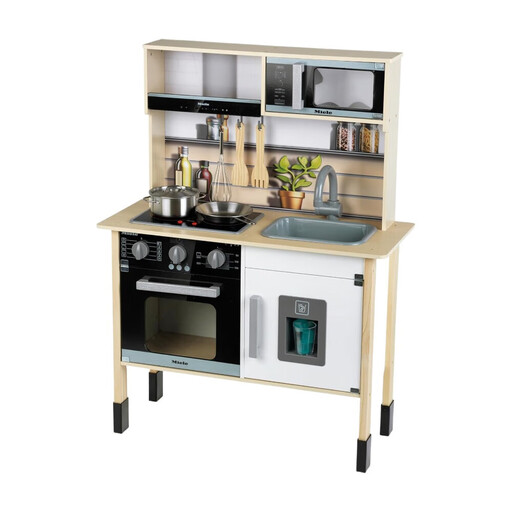
Why this product suits this use: The midi version takes up relatively little floor space at 70 × 30 cm, while still offering a hob, microwave, fridge with ice dispenser and removable sink.
The product information gives the exact dimensions, lists what’s included and specifies the two AA batteries required. This makes it easier to assess the space needed and any extra costs before buying.
MDF wood construction, a light and sound module on the hob, and metal and wooden cooking utensils, according to the product description.
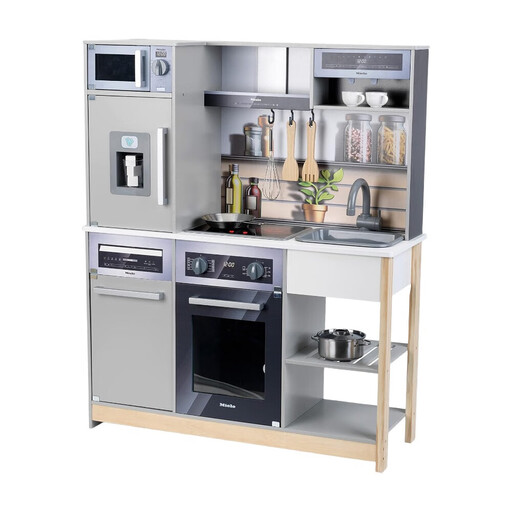
Why this product suits this use: This larger Miele kitchen brings together several play areas for children who enjoy cooking, sorting and acting out household routines.
The features are listed in detail: microwave, espresso machine, fridge with ice dispenser, removable sink and cooking utensils. This reduces the chance of having to buy important parts separately.
FSC-certified wood according to the product description, dimensions of 83.5 × 30 × 101 cm, and light and sound features on the hob.

Why this product suits this use: The height-adjustable version is a good fit for families whose children of different heights will be using the kitchen over a longer period.
The adjustable height helps solve the problem of a worktop that’s at the wrong height. The kitchen must still be assembled correctly, and its joints should be checked regularly to make sure they’re secure.
Height-adjustable worktop, FSC certification according to the product information, and a hob with light and sound effects; two AA batteries are required.
We’ve put together a complete, regularly updated list of products that meet these strict selection criteria and the safety regulations in force across the EU.
According to the manufacturers, many of the models listed are intended as play kitchens for children aged 3 and over. This may be because they contain small accessories and detachable parts. Always follow the age recommendation and safety warnings for the specific product. Children should be suitably supervised while playing.
Compact models are often around 70 cm wide and 30 cm deep. Larger versions can be more than 80 cm wide and around 100 cm tall. You should also leave enough room in front of the kitchen for children to move around safely and use doors, cupboards and accessories.
Battery-powered features mean you’ll need to replace the batteries from time to time. How often depends on how long the kitchen is used and how frequently the sound and light features are switched on. According to the product information, batteries are not included with the Theo Klein models listed. If the kitchen won’t be used for a long time, it’s best to remove the batteries.