
Lieferung heute & morgen

Qualitätsgarantie

Willkommens-Angebote freischalten: KOSTENLOSE Lieferung | Bis zu 80 % RABATT | Kostenlose 30-Tage-JoyPlus-Testphase
App herunterladen
A wooden play kitchen can be used for role play, crafting and sorting for many years. However, not every model suits every home, height or play environment. If you focus only on appearance, brand name or the number of accessories, you can easily overlook important details.
A wooden play kitchen for children requires more than just floor space. Before ordering, you should also consider doors, walkways and the space in front of the worktop. A kitchen with a depth of 30 cm may be suitable for a child's bedroom, while a model more than 80 cm wide takes up considerably more room in a living area.
The worktop height is also important. With a play kitchen for indoors and outdoors, the height can vary considerably depending on the model. Lower play surfaces are usually easier for younger children to reach. An adjustable-height version may remain suitable for longer, but it must be set securely.
A children's play kitchen with lights and sounds provides additional play stimulation, but does not replace the functions of real appliances. The hobs on the models presented here cannot be heated. Batteries are not always included and must be inserted by adults. You should therefore check:
An outdoor mud kitchen does not automatically have to remain permanently outdoors without protection. Weather-resistant, stained solid wood is designed for outdoor use, but a cover and dry winter storage will extend its service life. Water should be removed from tubs and containers after every play session. Before each use, screws, connections and wooden surfaces should be checked for damage.
A children's play kitchen for ages 3 and up is not suitable for younger children if it contains small parts or accessories with components that could be swallowed. Models with a suitable age recommendation are available for children from 18 months. The manufacturer's age recommendation is therefore more important than the kitchen's size alone.
Younger children should ideally use the kitchen under constant supervision. All accessories should be collected after play. Product information about warnings, load limits and assembly is already part of making a practical choice before buying.
For a robust children's play kitchen, look for rounded edges, sturdy connections and an easy-care surface. Solid wood and wood-based materials differ in weight, finish and care requirements. An FSC-certified children's play kitchen can provide traceable information about the origin of the wood used, provided the certification is expressly stated in the product details.
You should also check whether the accessories are made from metal, wood or plastic and whether they can be cleaned separately. A removable sink or removable tubs make everyday hygiene easier.
At least the following measurements are relevant when choosing a model:
A wooden play kitchen with water and sand functions should be able to dry out after play. For indoor use, electronic modules, wipe-clean surfaces and a compact depth are often more important than an extensive range of features.
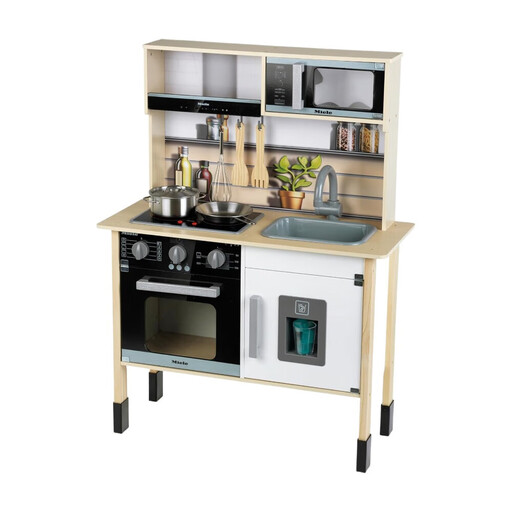
Why this product suits the profile: Measuring 70 × 30 × 95 cm, this compact model for children aged 3 and over takes up relatively little floor space while still offering a hob, microwave, fridge and removable sink.
The specific dimensions make planning the available space easier. The age limit and information about small parts make the requirements for use clear.
FSC-certified wood according to the product details, a light and sound module on the hob, and a weight of 9.5 kg.
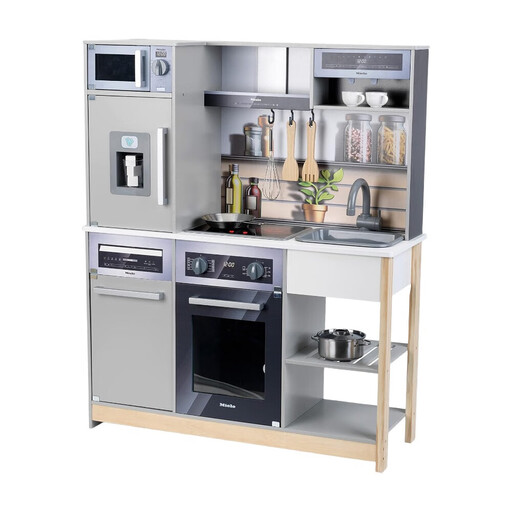
Why this product suits the profile: If you are looking for a well-equipped Miele children's play kitchen with several play stations, this model includes a cooker, microwave, espresso machine, fridge and sink.
The features are described individually, including the non-heating hob. This keeps play functions clearly separate from the functions of real appliances.
FSC-certified wood according to the product description, a weight of 16.3 kg, and two AA batteries for the light and sound functions.
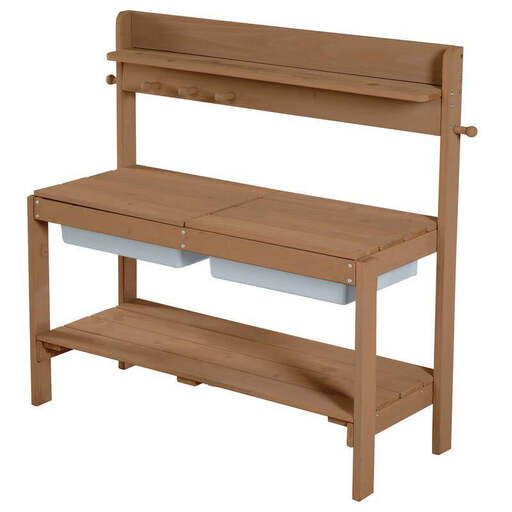
Why this product suits the profile: Designed for sand, water and mud play in the garden, on the patio or indoors, this model for children from 18 months can be used in a variety of ways.
Two removable plastic tubs and the weather-resistant stain are specifically designed for changing play situations. In winter, it can be used as a craft table.
Dimensions of 88.5 × 89.5 × 35 cm, a load capacity of up to 25 kg and wipe-clean surfaces according to the product details.
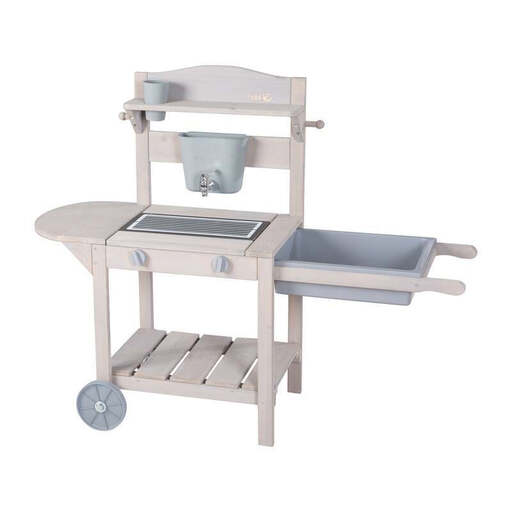
Why this product suits the profile: The wheels make it easy to move between the patio, garden and indoors. Designed for children from 18 months, this model combines grilling, water play and storage.
Outdoor use comes with specific care instructions: cover it or store it in a dry place, and remove water after play.
Overall dimensions of 114 × 37 × 89 cm, a worktop height of 52 cm, a plastic tub, a water container with tap and two wheels.
Assembly should be carried out by adults. Make sure you have a level surface and check all screws and connections after assembly. With a play kitchen with accessories, it is worth using a dedicated storage box so that small parts do not get lost.
For models with lights and sounds, ongoing costs are essentially limited to replacement batteries. Any AA or R6 batteries not included must be budgeted for separately. Remove the batteries if the kitchen will not be used for an extended period and check the battery compartment for leaks.
Wooden surfaces should be cleaned either dry or with a slightly damp cloth, in accordance with the manufacturer's instructions. Electronic components must not come into contact with water. Outdoor models should be checked regularly for cracks, loose parts and weather-related changes.
We have put together a complete, regularly updated list of products that fully meet these strict selection criteria and the safety regulations applicable in the EU.
That depends on the particular model. Some outdoor play kitchens are approved for children from 18 months, while Miele kitchens with small parts are generally intended for children aged 3 and over. The manufacturer's age recommendation and warnings are always decisive.
There is no universal answer regarding its service life. It depends on the materials, use, assembly and care. Indoor models should be kept dry; outdoor kitchens benefit from being covered, stored indoors over winter and having water removed after every use. Damaged or splintering parts must be repaired or replaced before further use.
Apart from the purchase price, the only usual costs are for the correct batteries. The models mentioned each require two AA or R6 batteries, which are not always included. The hobs produce light and sound effects but are not suitable for heating.