
Lieferung heute & morgen

Qualitätsgarantie

Willkommens-Angebote freischalten: KOSTENLOSE Lieferung | Bis zu 80 % RABATT | Kostenlose 30-Tage-JoyPlus-Testphase
App herunterladen
A wooden play shop is more than just a toy—it's a miniature world where children can practice social interactions, unleash their creativity, and learn about numbers and goods through play. But the selection is vast, and not every model lives up to its promise. Before you make a decision, it's crucial to understand the common pitfalls that often only become apparent after the purchase.
As your Joybuy Product Recommendation Officer, I'm here to help you separate the good from the bad. In this guide, I'll show you what to look for to find a durable, educationally valuable model that will bring joy for years to come.
Many products look appealing at first glance but quickly turn out to be a poor investment. Pay close attention to these three points to avoid disappointment:
To avoid making a bad buy, you should check a few technical parameters before deciding. These features are crucial for the safety, durability, and play value of a toy shop.
The choice of material is the foundation for a stable and safe wooden play shop.
Regardless of the material, rounded edges and a non-toxic finish are essential. Look for certification according to the European toy safety standard EN 71, which regulates the safety of children's toys.
A good toy shop with a counter offers more than just a sales area. Functional elements encourage creative role-playing and make the experience more realistic.
Before buying, carefully measure the available space in the child's room. Consider not only the footprint of the shop itself but also the space the child will need as a "customer" in front of the counter. A well-proportioned children's market stall should be designed to be played with comfortably for at least two to three years.
Instead of making a one-size-fits-all recommendation, we have selected products that suit different requirements and play scenarios.
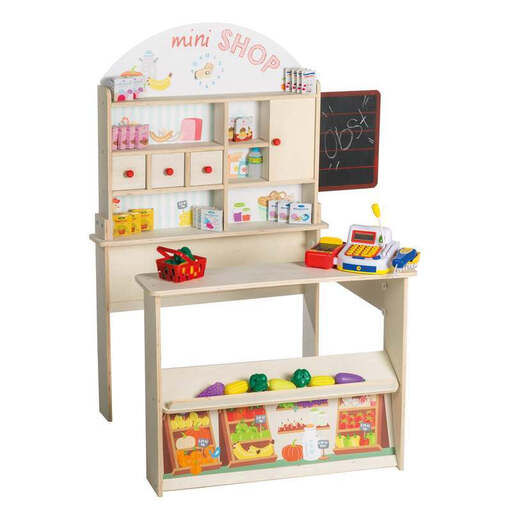
Why This Fits Their Persona: Ideal for families looking for a fully equipped, classic play shop that offers long-lasting, versatile fun for imaginative role-playing.
The plywood construction is significantly more stable than basic MDF models (avoids Trap 1). The generous features, including a counter, drawers, and a chalkboard, provide high play value right from the start (avoids Trap 2).
Spacious design with plenty of storage, 3 drawers, and a side chalkboard for creative offers. Promotes social skills through interactive play.
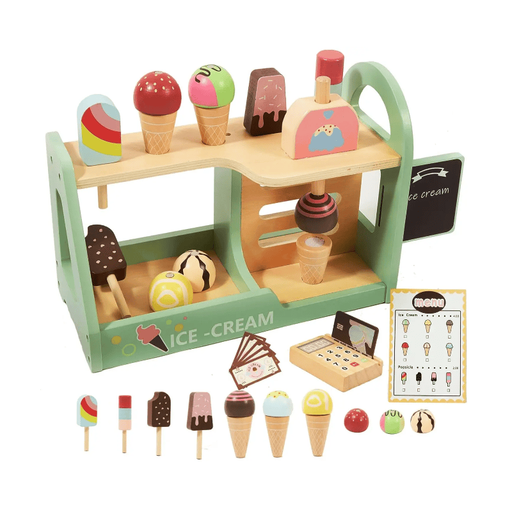
Why This Fits Their Persona: Perfect for children who have a preference for a specific theme, or for families with limited space. This compact market stall focuses on a clear role-playing scenario.
Its compact size bypasses the problem of oversized toys (Trap 3). The themed set often includes matching accessories, reducing the risk of hidden costs (Trap 2).
The focused theme (ice cream sales) encourages specific role-playing games. Its space-saving design makes it ideal for smaller children's rooms or as an addition to existing toys.
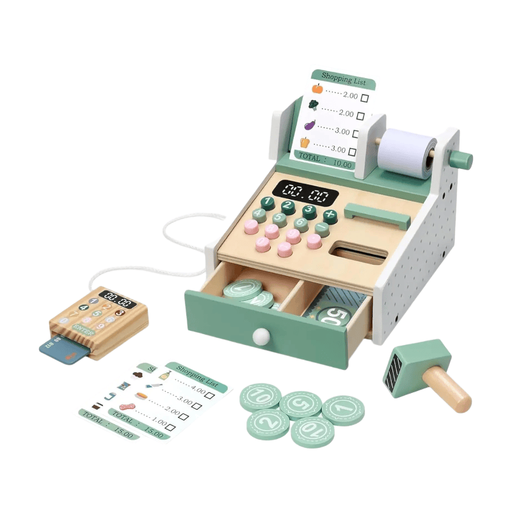
Why This Fits Their Persona: An excellent choice for parents who want to test their child's interest in retail role-play without immediately investing in a full shop. Any table can become the counter.
This accessory solves the "empty shell" problem (Trap 2) in the cleverest way: it is the central element needed to begin playing and allows for immediate fun with minimal investment.
Allows for a low-cost entry into play shop role-playing. It can easily be integrated into a larger play shop later, increasing its play value.
We have compiled a complete, up-to-date list of products that fully meet these strict selection criteria and safety regulations.
1. From what age is a wooden play shop suitable? As a rule, play shops are suitable for children from 3 years of age. At this age, children begin to understand and imitate social roles. When choosing for this age group, pay special attention to models with rounded edges, a stable construction, and no small, swallowable parts to ensure safety.
2. How much space do you need for a wooden play shop? The dimensions vary greatly. Compact market stalls can be around 70–80 cm wide, while larger models can measure over 100 cm in width. It is advisable to measure the intended space in the child's room carefully before purchasing. Also, plan for about one metre of space in front of the counter so that the child and their "customers" can play comfortably.
3. Do I have to buy accessories for a play shop separately? In most cases, yes. Most play shops are sold as a basic structure without accessories. Check the product description carefully to see what is included in the delivery. Accessories such as a cash register, play money, a scale, or play food are typically separate purchases, but they significantly enhance the play value.