
Lieferung heute & morgen

Qualitätsgarantie

Willkommens-Angebote freischalten: KOSTENLOSE Lieferung | Bis zu 80 % RABATT | Kostenlose 30-Tage-JoyPlus-Testphase
App herunterladen
A wooden puzzle for babies aged 12 months and over can be a suitable motor skills toy for a child’s first introduction to shapes, colours and simple matching. However, wooden baby puzzles vary considerably in terms of handles, piece size, workmanship and how they are played with. An appealing animal graphic alone says little about whether a toy is genuinely suitable for everyday family life.
Before buying, parents and relatives should therefore look beyond the price or product images. What matters is an age-appropriate design, clear information about the materials and a construction that suits the child’s stage of development.
A wooden puzzle for children aged 1 and over with lots of small pieces can quickly become overwhelming for a child aged 12 months. At this age, simple matching activities are usually easier to understand: the child picks up a piece, turns it and places it into the matching recess. Too many variations, on the other hand, can cause frustration or mean that some pieces are ignored.
A puzzle without easy-to-reach handles can be difficult for little hands to use. Very flat elements can also be harder to pick up. A puzzle with wooden knobs or sufficiently large handles makes independent gripping easier. Nevertheless, the pieces must be securely attached or large enough, and must not be used for chewing or teething.
The term ‘wooden toy’ initially describes only the material. It does not provide complete information about the paints, edges, workmanship or suitability for a particular age. A reference to FSC-certified wood concerns the origin of the wood and is not the same as a safety approval. Parents should also check the age recommendation, warnings and manufacturer’s information.
Simple inserting and matching games are often suitable for children aged 12 months and over. A peg puzzle for toddlers should offer a manageable number of elements and clearly recognisable shapes. With a shape-sorting game, there are additional matching tasks: the child learns to recognise which shape or picture belongs in which opening.
It is important not to use the puzzle below the manufacturer’s recommended age. In households with several children, you should also check whether younger siblings could gain access to small parts.
Practical wooden knobs or larger grip areas can make it easier to pick up the puzzle pieces. Look for:
With a new toy, it is advisable to inspect it before first use. If pieces come loose, show cracks or are damaged, the product should no longer be used.
For an educational toy made from FSC wood, the product description should clearly state the certification. FSC indicates that the wood comes from a controlled source within certified forestry systems. This may be important to buyers looking for sustainable toys for babies.
For many wooden products, a slightly damp cloth is sufficient for cleaning. The toy should not be soaked or treated with harsh cleaning products. Always follow the manufacturer’s specific care instructions.
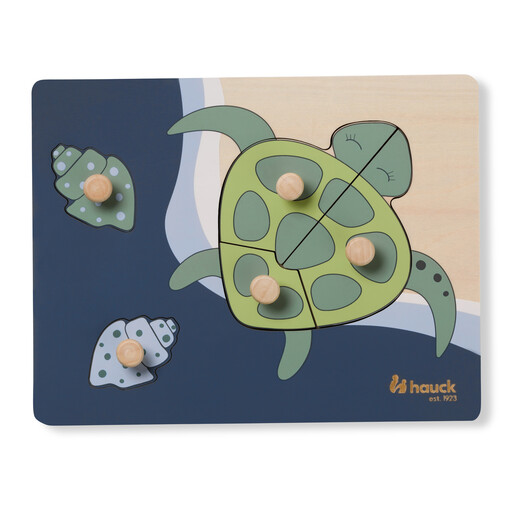
Why this product suits this profile: The animal design and clearly defined recesses offer an easy introduction to a peg puzzle for toddlers aged 12 months and over.
The product details mention wooden knobs, rounded edges and suitability from 12 months. This makes key buying criteria easy to check at a glance.
According to the product description: FSC-certified wood, dimensions of 22 × 17 cm and three available designs or colours.
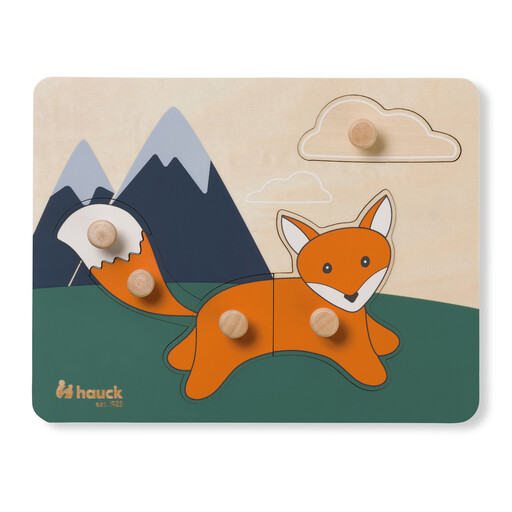
Why this product suits this profile: The board with animal-shaped pieces is ideal for families looking for a clearly structured activity involving gripping and placing pieces.
The product details point to practical wooden handles and rounded edges. This addresses the common difficulty of flat pieces or pieces that are hard to grip.
According to the product details: dimensions of 22 × 17 × 2 cm, weight of 170 g, FSC-certified wood and production in Germany.
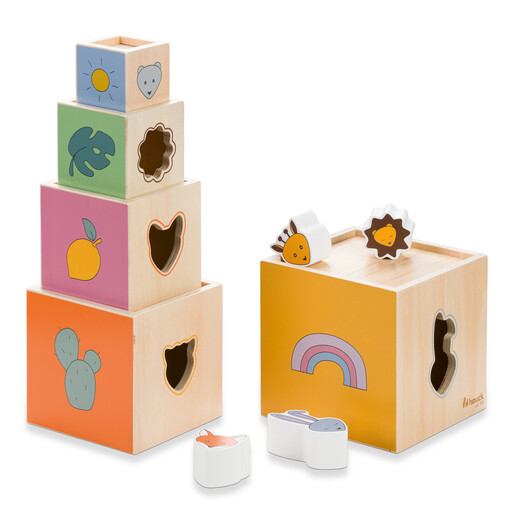
Why this product suits this profile: This model combines sorting, stacking and storage, making it a good fit for households where a motor skills toy for children aged 12 months and over should offer several ways to play.
According to the product description, the cubes can be stacked, lined up and matched to the corresponding openings. This means the play concept is not limited to a single peg puzzle.
According to the product details: FSC-certified wood, stackable cubes and space-saving storage by turning the elements over.
For this model, the manufacturer explicitly points out the presence of small parts and the need for adult supervision. The components are not intended for chewing or teething. Damaged, splintered or loose pieces must be removed immediately.
We have put together a complete, regularly updated list of products that fully meet these strict selection criteria and the safety regulations applicable in the EU.
The age recommendation is a useful guide, but it does not replace observing the child’s individual stage of development. Some children begin with a single peg piece, while others are initially more interested in taking pieces out and sorting them. Simple shapes, large handles and a small number of pieces make it easier to get started. The toy should be used under direct supervision.
How long it can be used depends on the workmanship, the child’s interest and how well it is cared for. A puzzle board with clear designs can initially be used for gripping and placing pieces. Later, parents can also name words, colours and shapes, or ask the child to find matching pieces. If there is any visible damage, the toy should no longer be used, regardless of the child’s age.
Wooden puzzles should be stored in a dry, clean place. A slightly damp cloth is generally sufficient for cleaning, unless the manufacturer specifies otherwise. After playing, check that all pieces are present. Storing the puzzle in a closed container out of younger siblings’ reach reduces the risk of small parts getting into their hands unsupervised.