
Lieferung heute & morgen

Qualitätsgarantie

Willkommens-Angebote freischalten: KOSTENLOSE Lieferung | Bis zu 80 % RABATT | Kostenlose 30-Tage-JoyPlus-Testphase
App herunterladen
A wooden puzzle for children should encourage little hands to grasp, match and explore. But choosing one involves more than cute animal pictures or bright colours. The key things to consider are the recommended age, piece size, material, finish and whether the puzzle is right for your child’s stage of development.
A peg puzzle for children aged 1+ isn’t automatically suitable for every child from their first birthday. Some children can already grasp individual pieces with confidence, while others need more time. It’s especially important to check whether the puzzle contains small parts and whether it should only be used under direct supervision.
The wooden puzzles featured here have a minimum age recommendation of 12 months or older. Small, detachable parts are a particular consideration for children under three. Always check the age recommendation on the product page against your child’s individual development.
A puzzle with large knobs can make the pieces easier to pick up. But the cut-outs also need to be easy to recognise, and the pieces should sit securely in little hands. If the pieces fit too tightly, a wooden puzzle for babies can quickly become frustrating; if they’re too loose, they may fall out.
Look for rounded edges, securely attached knobs and a board that won’t slide around easily during play. Check the attachments on puzzles with knobs regularly.
The word “sustainable” on its own tells you little about where the material comes from. A specific certification, such as FSC-certified wood, gives you more useful information. Care instructions matter too: many wooden puzzles shouldn’t be soaked in water or cleaned with harsh products, as this can warp the material or damage the finish.
Simple inset or peg puzzles with a few easy-to-distinguish shapes are usually suitable for children aged 12 months and over. An animal puzzle for children helps them match pictures and can be used to introduce animal names. A shape puzzle focuses more on circles, colours, outlines and matching shapes in space.
From around two to three years, puzzles with more pieces or a gradually increasing level of difficulty may be suitable. Traditional cardboard frame puzzles, such as those with 15 or 24 pieces, are often recommended for children aged three or four and over, so they’re not the same as a wooden puzzle for children aged 12 months and over.
Check the following before you buy:
Check a wooden puzzle for children for cracks, splinters and loose parts after any particularly intensive use. Damaged pieces should be kept out of a young child’s reach.
The size of the board determines whether the puzzle can be used on a small table or taken out and about. For example, the hauck Wooden Peg Puzzle “Forest” measures 30 × 20,5 × 2 cm. The hauck Wooden Shape Puzzle “Turtle” is more compact at 22 × 17 cm. Set aside a specific place to store the puzzle so that individual pieces don’t get lost.
A puzzle designed to develop fine motor skills works best when your child can reach and turn the pieces independently. A non-slip mat can also be useful on smooth table surfaces.
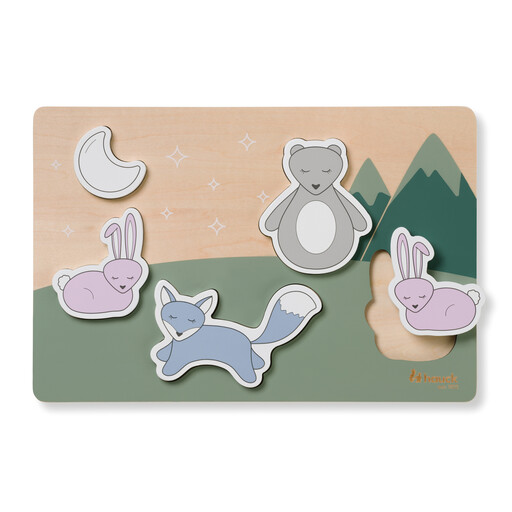
Why this product suits this profile: The simple inset design with animal pictures is intended for children aged 12 months and over. It needs no batteries or extra play materials.
The product information highlights rounded edges, FSC-certified wood and a clear age recommendation of 12 months and over.
30 × 20,5 × 2 cm, animal shapes, wooden knobs and a weight of 0,38 kg.
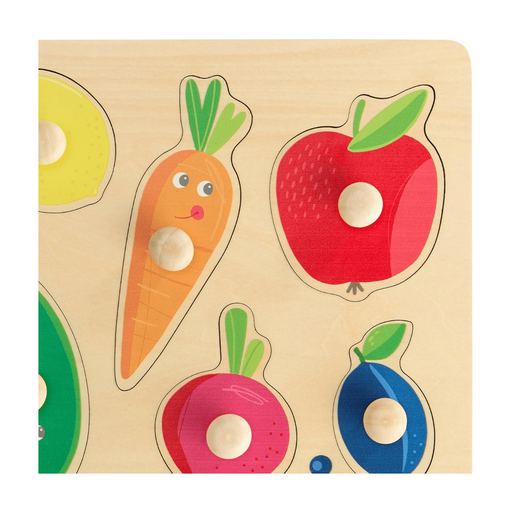
Why this product suits this profile: Large wooden knobs and pictures of fruit and colours combine an easy-to-grip design with simple matching activities.
The large knobs address the common difficulty of picking up small pieces. The care instructions recommend wiping the puzzle rather than soaking it.
Solid wood, a 30 × 21 cm puzzle board and an age recommendation of 12 months and over.
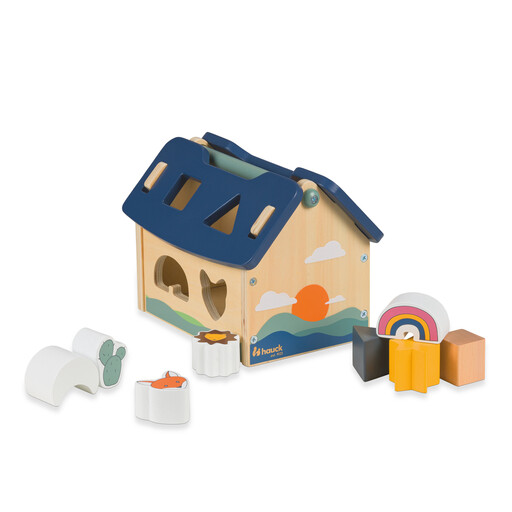
Why this product suits this profile: As well as slots for sorting shapes, this sorting house has built-in storage and can be carried by its handle.
Rather than focusing on just one picture, this product combines shapes, colours and built-in storage for the pieces. The small parts require supervision.
FSC-certified wood, eight building blocks, a removable roof and a carry handle.
We’ve put together a complete, regularly updated list of products that meet these strict selection criteria and the safety regulations in force in the EU.
Clean wooden pieces with a soft, dry cloth. If the manufacturer says you can use a slightly damp cloth, dry the surface straight afterwards. Avoid soaking the puzzle for long periods, storing it near a radiator or leaving it in direct sunlight.
It’s a good idea to give the puzzle a quick visual check before each use. Pay particular attention to knobs, edges, splinters and cracks. If the puzzle is damaged, remove it from the play area. Direct adult supervision is especially important for children under three, even if the product is recommended for ages 12 months and over.
For a child aged 12 months and over, simple peg and inset puzzles with a few large pieces are worth considering. Animal pictures, clear shapes and large knobs can make it easier to get started. Always follow the specific age recommendation and the manufacturer’s warnings.
Grasping, turning and fitting the pieces helps engage skills such as fine motor skills, hand-eye coordination and shape recognition. Naming colours, animals or objects together can also prompt conversation. However, you can’t assume that a puzzle will have a particular effect on a child’s development.
For beginners, a small number of clearly distinguishable pieces is usually easier to manage than a puzzle with lots of parts. As your child gains experience, you can choose puzzles with more complex shapes or more pieces. What matters is how easy the puzzle is to handle, your child’s attention span and their interest – not just the number of pieces printed on the box.