
Lieferung heute & morgen

Qualitätsgarantie

Willkommens-Angebote freischalten: KOSTENLOSE Lieferung | Bis zu 80 % RABATT | Kostenlose 30-Tage-JoyPlus-Testphase
App herunterladen
Wooden toys for children may seem straightforward at first glance: a natural look, sturdy shapes and often less electronics than plastic toys. Even so, products can differ considerably in terms of age suitability, craftsmanship, space requirements, cleaning and play value. Those who buy based solely on design or vague educational claims may end up with a toy that quickly loses its appeal or does not match the child’s developmental stage.
This guide is intended for parents, grandparents and anyone else looking for gifts in Germany. It explains what to look for in a wooden baby gym, a wooden puzzle for children aged 12 months and up, a wooden baby walker or a wooden play kitchen.
A toy labelled for ages 1 year and up is not automatically suitable for every baby. Small parts, cords, detachable accessories or electronic components may be unsuitable for younger children. Toys intended for children aged 3 and up often have different requirements for independent use.
The recommended age should therefore be considered alongside the child’s actual developmental stage. A wooden puzzle with large handles may be suitable for a child aged 12 months and up, while a DIY Bluetooth speaker kit should only be used by older children under supervision because of its small parts and functional edges.
Terms such as Montessori toy, wooden educational toy or fine-motor toy describe a play concept rather than a consistent quality standard. What matters are the specific product details:
A simple wooden puzzle can be more useful in everyday life than a large activity centre if it is used regularly and suits the child’s hand size.
Large wooden toys require sufficient floor space and a secure location. A wooden play kitchen over one metre high will not fit comfortably in every home and should be positioned so that it cannot tip over. Smooth, wipe-clean surfaces are particularly practical for baby toys. Electronic components, on the other hand, must not come into contact with water.
Pay attention to the stated age range, warning notices and the manufacturer’s information. In Germany, toys should meet, among other requirements, the standards of the Toy Safety Directive 2009/48/EC and carry a CE marking. The CE marking is not a quality seal, but a manufacturer’s declaration that the product complies with relevant EU requirements.
For wooden toys, references to EN 71 are also relevant. Check that edges are smoothly finished, parts are securely attached and there are no signs of damage, splinters or loose screws.
“Made of wood” does not necessarily mean that a product is made from solid wood. MDF, plywood and coated wood-based materials are also frequently used. This is not automatically a disadvantage, but it should be stated transparently.
Practical questions to ask:
For coated products, follow the specific material information and manufacturer’s instructions rather than relying on blanket claims about being free from harmful substances or environmentally friendly.
A wooden baby walker should be used on a level surface. Important features include a sturdy frame, easily accessible handles and wheels that will not slide away uncontrollably on the flooring available in your home. A wooden baby gym should likewise be placed on a flat, secure surface and used under supervision.
For large play kitchens, stability, assembly quality and the accessibility of the hob, sink and accessories matter just as much as the features included. After assembly, check screws, connections and moving parts regularly.
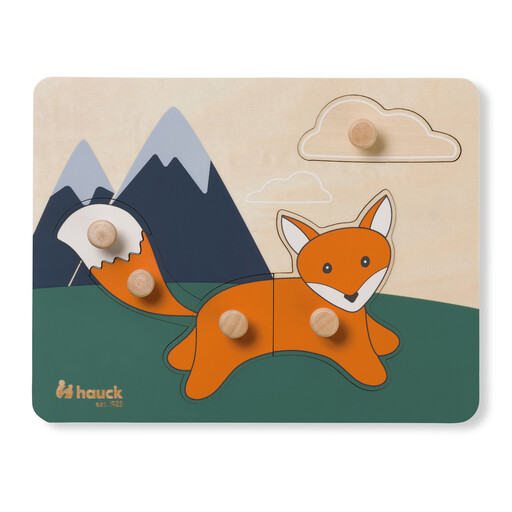
Why it suits this profile: A compact gift idea for smaller homes and for children aged 12 months and up. The puzzle measures 22 × 17 × 2 cm.
Large wooden handles make the pieces easier to pick up. The stated suitability for ages 12 months and up provides clearer guidance than general marketing claims.
FSC-certified wood according to the product information; rounded design and an animal theme with shape-matching pieces.
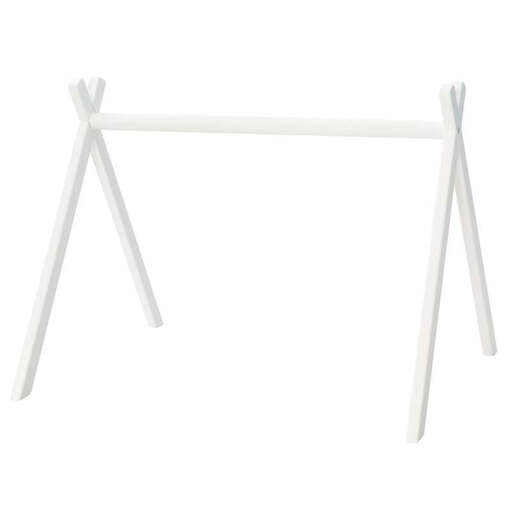
Why it suits this profile: Ideal for families looking for a cleanly designed wooden baby gym with an easy-care surface.
The dimensions of 52 × 70 × 50.5 cm make it easier to assess the space required before buying. The play arch must be used exclusively on a level surface and under supervision.
White-painted wood, wipe-clean surfaces and separately available play and grasping sets according to the product description.
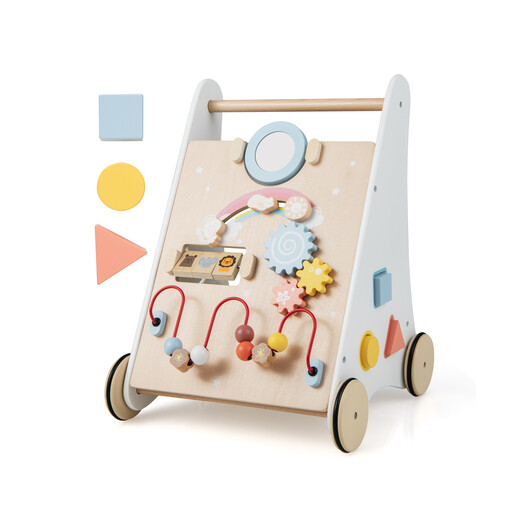
Why it suits this profile: For households that want one toy to support both walking practice and seated play.
The product information specifies a minimum age of 12 months, step-by-step assembly and rubberised wheels. Use should nevertheless be limited to suitable, level floors and supervised play.
Several integrated activities, a storage basket and dimensions of 34.5 × 32.5 × 45 cm according to the product details.
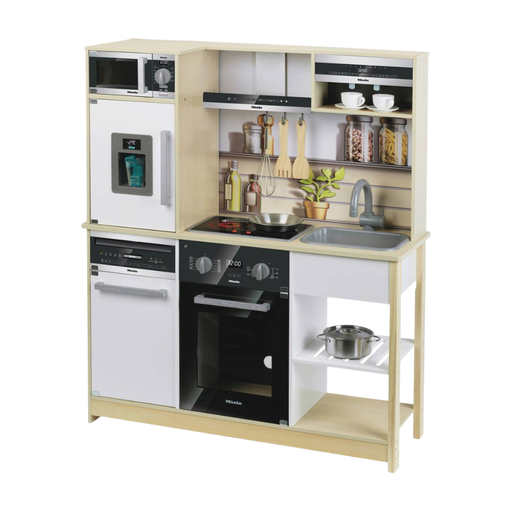
Why it suits this profile: A full-size wooden play kitchen for children aged 3 and up and households with sufficient floor space.
The product dimensions of 83.5 × 30 × 101 cm clearly show that this is a large model. Small parts and battery operation are mentioned in the warning and care instructions.
FSC-certified wood according to the product information, a removable sink and a hob with light and sound functions.
The category features an ever-changing selection of wooden gifts for newborns, along with further play ideas for different age groups.
For many children aged 12 months and up, large peg puzzles, simple sorting games and a sturdy wooden baby walker may be suitable. Look for large, easy-to-grasp elements, a clear age recommendation and appropriate warning notices. Use should match the child’s developmental stage and be supervised when necessary.
Lifespan depends on the materials, craftsmanship, frequency of use and care. Regular checks are more meaningful than blanket promises. Loose screws, damaged painted surfaces, splinters or faulty battery compartments should be inspected immediately. If the toy is damaged, it should not be used again until it can be repaired safely.
Purely wooden toys generally do not incur ongoing energy costs. Products with lights, sound or Bluetooth functions may require batteries. For example, the Theo Klein hob requires two AA batteries, which are not included according to the product information. With the DIY Bluetooth speaker kit, particular attention should be paid to the small components and supervised use.