
Lieferung heute & morgen

Qualitätsgarantie

Willkommens-Angebote freischalten: KOSTENLOSE Lieferung | Bis zu 80 % RABATT | Kostenlose 30-Tage-JoyPlus-Testphase
App herunterladen
A wooden wall shelf seems like a simple purchase. It’s meant to create storage, display decor, and bring life to empty walls. In practice, however, subtle flaws and exaggerated marketing claims often lead to disappointment. A shelf that sags after a few months, a surface that swells at the first contact with moisture, or mounting hardware unsuitable for your walls provides no real value.
This guide reveals the three most common pitfalls when buying a wooden shelf and explains which technical parameters you should look for to make a durable and functional choice.
To avoid the problems mentioned above, it is essential to check the following core features before purchasing. These define the quality, durability, and safety of your wall shelf.
The choice of material is fundamental. Pay attention to a precise product description:
The mounting system determines not only the appearance but also the stability. A floating wooden shelf creates a minimalist aesthetic with a concealed bracket. Here, it is crucial that the steel pins of the bracket are long and sturdy enough and can be firmly anchored in the wall.
Always check the specified maximum load capacity in kilograms. However, this figure is only valid if the installation is done correctly and with materials appropriate for the wall type. A good wall shelf set should ideally include different types of wall plugs or at least clear instructions on choosing the right mounting hardware. For an industrial look, an industrial wall shelf often combines wooden elements with visible metal brackets that offer a high and clearly defined load capacity.
The intended use dictates the requirements. A wall-mounted kitchen shelf must be easy to clean and resistant to moisture and grease. Here, sealed solid wood or even metal shelves can be a practical solution. A hanging wooden shelf used to display collectibles has different requirements for the depth and shape of the shelf board than a shelf for heavy coffee table books.
Instead of a one-size-fits-all recommendation, we present models here that offer a suitable solution for clearly defined user profiles and applications.
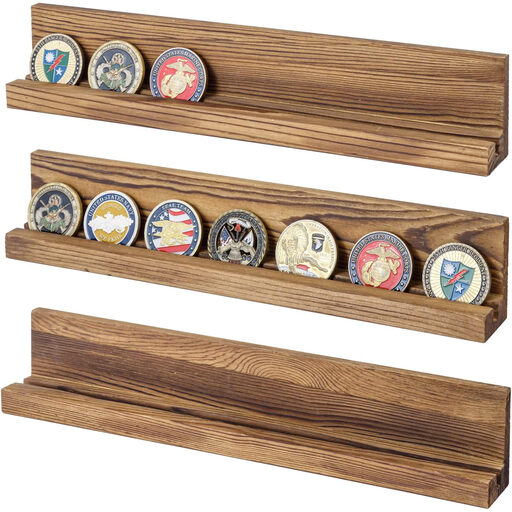
Why This Fits Their Persona: Ideal for those seeking a specialised solution for displaying challenge coins, minerals, or other small collectibles. The narrow, grooved ledge design is engineered specifically for this purpose.
According to the manufacturer, the shelf is made of solid wood, which avoids the trap of inferior material deception. The design is intended for lightweight objects, preventing false expectations about its load capacity.
Specialised grooved design ensures a secure hold for coins. Delivered as a set of 3, allowing for flexible and cohesive wall styling.
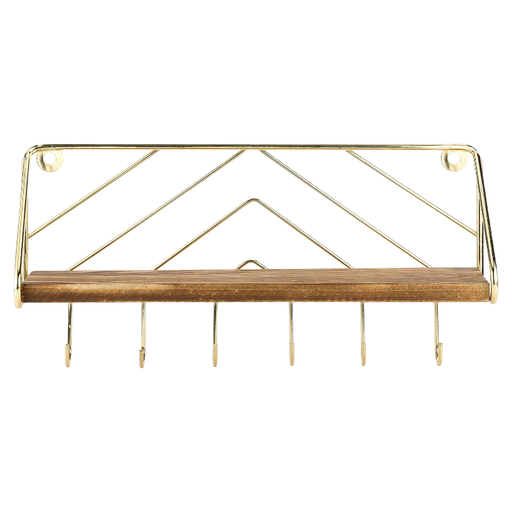
Why This Fits Their Persona: Perfect for those who need a compact solution in the hallway or entryway for keys, mail, and a smartphone. It combines a shelf and hooks in a minimal footprint.
The combination of solid wood and metal hooks offers a clearly defined function and sturdiness. The load from keys and mail is low and matches the construction, thus avoiding the problem of overloading.
Multifunctional 2-in-1 solution (shelf and key rack). Space-saving design, ideal for narrow hallways or small apartments.
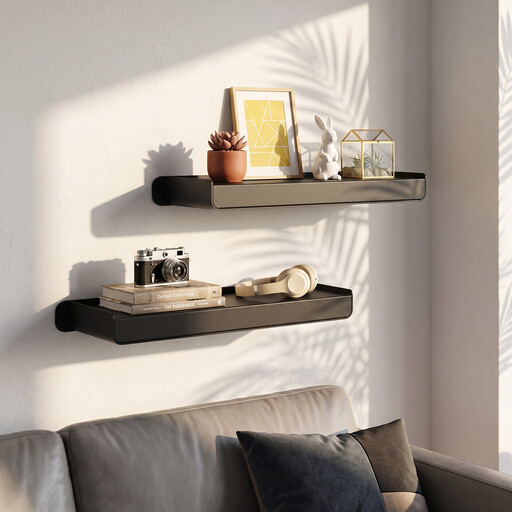
Why This Fits Their Persona: For users who want a minimalist, modern design and a material that will last in a bathroom or kitchen. An alternative to wood with clear technical advantages.
The material is aluminium and is waterproof and rust-resistant, according to the manufacturer. This completely bypasses the pitfall of poor surface treatment that affects wood in humid areas. The specified load capacity of up to 20 kg is a clear performance metric.
Winner of the German Design Award 2022. High load capacity and explicitly suitable for humid environments. Rubber bumpers on the back protect the wall.
We have compiled a complete, up-to-date list of products that fully meet these strict selection criteria and safety requirements.
Standard wall plugs are unsuitable for mounting on drywall. Instead, use special hollow-wall anchors (e.g., metal or plastic toggle anchors). Check the weight rating of the anchor and ensure that, combined with the shelf's load limit, it is sufficient for the intended weight. Ideally, installation should be done where the wall studs (the metal or wood sub-structure) are located.
For a wall shelf intended to hold heavy books, hardwoods like oak, beech, or acacia are an excellent choice due to their high density and resistance to bending. A more affordable but still sturdy option is solid pine, provided the board thickness is sufficient (at least 18-20 mm) and the distance between the brackets is not too wide, to prevent sagging. Particleboard or MDF is not recommended for heavy loads over long periods.