
Lieferung heute & morgen

Qualitätsgarantie

Willkommens-Angebote freischalten: KOSTENLOSE Lieferung | Bis zu 80 % RABATT | Kostenlose 30-Tage-JoyPlus-Testphase
App herunterladen
A wooden chopping board may seem straightforward at first: compare the material, dimensions and price, place your order and you’re done. In practice, however, a few details can quickly make a kitchen board impractical. A board that is too thin may slip on the worktop, while the absence of a juice groove can allow liquid to run onto the kitchen work surface. Incorrect care can also encourage warping.
This buying guide explains what home cooks, families and frequent users should look out for when buying. The selection ranges from compact wooden chopping boards to large butcher’s blocks that can also be used as serving boards.
A large chopping board offers more space for vegetables, bread or meat. However, it is not just the length and width that matter — material thickness is also important. With larger formats, a thicker board provides greater stability. Models around 18 to 26 mm thick are structurally more stable for many everyday preparation tasks than very thin boards.
Terms such as “robust”, “hygienic” or “gentle on knives” should not be assessed in isolation. Verifiable details are more informative:
A description such as “100% bamboo” identifies the material, but on its own says nothing about the precise construction or whether the board is suitable for the dishwasher.
Wood and bamboo require more attention than plastic. According to the product information, most models in this selection are not dishwasher-safe. Prolonged soaking, intense heat and storing the board while damp can encourage cracks or warping. If you are looking for a maintenance-free kitchen board, you should take this limitation into account before buying.
A bamboo chopping board is made from a fast-growing plant-based material and is often chosen for its firm surface. Bamboo is generally dense and moisture-resistant, although its actual durability also depends on the processing and construction. Product descriptions such as “solid”, “made from one piece” or “cross-laminated core” provide clues about how the board is made.
Traditional woods also differ in their characteristics:
Regardless of the material, the surface should be smooth, free from splinters and intended for contact with food.
For small work surfaces, a format of around 30 × 20 cm may be suitable. A large chopping board measuring 40 to 50 cm in length, on the other hand, provides more space for several ingredients, dough or larger loaves of bread. Before buying, check that the board will sit fully on the worktop and fit in your sink or cupboard.
Thickness affects both weight and stability. A 26 mm-thick model is generally more stable, but also heavier to move. Thinner boards are lighter and take up less space. A sturdy construction is recommended for regular chopping and preparing large quantities; for occasional chopping, a more compact format is often sufficient.
A chopping board with a juice groove is practical when cutting juicy foods or carving meat. The groove holds liquid near the edge, but it does not replace thorough cleaning afterwards.
A chopping board with a handle is easier to carry from the worktop to the sink or table. When using it as a serving board, the handle should be easy to grip and should not take up too much usable surface area. A reversible design can help separate areas for different foods. Wherever possible, separate boards or clearly separated sides should be used for raw animal products and ready-to-eat ingredients.
The manufacturer’s instructions take priority. However, the following basic rules apply to many wooden and bamboo boards:
A wooden board is not a permanently maintenance-free product. Regular drying and suitable storage are essential parts of using one.
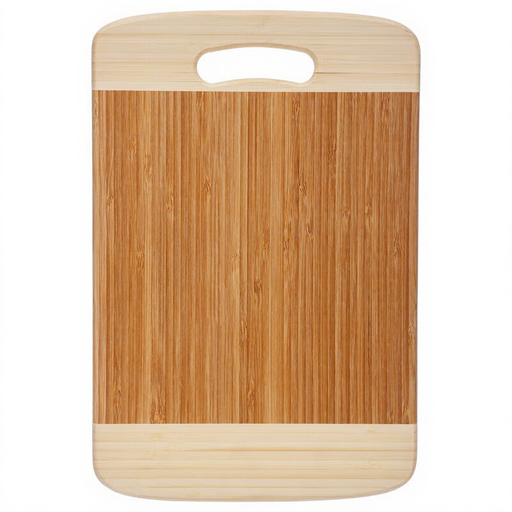
Why this product suits this profile: The compact bamboo board takes up little space and has an integrated handle. It is suitable for smaller kitchens, quick preparation tasks and carrying to the table.
The dimensions and material are clearly specified. The handle makes it easier to use, while the hand-wash-only requirement sets clear expectations for care.
30 × 20 cm, integrated handle, bamboo construction and easy hand cleaning.

Why this product suits this profile: The generous format provides plenty of room for extensive preparation. A juice groove and reversible construction broaden its uses in the kitchen.
The product details explicitly state the dimensions, material, juice groove and care requirements. This makes it easier to match the board to your worktop and cooking routine.
45 × 30 cm, juice groove, reversible use and suitability as a serving board according to the product description.

Why this product suits this profile: Three sizes support different tasks: chopping vegetables, preparing meat, or serving cheese and bread. Handles and juice grooves are practical when switching between tasks frequently.
The set reduces the need to prepare raw and ready-to-eat foods on the same surface. However, the hand-wash instruction must still be followed.
Three sizes, integrated juice grooves, handles and a cross-laminated construction according to the product description.
We have put together a complete, regularly updated list of products that fully meet these strict selection criteria and the safety regulations applicable in the EU.
A wooden or bamboo board can be suitable for food preparation when cleaned correctly. After every use, it should be cleaned with warm water and mild washing-up liquid, then dried thoroughly. Claims such as “antibacterial” should be assessed on a product-by-product basis and do not replace good kitchen hygiene. A separate board is recommended for raw animal products.
Its service life depends on the material, thickness, use and care. Deep cuts, cracks, splinters or permanent warping indicate that the board needs to be replaced. If you do not soak the board, put it in the dishwasher or treat it regularly with a suitable conditioning oil, you can help preserve the surface for longer.
For meat, a surface that is easy to clean and offers sufficient working space is a sensible choice; a juice groove can collect liquids. Bread and cheese can often be prepared and arranged on a separate serving board. A set with several sizes offers practical separation, while a large, sturdy butcher’s block is suitable for extensive preparation tasks.