
Lieferung heute & morgen

Qualitätsgarantie

Willkommens-Angebote freischalten: KOSTENLOSE Lieferung | Bis zu 80 % RABATT | Kostenlose 30-Tage-JoyPlus-Testphase
App herunterladen
A well-chosen children's bookshelf not only creates order but also fosters your child's independence. However, the market can be overwhelming, and many products fail to live up to their promises. As a Joybuy Product Recommendation Officer, I'll help you identify the crucial features and avoid typical traps, ensuring you make a safe and long-lasting choice for your child's room.
Many shelves look appealing at first glance but reveal their weaknesses only in daily use. Pay attention to these three points to avoid disappointment:
To find a suitable and safe bookshelf for the children's room, you should check three central aspects. These form the basis for good toy storage and a functional bookshelf in the nursery.
Safety is the top priority. An indispensable feature is an anti-tip kit that securely anchors the shelf to the wall. This hardware is included with most high-quality models.
Also, pay close attention to the material specifications. E1-grade MDF boards are an established standard in Europe that guarantees low formaldehyde emissions. Rounded corners and edges minimise the risk of injury during play.
The functionality of a children's bookshelf is measured by how well a child can use it independently.
A wooden children's bookshelf is a popular choice. However, there are differences: solid wood is very robust, while high-quality MDF or particleboard with a melamine resin coating offers a low-maintenance and durable surface. This coating protects the shelf from scratches and moisture and is easy to clean—an important factor in the chaotic reality of life with kids.
Instead of making a one-size-fits-all recommendation, we have identified models tailored to specific needs and living situations.
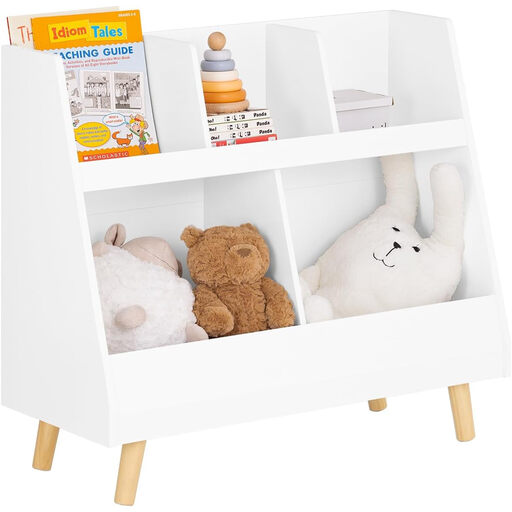
Why it's a great fit: Ideal for parents looking for a solid, functional starter piece without compromising on safety. It provides a clear structure for books and toys at an accessible price point.
The child-friendly height of 78 cm and the open compartments prevent the problem of inaccessibility. According to the manufacturer, all edges are rounded to minimise the risk of injury.
Combination of book and toy compartments. Made from MDF (E1) with sturdy legs made of solid pine wood.
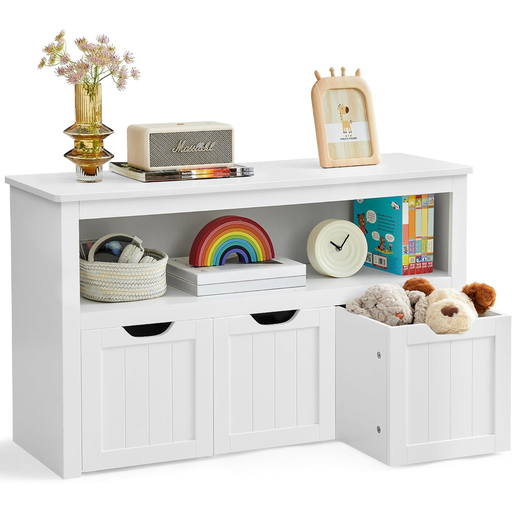
Why it's a great fit: Perfect for families who need a flexible solution for books and a large amount of toys. The removable bins on casters turn cleanup into an interactive game.
The low height of 60 cm is ideal for toddlers. The mobile bins solve the problem of impractical, deep compartments, as the contents are easily accessible. An anti-tip kit for wall mounting is included, according to the manufacturer.
Three removable storage bins with casters. Additional top shelf space and an open compartment.
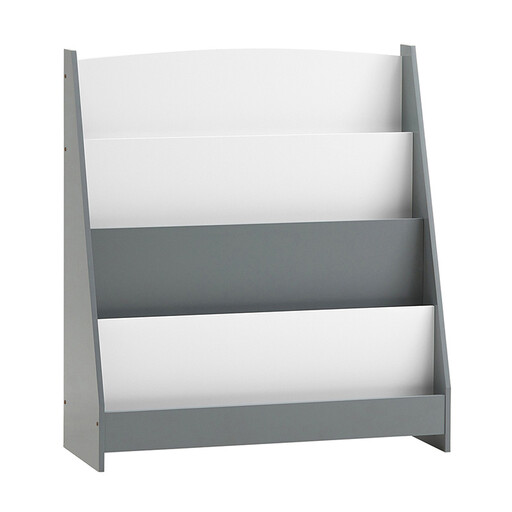
Why it's a great fit: This shelf is strictly designed around the principles of Montessori education. Books are displayed with their covers facing forward, encouraging children to independently discover and read.
The 88 cm height and forward-facing shelves are perfectly tailored to the needs of young children, solving the problem of inaccessibility. It features rounded corners and an anti-tip kit.
Four tiers for front-facing book display. Made from solid E1-grade MDF boards for long-term use.
We have compiled a complete, up-to-date list of products that fully meet these strict selection criteria and safety standards.
The ideal height depends on your child's age and size. For toddlers (1-3 years), shelves up to about 80 cm high are well-suited. For preschool-aged children (3-6 years), the shelf can be up to 120 cm high. The key is that the child can comfortably and safely reach the top shelf while standing, without needing to climb.
Any shelf that is taller than it is wide should be secured to the wall. Always use the provided anti-tip kit. This usually consists of a bracket or a strap that is screwed to the shelf and the wall. Choose anchors and screws that are appropriate for your wall type (e.g., concrete, drywall). The manufacturer's assembly instructions will provide specific guidance.
MDF stands for "Medium-Density Fibreboard." The E1 class is a European standard that limits the emission of formaldehyde, a binding agent used in the wood composite. Products with this label release only very small amounts into the indoor air and are considered safe for use in living spaces and children's rooms.