
Lieferung heute & morgen

Qualitätsgarantie

Willkommens-Angebote freischalten: KOSTENLOSE Lieferung | Bis zu 80 % RABATT | Kostenlose 30-Tage-JoyPlus-Testphase
App herunterladen
A WORKPRO clamp set can save time when gluing, aligning and securing workpieces. But your choice shouldn’t be based solely on the number of clamps in a set or its marketing claims. For DIY enthusiasts, carpenters, model makers and mechanics, the key factors are clamping capacity, clamping force, materials and ease of use.
A wide opening doesn’t automatically mean a clamp is right for every job. What matters is whether the maximum opening suits the thickness of the material and whether the clamp remains stable at that extension. For small craft projects, compact one-handed clamps are often more practical than a long model. For wider boards, you’ll need an F-clamp set or a screw clamp of a suitable length.
A high stated clamping force can be useful for assembly and woodworking. However, overtightening a clamp can leave pressure marks on delicate surfaces. Protective caps, soft pads and careful operation are just as important as the stated force in kilograms.
Also check whether you can adjust the clamping force precisely. A quick-release mechanism makes positioning easier, but you’ll still need to tighten the clamp carefully.
Plastic bodies can reduce weight, while steel bars offer greater rigidity. For screw clamps, the combination of steel, thread and contact surface is particularly important. Check which sizes are actually included, too. A set of several small clamps won’t necessarily be suitable for large workpieces.
For DIY clamping tools, moving parts should also operate smoothly, handles should feel secure in your hand, and the pads should avoid damaging the workpiece wherever possible.
Clamping capacity describes how wide the jaws open. The throat depth is the distance from the clamping surface to the edge of the guide rail or body. Both measurements matter for woodworking:
One example is the WORKPRO Ratchet Bar Clamp, with a stated clamping capacity of 305 mm, a spreading capacity of 440 mm and a throat depth of 60 mm.
The manufacturer’s stated clamping force is a guide and shouldn’t be exceeded. When working with delicate wood, veneered surfaces or painted components, use protective pads and increase the pressure gradually.
The WORKPRO Screw Clamps Set of 4 is specified with a clamping force of 272 kg and a throat depth of 80 mm. The set includes two clamps with a 150 mm capacity and two with a 300 mm capacity. The quick-adjustment button can make initial positioning easier; final tightening is done using the screw mechanism.
Hardened or heat-treated steel bars can offer greater resistance to bending and wear. Reinforced nylon bodies, on the other hand, reduce weight. Soft TPU or plastic pads can help prevent visible pressure marks, but they need to be kept clean and in good condition.
For regular jobs, one-handed clamps and quick-release clamps are handy. If you glue up workpieces regularly, look for a stable guide rail, a reliable locking mechanism and release buttons that are easy to reach.
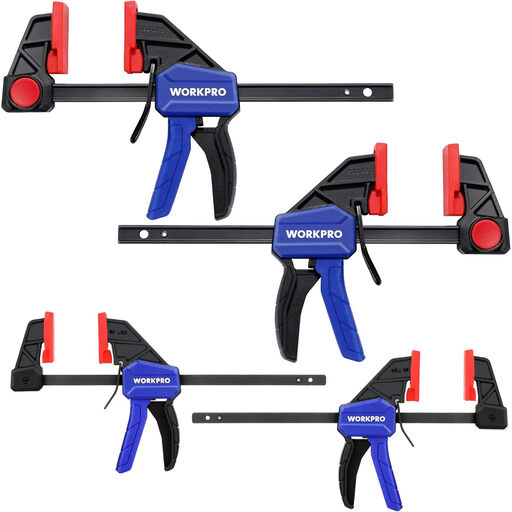
Why this product suits this user: Two sizes and one-handed operation make this set suitable for smaller woodworking jobs, craft projects and occasional repairs.
The different clamping capacities avoid the limitations of a set containing only small or only large clamps.
Four clamps, reinforced nylon bodies, heat-treated steel bars and separate release buttons.
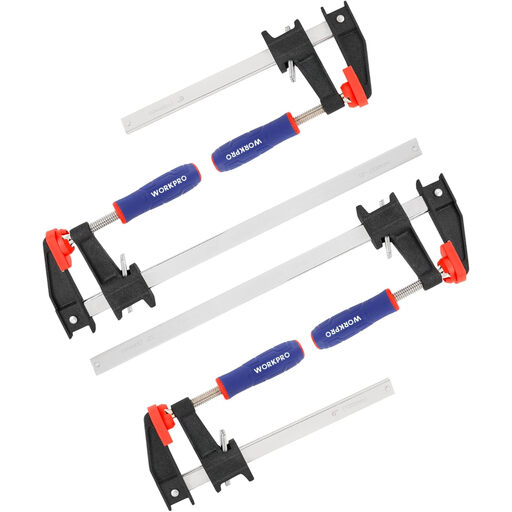
Why this product suits this user: With two clamping capacities and a screw mechanism, this set is designed for controlled clamping in woodworking and metalworking projects.
The stated dimensions, 80 mm throat depth and protective caps make it easier to assess suitability than a marketing claim about clamping force alone.
Nickel-plated alloy steel, quick adjustment and a stated clamping force of 272 kg.
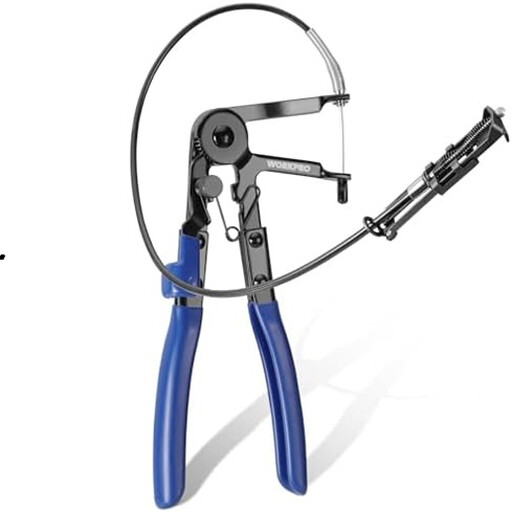
Why this product suits this user: For mechanics and maintenance work in hard-to-reach places, these flexible hose clamp pliers are a specialist addition to conventional clamps.
This isn’t a general-purpose screw clamp. It’s designed for spring hose clamps with a stated opening range of 10 to 50 mm.
67 cm flexible shaft, locking function and PVC-coated handle for working on fuel, oil and coolant hoses.
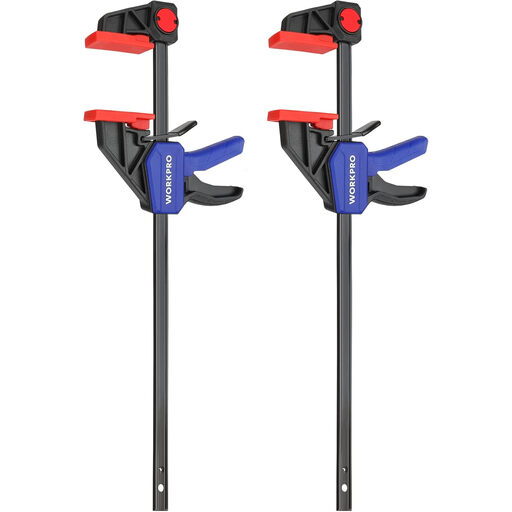
Why this product suits this user: Its convertible design is a good fit for anyone who wants to clamp and spread when gluing workpieces.
Its dual function as a clamp and spreader is clearly described in the design, rather than inferred from a general set name.
305 mm clamping capacity, 440 mm spreading capacity, 60 mm throat depth and quick-release button.
We’ve put together a complete, regularly updated list of products that meet these strict selection criteria and the safety regulations in force in the EU.
For light to medium woodworking jobs, one-handed clamps with a quick-release function are handy. For gluing larger boards, consider longer F-clamps or screw clamps with sufficient clamping capacity and throat depth. Use protective pads on delicate surfaces.
Not entirely. Clamps press two workpieces together, while spreader clamps hold components apart or position them in an opening. A convertible model can do both, provided its clamping and spreading capacities suit the job.
Lifespan depends on how heavily they’re used, how they’re stored and how well they’re maintained. Don’t exceed the stated clamping force, avoid twisting the clamp out of alignment, and keep steel bars and moving mechanisms clean and dry. Corrosion, damaged pads or a stiff release mechanism are signs that you should check the tool before using it again.