
Lieferung heute & morgen

Qualitätsgarantie

Willkommens-Angebote freischalten: KOSTENLOSE Lieferung | Bis zu 80 % RABATT | Kostenlose 30-Tage-JoyPlus-Testphase
App herunterladen
A WORKPRO tool set can replace several individual purchases for woodworking, assembly, repairs or plumbing work. However, the number of tools included is not the only deciding factor. The sizes, clamping force, materials and actual contents determine whether the set is suitable for your project.
As a Joybuy Product Recommendation Officer, I therefore assess the information using clear, verifiable criteria. This helps avoid common disappointing purchases where a tool is advertised as versatile but is too small, too weak or impractical for the job in hand.
A large opening width does not automatically mean that a clamp can securely hold a workpiece with high force. A compact one-handed clamp is often sufficient for small strips. When gluing wide panels or securing heavier components, however, you should consider clamping capacity, throat depth and stated clamping force together.
The product description of a WORKPRO clamp set should be checked carefully. The number and sizes of the clamps included may be more important than an attractive set price. For the WORKPRO 305 mm Ratchet Bar Clamp Set, the product title states a 2-pack, while the detailed information lists “1 x Clamp” as an included component. Before buying, it is therefore advisable to compare the title, product details and images.
Metal clamping surfaces can damage wood, plastic or painted surfaces. Soft, non-marking protective pads reduce this risk, but they do not replace careful positioning. A quick-release mechanism must also be easy to reach if you need to make frequent adjustments. One-handed clamps are convenient to operate with one hand, but the stated load limit must not be exceeded.
Clamping capacity describes how far the jaws can open at most. The throat depth indicates how far the jaws reach from the edge of the workpiece towards its centre. For narrow frames, 120 to 150 mm may be sufficient; for larger wooden joints, 300 mm or more is useful.
A spreader clamp works in the opposite direction: its jaws push a workpiece apart. The WORKPRO 305 mm Ratchet Bar Clamp is specified as offering up to 305 mm of clamping width and up to 440 mm of spreading width. Conversion is carried out by loosening the wing nut and repositioning the fixed jaw.
The stated clamping force is a technical guideline under the intended conditions. A WORKPRO screw clamp set with a stated clamping force of 272 kg is designed for sturdy securing work. This figure should not be taken as an invitation to tighten the clamp as far as possible: excessive pressure can dent wood, damage surfaces or put strain on the mechanism.
For lighter F-clamps, for example, 23 kg is specified for the 120 mm version and 68 kg for the 150 mm version. Protective caps and even positioning are particularly important when working with delicate materials.
For pliers and clamps, material specifications such as hardened steel, alloy steel or Cr-V steel are important points of comparison. A water pump plier made from chrome vanadium steel is designed for gripping and turning tasks. However, it is not a substitute for a suitable open-ended or ring spanner when loosening delicate threaded connections without causing damage.
A push-button or quick-adjustment mechanism makes it easier to adapt the tool to different workpiece sizes. An adjustable pair of pliers should specify its maximum opening. According to the product data, the WORKPRO model measuring 305 mm in length opens up to 50 mm.
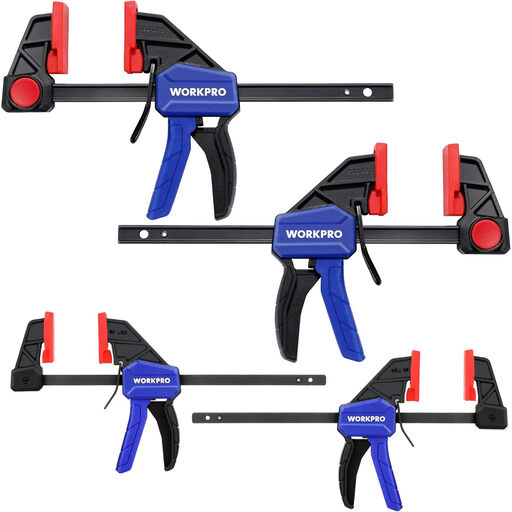
Why this product suits this profile: Four compact clamps cover smaller woodworking jobs, craft projects and straightforward assembly tasks. One-handed operation makes quick securing easier.
The two sizes and stated load ratings make the limits of use clearer than advertising based solely on the number of pieces.
2 x 120 mm, 2 x 150 mm; stated clamping force of 23 and 68 kg respectively; TPU pads.
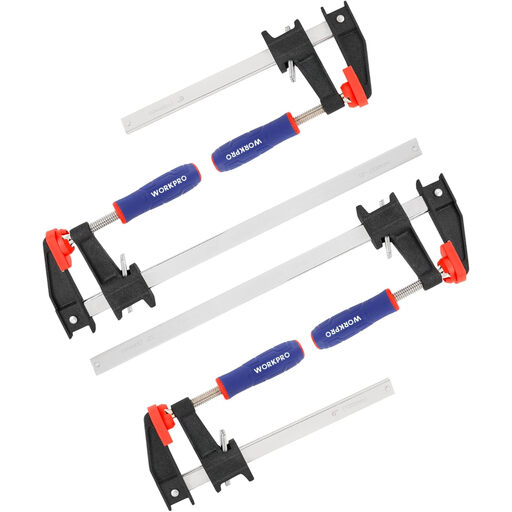
Why this product suits this profile: The combination of two sizes is suitable for precise wooden joints, repairs and fabrication work involving workpieces of different widths.
The product data specifies the clamping capacity, 80 mm throat depth and 272 kg clamping force. Protective caps help reduce pressure marks.
2 x 150 mm and 2 x 300 mm; nickel-plated alloy steel; push-button quick adjustment.
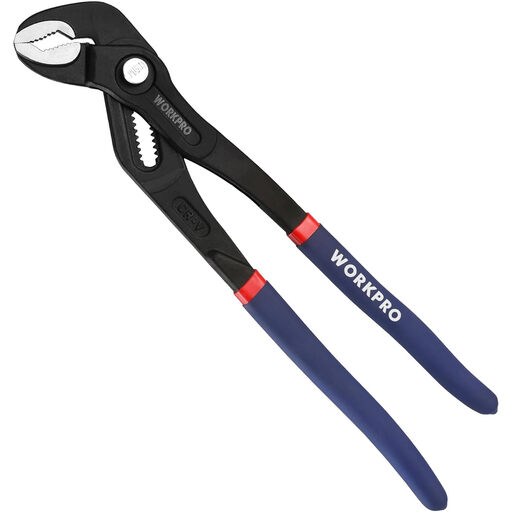
Why this product suits this profile: For plumbing, pipe fitting and general maintenance, the longer design provides extra leverage and an opening of up to 50 mm.
The maximum opening and 305 mm length are clearly specified. This makes it easier to compare the intended applications with pipe and workpiece dimensions before buying.
Cr-V steel; push-button adjustment; serrated gripping surfaces; maximum opening 50 mm.
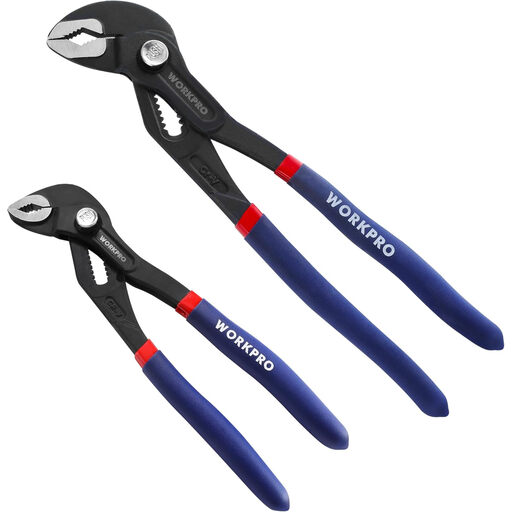
Why this product suits this profile: Two lengths cover smaller and larger gripping jobs. This is practical for toolboxes, workshops and a range of repair tasks.
The two maximum openings of 33 mm and 43 mm clearly show the workpiece sizes these pliers are designed for.
180 mm and 250 mm pliers; Cr-V steel; push-button adjustment; non-slip handles.
We have put together a complete, regularly updated list of products that fully meet these strict selection criteria and the safety regulations applicable in the EU.
Before applying any load, the clamping jaws should sit parallel and securely against the workpiece. When working with wood, it is advisable to use a layer of suitable protective material if the existing pads do not provide sufficient protection. Clamps should not be used as levers, as supports for suspended loads or as a substitute for securing a workbench.
For care, you will usually only need to:
With pliers, it is also important to position the gripping surfaces according to the shape of the workpiece. Water pump pliers are suitable for round, flat, square and hexagonal shapes, but their serrated jaws can mark delicate surfaces.
For smaller workpieces, compact F-clamps with 120 or 150 mm capacities are a sensible choice. For larger glue-ups, 300 mm screw clamps or a convertible clamp with a 305 mm clamping capacity are suitable options. Throat depth, protective pads and the required clamping force are also important.
One-handed clamps can be positioned and operated quickly using a handle or trigger. Screw clamps typically use a spindle and allow the pressure to be increased in a controlled way. One-handed clamps are convenient when frequent adjustments are needed; for more demanding securing work, you should compare the specific load ratings.
No. The length of 305 mm and maximum opening of 50 mm describe the possible working range, but they do not replace checking the pipe diameter, accessibility and surface sensitivity. Suitable protection should be used with visible or coated components.