What should you look for when buying?
Workshop cleaning
A good fit if: You mainly want to remove settled shavings and permitted types of dirt from the floor and workbench.
Bear in mind: Cleaning up afterwards won’t automatically capture the dust created while you’re working.
Extraction at the tool
A good fit if: You regularly use connected power tools and want to capture dust as close to its source as possible.
Bear in mind: The connection, hose and automatic start control must suit the specific tool and its power supply.
Classified dust extractor
A good fit if: The appliance’s dust class and workplace use are key for more demanding or commercial work.
Bear in mind: An appliance’s dust class doesn’t replace checking the requirements of the specific workplace.
The following overview is for consumers in Germany planning regular DIY woodworking. Potential future commercial use may also affect your choice.
| What you need |
What to check before buying |
Who should consider this? |
| Capture dust while working |
Intended use, tool connection and suitable automatic start control |
If you want to capture dust directly when sawing, routing or sanding, extraction at source matters more than cleaning up afterwards. Around 33% of consumers rank this as their top priority. |
| Connection and automatic start control |
Connection dimensions, included adaptor and the permitted load for an appliance socket |
If you frequently change tools, you’ll want a connection that fits your equipment and is easy to use. Around 27% of consumers prioritise this convenience. |
| Collect shavings and plan for maintenance |
Included nozzles, hose and cable length, and type of filter cleaning |
If you regularly clean your workbench and floor, the reach should suit your workspace and filter care should fit your routine. About 20% of consumers prioritise their cleaning routine. |
| Check the appliance’s dust class |
Dust class of the exact model variant, intended use and workplace requirements |
If you need a classified solution for more demanding work or planned commercial use, check the complete appliance rather than just the filter specification. Around 20% of consumers prioritise this evidence of protection. |
An appliance socket or a mechanically compatible adaptor does not, by itself, prove compatibility with every tool or confirm a suitable dust classification. For commercial woodworking, the BGHM specifies M-class dust extractors for hand-held woodworking machines. You should also check the requirements of the specific workplace.
Joybuy products for workshops and tool connection
The following wet and dry vacuums are described for workshop cleaning and use with a connected power tool. Before use, check that the connection and intended use are suitable for your tool.
 No image available
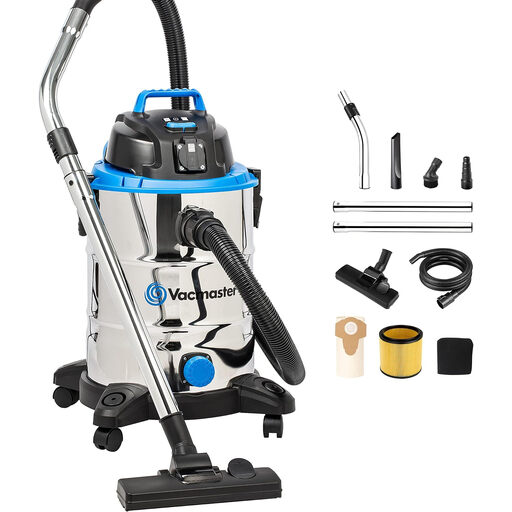
Vacmaster VQ1530SFDC 1500W 30L
For workshop tasks when you’re looking for a wet and dry vacuum with an integrated socket for a connected power tool.
The product description specifies: 1500 W, 30 l, a 240-V EU socket, a dry dust filter and a foam filter for wet vacuuming.
The description excludes hazardous substances and potentially explosive environments. Don’t use the appliance for unknown dust from older building materials; assess the required appliance dust class and tool connection separately before use.
View at Joybuy
 No image available
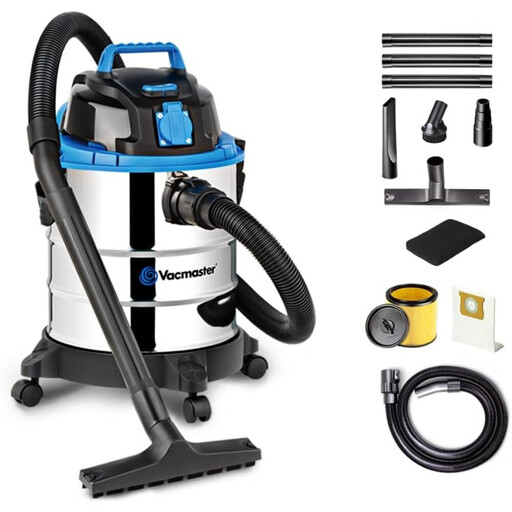
Vacmaster VQ1220SC 1250W 20L
For regular workshop tasks when the included adaptor, as described, is compatible with your power tool.
The product description specifies: 1250 W, 20 l, wet and dry operation, a tool adaptor and filters for wet and dry use.
The description excludes hazardous substances and potentially explosive environments. Don’t use the appliance for unknown dust from older building materials; assess the required appliance dust class and tool connection separately before use.
View at Joybuy
Frequently asked questions
Does a vacuum for DIY use always need to be Class M?
The workplace health and safety sources referenced here don’t establish a blanket Class M requirement for every purely private DIY use. Health and safety at work legislation concerns the protection of employees, but that doesn’t mean an unclassified vacuum can be assumed to be safe.
What’s different about commercial woodworking?
Workplace requirements determine what’s needed for commercial woodworking. The BGHM specifies M-class dust extractors for hand-held woodworking machines and M-class appliances for cleaning. Effectiveness checks are also part of workplace protection arrangements; buying an appliance alone doesn’t meet these requirements.
Can I simply connect a stationary saw to a small vacuum?
Check the machine’s extraction requirements rather than relying only on whether a reducer fits mechanically. Hose connections and available airflow are separate considerations. For commercial stationary woodworking machines, take into account the requirements explained by the BGHM.
Will an automatic socket also start a cordless tool?
An automatic socket doesn’t power a cordless tool. For the Kärcher WD 6 Control P S 30/6/35/T, the manufacturer describes a vibration-controlled wireless solution; Festool specifies compatible Bluetooth battery packs or a remote control. Features depend on the specific model and system.
Can I vacuum up water straight after wood dust?
Follow the wet-use instructions for the specific model. A special wet filter is required for the Festool CTM MIDI I, so the term ‘wet and dry vacuum’ doesn’t automatically mean you can switch between modes without preparing the appliance.


