
Lieferung heute & morgen

Qualitätsgarantie

Willkommens-Angebote freischalten: KOSTENLOSE Lieferung | Bis zu 80 % RABATT | Kostenlose 30-Tage-JoyPlus-Testphase
App herunterladen
As a Joybuy Product Recommendation Officer, I see it every day: travellers focusing on the wrong features and ending up with useless tech. An unsuitable travel adapter can cause more than just inconvenience—it can damage your devices or pose a safety risk. So, before you invest your money, let's shed light on the three most common pitfalls to avoid.
To avoid making the wrong choice, you should focus on objective, technical parameters rather than marketing promises. Three factors here are non-negotiable.
The total power output, measured in watts (W), determines how fast you can charge your devices and which ones you can charge. A modern smartphone often needs 20W or more for fast charging. A tablet benefits from 30W, while many laptops require at least 45W to 65W. Look for support for fast-charging protocols like Power Delivery (PD), which is primarily used in USB-C fast chargers and enables smart, rapid power transfer. An adapter that powers multiple devices simultaneously must have a correspondingly high total output that is distributed among the individual ports.
A modern power adapter with USB should offer a mix of USB-A and USB-C ports to accommodate both older and newer devices. A more recent development is GaN (Gallium Nitride) technology. GaN semiconductors make it possible to build chargers that are smaller, lighter, and more energy-efficient than traditional silicon-based models with the same power output. They also generate less waste heat, which increases operational safety.
A true international power adapter should cover clearly defined plug types for major travel regions (EU, UK, US, AUS). In Germany and large parts of Europe, the Type F (Schuko) plug is standard. For operation in the EU, the CE marking is essential. It signals that the product meets the applicable EU requirements for safety, health, and environmental protection. Additional features like a child safety lock or the use of fire-retardant PC (Polycarbonate) material are further indicators of a well-designed product.
Instead of making a one-size-fits-all recommendation, we have identified products that are precisely tailored to different use cases.
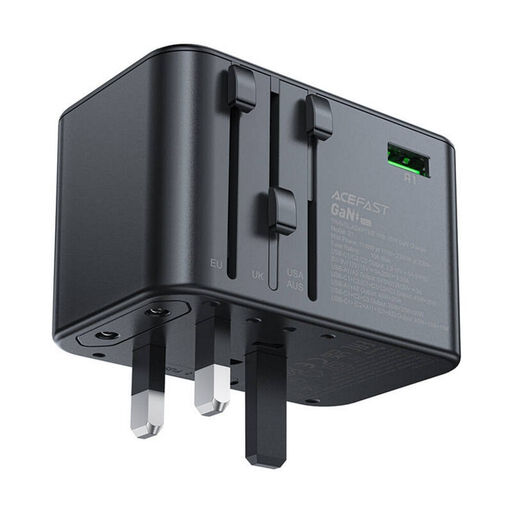
Why This Fits Their Persona: Ideal for users who need to charge their laptop, smartphone, and other devices simultaneously at maximum speed. The high power output and port variety make separate chargers redundant.
Thanks to 75W GaN technology, this model bypasses the 'universal' trap by providing sufficient power for demanding devices like laptops, instead of just offering a mechanical fit.
High total output of 75W; 3 USB-C and 2 USB-A ports; integrated plugs for EU, UK, US, AUS.
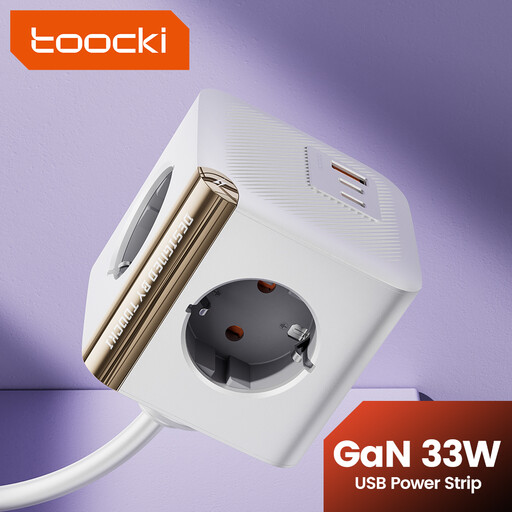
Why This Fits Their Persona: Perfect for the home office, a student dorm, or a temporary workspace while travelling. This power strip transforms a single wall outlet into a versatile charging station.
This product fundamentally solves the 'outlet-blocking' problem by turning one port into four AC outlets and multiple USB ports without obstructing adjacent sockets.
Combines 4 AC outlets with 33W PD fast-charging ports; integrated surge protection for added device safety.
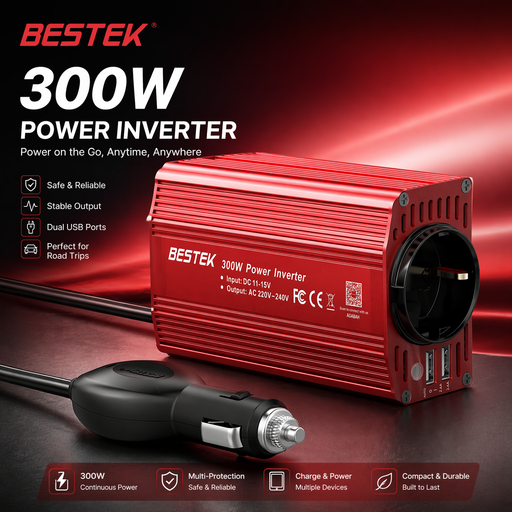
Why This Fits Their Persona: For anyone who doesn't want to go without 230V power for laptops, coolers, or other small appliances while on the road or camping. This power inverter is a mobile power outlet.
This is a specialised power inverter, not a simple adapter. It solves the problem of running 230V devices from a 12V source—a task at which any standard travel adapter would fail.
Converts 12V DC power to 230V AC power; delivers up to 300W of power for one AC outlet and two USB ports.
We have compiled a complete, real-time updated list of products that fully meet these strict selection criteria and comply with essential safety regulations.
A travel adapter only changes the physical shape of the plug to fit a different outlet. It does not change the electrical voltage. A voltage converter, on the other hand, converts the voltage (e.g., from 110V in the US to 230V in Germany). Most modern power supplies for laptops, cameras, and smartphones are multi-voltage (identifiable by the "INPUT: 100-240V" label) and therefore only require an adapter. Simple electrical devices like hair dryers or shavers are often not multi-voltage and require a voltage converter if they are to be used in a country with a different mains voltage.
GaN stands for Gallium Nitride, a semiconductor material that is increasingly replacing silicon in modern power supplies. A travel charger with GaN technology can be built to be significantly more compact and lightweight for the same power output. It operates more efficiently, converting more energy into charging current instead of heat, and therefore stays cooler during operation. This increases both the lifespan of the charger and its safety.
Look for several features. The most important for use in Europe is the CE marking, which confirms that the product complies with EU safety standards. Also, check the material specifications: high-quality adapters use fire-retardant PC (Polycarbonate) material. Other positive features include integrated fuses for overload protection and a child safety shutter, which prevents objects from being inserted into the live contacts.