
Lieferung heute & morgen

Qualitätsgarantie

Willkommens-Angebote freischalten: KOSTENLOSE Lieferung | Bis zu 80 % RABATT | Kostenlose 30-Tage-JoyPlus-Testphase
App herunterladen
A good wrench set is the cornerstone of any workshop, whether for professional automotive work or for household repairs. But the market is flooded with offers that promise more than they deliver. A purchase that seems like a bargain at first glance can quickly turn out to be a poor investment when the tool gives way on the first stubborn bolt. As your Joybuy Product Recommendation Officer, I'll help you recognise the common pitfalls and make an informed decision.
Many buyers focus on the piece count or on prominently advertised material specs. However, this is precisely where costly mistakes lie, which can severely limit a set's usability.
To avoid a bad purchase, you should focus on three verifiable criteria that determine the quality and functionality of a wrench set.
Look beyond the mere material specification for clues about the processing. A high-quality heat treatment provides the necessary hardness and toughness to withstand high torque. The surface finish is also relevant:
Some tools also comply with industry standards like DIN 838, which specifies requirements for the dimensions and load capacity of offset box-end wrenches.
A one-size-fits-all set doesn't exist. The intended use determines the choice of the right type:
For use in the UK and Europe, a purely metric set is the right choice. Look for gap-free coverage of common sizes, typically from 8 mm to 19 mm. Check if a robust storage solution—be it a sturdy case with clearly labelled slots or a durable roll-up pouch—is included.
Based on the quality criteria mentioned, we have identified some products that represent a suitable solution for specific user groups.
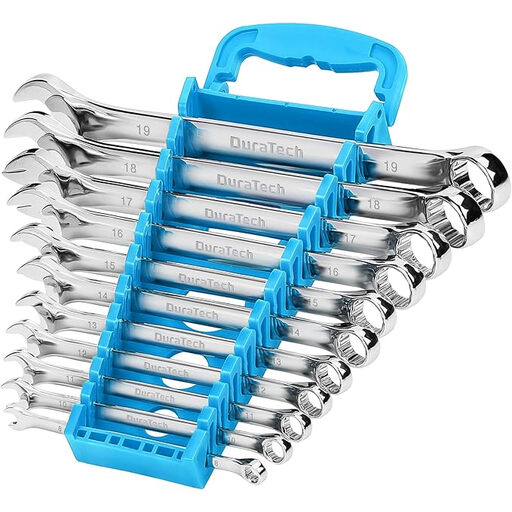
Why This Fits Their Persona: This set provides a solid and versatile starter kit for general repairs around the house, on a bicycle, or for initial work on a car. It covers the most important tasks without overwhelming the user with specialty tools.
It focuses on the 11 most common metric sizes from 8-19 mm, thus avoiding the incomplete assortment trap. The included plastic holder is a simple but functional storage solution.
The box end is offset by 15 degrees, which improves handling and protects knuckles. The polished surface makes cleaning easier.
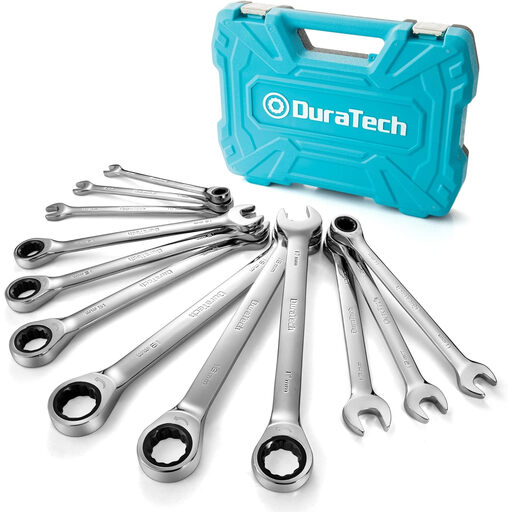
Why This Fits Their Persona: Ideal for users who frequently work in hard-to-reach places, such as a car's engine bay, and prioritise maximum speed. The ratcheting function is the decisive advantage here.
The specification of a 72-tooth mechanism is a specific, verifiable performance feature that goes beyond vague material advertising. The sturdy case with clear size markings prevents the disorganisation of the "cheap set" trap.
The integrated ratchet with a 5-degree swing arc significantly speeds up work, as the wrench doesn't need to be repositioned after every turn.
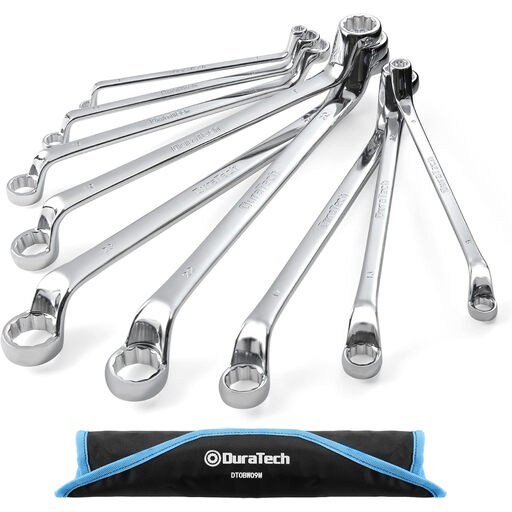
Why This Fits Their Persona: This set is not an all-rounder, but a specialty tool. It is indispensable for professional automotive technicians or ambitious hobby mechanics who need to work on deep-set bolts on engines, transmissions, or chassis.
It solves a specific access problem that standard wrenches cannot handle. The 75-degree offset is a clear, functional feature, not a marketing gimmick. Compliance with DIN 838 is an additional quality indicator.
The deep 75-degree offset allows access to deeply recessed fasteners. The included roll-up pouch is space-saving and practical for mobile use.
We have compiled a complete, up-to-date list of products that fully meet these strict selection criteria and applicable safety regulations.
1. What does the "Chrome Vanadium" specification really indicate? The term Chrome Vanadium Steel (Cr-V) merely describes the alloy of the steel, which gives it basic strength and rust resistance. However, it is not a sole indicator of quality. The crucial finishing step is the heat treatment (hardening), which gives the tool its final load-bearing capacity and wear resistance. A well-hardened wrench made of Cr-V steel will not give way even under high torque.
2. How many pieces should a good wrench set for home use have? For most DIY and household tasks, a set with 10 to 15 pieces that provides gap-free coverage of metric sizes from 8 mm to 19 mm is completely sufficient. Don't be dazzled by sets with over 50 pieces, which often contain many rarely needed micro-sizes or filler pieces while missing important standard sizes. Quality and completeness in the relevant size range are more important than the sheer piece count.
3. Do I need a ratcheting wrench set, or is a normal combination wrench set enough? That depends on your primary application. A classic combination wrench set is a robust and versatile all-rounder for most jobs. However, if you frequently work in tight, hard-to-reach places (e.g., in a car's engine bay), a ratcheting wrench set will significantly speed up your work, as the wrench does not need to be constantly repositioned to tighten or loosen. For many users, a combination of both sets is the ideal setup.