
Lieferung heute & morgen

Qualitätsgarantie

Willkommens-Angebote freischalten: KOSTENLOSE Lieferung | Bis zu 80 % RABATT | Kostenlose 30-Tage-JoyPlus-Testphase
App herunterladen
Preparing meals for the whole family is a daily challenge for many households: it needs to be quick, healthy, and ideally, energy-efficient. An XXL air fryer can be a practical solution, combining the functions of a convection oven into a more compact and often more efficient appliance. However, the market offers a wide variety of models, from the dual-basket air fryer to the mini oven with an air fry function.
This guide is here to help. We will introduce different types of appliances and explain their specific features to provide you with a solid basis for making an informed purchasing decision.
Before you decide on a model, a few key considerations will help. The size of your household and your preferred cooking methods are crucial factors.
Capacity is the most important feature of a family-sized air fryer. It is typically specified in litres.
Modern XXL air fryers can do much more than just fry. Pay attention to the available programmes and setting options:
A key advantage of air fryers is their energy efficiency. Compared to a large oven that requires a long preheating time, they are often significantly more energy-efficient. These appliances heat up the smaller cooking chamber very quickly and shorten the cooking time thanks to intense air circulation. Some manufacturers claim their devices use up to 70% less energy than a conventional oven. The power, measured in watts, determines how quickly the appliance reaches the desired temperature. Values between 1700 and 2200 watts are common.
Here, we present three models with different strengths, suitable for families and demanding users.

Why this model stands out: The OIMIS Air Fryer is a fully-featured mini oven with an air fry function. With its exceptionally large 30-litre cooking chamber and included rotisserie, it can replace a conventional oven in many situations.
Advantages:
Who is this appliance for? For large families or anyone looking for a multifunctional device that offers the capacity and versatility of a compact oven.
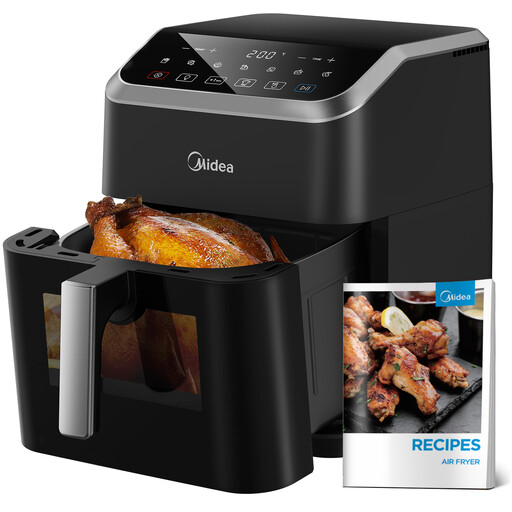
Why this model stands out: This model from Midea focuses on efficiency and user-friendliness. Its "HeatXpress" technology, as named by the manufacturer, is designed for exceptionally fast cooking times. The illuminated viewing window is a practical detail for everyday use.
Advantages:
Who is this appliance for? For households looking for a fast, energy-saving, and straightforward appliance for daily use that also features a modern design.
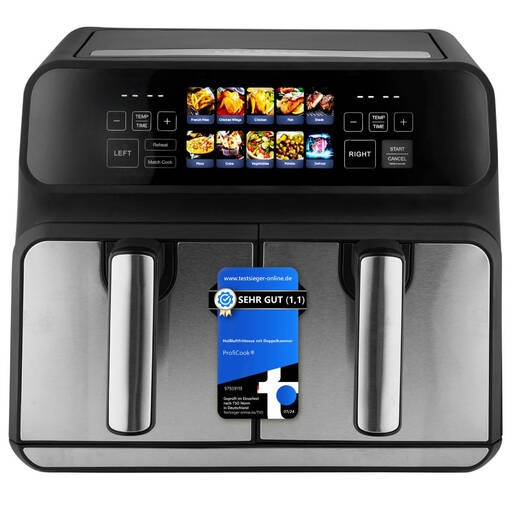
Why this model stands out: The ProfiCook fryer is a classic dual-basket air fryer. With two independently controlled cooking chambers, it offers a high degree of flexibility for preparing complete meals.
Advantages:
Who is this appliance for? Ideal for anyone who regularly prepares complete meals and values the flexibility of cooking a main course and a side dish simultaneously with different settings.
The models featured here cover a broad spectrum, but the market offers many other variations. If you are looking for different sizes, specific functions, or designs, you can find more appliances in our comprehensive category.
Discover our entire range of freestanding electric convection ovens here
For many everyday tasks, such as reheating pastries, preparing frozen foods, cooking vegetables, or smaller portions of meat, an XXL air fryer can often replace an oven. It is typically faster and more energy-efficient. However, a conventional oven still has the advantage when it comes to preparing very large roasts, baking multiple trays of pastries at once, or for dishes that require precise top and bottom heat.
The exact electricity consumption depends on the model's power, the set temperature, and the cooking duration. In general, however, air fryers use less energy than conventional ovens because they require a shorter preheating time and have a smaller cooking chamber. The reduced cooking time also contributes to energy savings.
The main advantage of a dual-basket air fryer is the ability to cook two different foods simultaneously at different temperatures and for different durations. This is especially practical for preparing a complete meal—for example, chicken legs in one basket and potato wedges in the other—without the flavours mixing. This saves time and helps coordinate serving the finished dishes.