
Lieferung heute & morgen

Qualitätsgarantie

Willkommens-Angebote freischalten: KOSTENLOSE Lieferung | Bis zu 80 % RABATT | Kostenlose 30-Tage-JoyPlus-Testphase
App herunterladen
As a Joybuy Product Recommendation Officer, I see the challenges cat owners face every day. One of the most common is finding a suitable cat tree, especially for those who own large breeds like Maine Coons or Norwegian Forest Cats, or share a home with multiple, highly active cats. Standard models are often too small, unstable, or don't offer enough variety.
This guide is designed to help you make an informed decision. We'll showcase a selection of models tailored to the needs of large and discerning cats and explain which features truly matter in an XXL cat tree.
Choosing the right model depends on several factors. Instead of being swayed by marketing promises, you should focus on objective criteria that guarantee safety and durability.
Keeping a cat tree stable is the top priority, especially with heavy or very agile cats. Look for the following features:
A large cat tree needs to offer more than just height. For a household with multiple pets or for large cats, the following features are relevant:
Modern cat trees are often more than just a place to play and sleep. Models like a cat tree with a litter box enclosure integrate a cabinet in the lower section where the litter box can be discreetly housed. This saves space and blends more harmoniously into your living space. Integrated feeding stations can also be a practical addition.
Based on the criteria above, we have compiled a selection of models that stand out for their construction, size, and functionality.
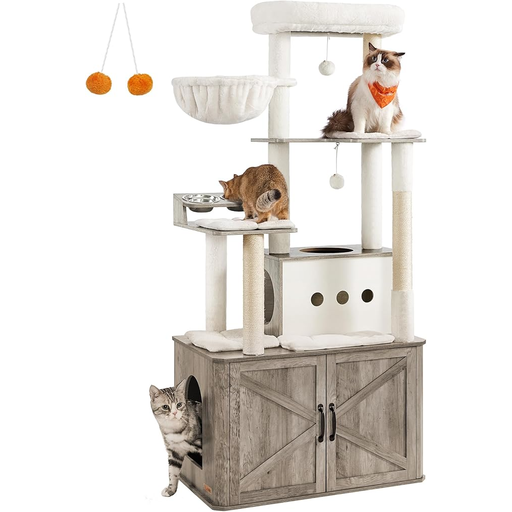
Why It Stands Out: This model is a complete living centre for cats. It combines a 170 cm tall playground with essential functions like a feeding station and a hidden cabinet for the litter box, making it an extremely space-saving solution.
Advantages:
Who Is It For? Ideal for cat owners in apartments or smaller homes who are looking for a multifunctional, space-saving solution without compromising on features for their cat.

Why It Stands Out: At 143 cm tall, this model is a more compact yet versatile option. It offers everything a cat needs to relax and play across multiple levels, and its stair-like layout also makes it suitable for kittens or senior cats.
Advantages:
Who Is It For? A great choice for owners of small to medium-sized cat breeds or for households where space is limited, but a varied place for play and rest is still desired.

Why It Stands Out: With an impressive height of 206 cm, this tower is a true climbing paradise. It was specifically designed as a cat tree for multiple cats and offers an exceptional variety of scratching, playing, and sleeping options.
Advantages:
Who Is It For? The top choice for households with multiple, highly active cats or for owners of particularly large breeds who need an extremely robust and spacious cat tree.
The needs of every cat and every home are unique. If the models presented here don't exactly match what you're looking for, that's not a problem. There is a wide variety of other designs, sizes, and features available.
Explore our entire collection and find the perfect cat tree that suits your cats and your home's style.
See More Models in the Cat Trees & Scratching Posts Category
For large cats like Maine Coons (often over 8 kg), stability is crucial. To make a cat tree stable, it requires a heavy, wide base plate, thick posts (over 8 cm in diameter), and ideally, additional anchoring to the wall with an anti-tip kit. The overall weight of the cat tree itself is also a good indicator of its stability.
Place the cat tree in an area where your family frequently gathers, such as the living room. Cats enjoy observing their surroundings from an elevated spot. A corner placement offers stability from two sides, while a location near a window (without long blind cords) provides an exciting view. Avoid placing the tree in an isolated spot, as it may not get used.
If you have an old one, place the new cat tree next to it initially. Make the new spot attractive by placing treats or your cat's favourite toy on the different levels. You can also rub some catnip on the sisal posts to entice their scratching instinct. Praise your cat when it explores or uses the new tree. Patience is key here.