
Lieferung heute & morgen

Qualitätsgarantie

Willkommens-Angebote freischalten: KOSTENLOSE Lieferung | Bis zu 80 % RABATT | Kostenlose 30-Tage-JoyPlus-Testphase
App herunterladen
Choosing the right filament is crucial for the success of any 3D print. When it comes to a specific colour like yellow, the question often arises: which material is best suited for my project? Whether you want to print a vibrant yellow decorative object, a robust prototype, or a heat-resistant technical component, the material properties are just as important as the shade.
This guide is designed to help you understand the differences between common yellow filaments. We will introduce a selection of materials for various applications, enabling you to make an informed decision for your next project when you need to buy yellow filament.
Before you decide on a product, there are several technical aspects to consider. These factors determine not only the print quality but also the functionality of the finished object.
Yellow 3D printing material is available in various types of plastic, each with specific properties.
Yellow PLA filament is especially popular with beginners and for printing visual prototypes, figurines, and decorative items due to its ease of use. It has a very low tendency to warp, does not necessarily require a heated print bed, and produces almost no odour during printing.durable 3D printer filament, yellow PETG filament is an excellent choice. It combines the ease of printing of PLA with greater strength, flexibility, and temperature resistance. PETG is also water-resistant and well-suited for mechanical parts or containers.Yellow ABS filament is an engineering-grade plastic known for its high toughness, impact resistance, and heat resistance. It is used for functional components that must withstand mechanical stress. Printing with ABS is more demanding and requires a heated print bed as well as good ventilation or an enclosed chamber, as fumes can be produced.A consistent filament diameter is essential for a smooth printing process. The standard for most common filament for FDM printers is 1.75 mm. Look for a low diameter tolerance (e.g., ±0.02 mm), as this minimises the risk of nozzle clogs and ensures consistent extrusion. A neat, tangle-free winding on the spool also prevents the printing process from being interrupted by snagged material. The standard 1kg yellow 1.75 filament size typically offers good value for money for most projects.
Here is a selection of yellow filaments with a 1.75 mm diameter, suitable for different requirements and printers.
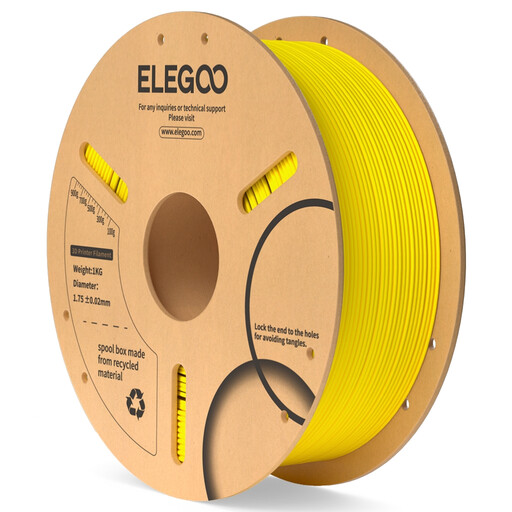
What Makes It Stand Out This yellow Elegoo filament is distinguished by its high dimensional accuracy with a stated tolerance of ±0.02 mm, which promotes reliable and consistent extrusion. The mechanical winding ensures a neat, tangle-free spool. Another feature is the more eco-friendly cardboard spool, which is more biodegradable than traditional plastic spools.
Advantages
Who It's For Ideal for 3D printing beginners, hobbyists, and for creating decorative objects, figurines, and non-functional prototypes where ease of use and a clean surface finish are a priority.
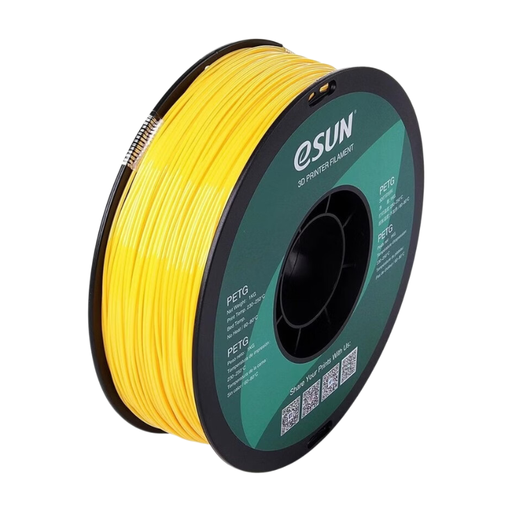
What Makes It Stand Out The yellow eSUN filament in the PETG variant is known for its robustness and chemical resistance. It combines high impact strength with good flexibility. According to the manufacturer, the material is hydrophobic, meaning it absorbs very little water, making it easier to store than moisture-sensitive filaments.
Advantages
Who It's For Suitable for advanced users who want to print mechanically resilient and durable components. It is a great choice for functional prototypes, enclosures, or parts that require greater stability than PLA.
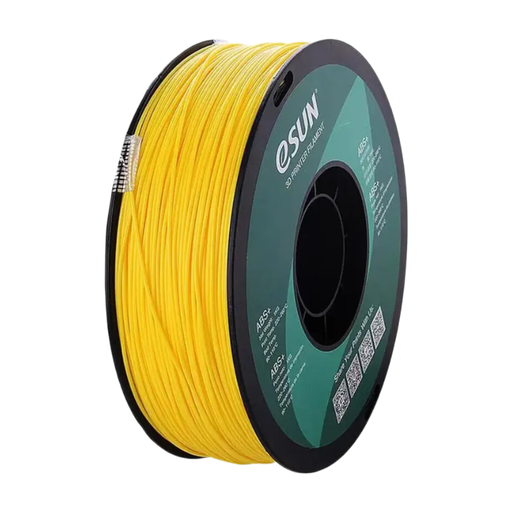
What Makes It Stand Out This material is ABS+, an enhanced version of standard ABS. According to the manufacturer eSUN, the formula has been optimised to reduce the warping typical of ABS and improve bed adhesion. It retains the high toughness and impact resistance of ABS and can be mechanically post-processed (e.g., sanded, drilled, glued).
Advantages
Who It's For This filament is aimed at experienced users and professionals printing technical components for mechanical engineering, the automotive industry, or other fields where high thermal and mechanical resilience is required. A printer with an enclosed build chamber is recommended.
Our selection covers the most common use cases for yellow filament. However, if you prefer other brands, specific shades of yellow, or special material blends, you will find an even wider range of products in our main category.
Discover Our Entire Range of Yellow 3D Filament
1. What is the basic difference between PLA, PETG, and ABS filament? In short: PLA is the easiest to print and ideal for visual purposes. PETG offers a compromise between ease of use and high mechanical and thermal resistance. ABS is an engineering-grade plastic for high-stress, heat-resistant parts, but it is more challenging to print.
2. Do I always need a heated print bed for yellow filament? No, the need for a heated bed depends on the material, not the colour. For PLA, it is often optional but improves adhesion. For PETG, it is strongly recommended (approx. 45–70°C), and for ABS, it is mandatory (approx. 100–110°C) to prevent warping.