
Lieferung heute & morgen

Qualitätsgarantie

Willkommens-Angebote freischalten: KOSTENLOSE Lieferung | Bis zu 80 % RABATT | Kostenlose 30-Tage-JoyPlus-Testphase
App herunterladen
A yellow marker can highlight text, label presentation slides or permanently mark materials. The choice may seem straightforward at first, but different inks and tips are not interchangeable. If you decide based only on colour or price, you risk smudged documents, markings that are difficult to remove or an unsuitable line width.
A yellow highlighter is usually designed for paper and often uses water-based, fluorescent ink. A yellow permanent marker, on the other hand, adheres to materials such as plastic, glass, metal or film. On paper, however, permanent ink cannot be removed easily.
A highlighter is suitable for books, worksheets and printouts. A permanent marker is more appropriate for laboratory containers, storage boxes or technical films. Before buying, you should therefore be clear whether the marking should be permanent or erasable.
A 0.4 mm yellow marker is suitable for fine lettering and precise lines. A 0.6 mm tip creates a clear but still narrow mark. A 1.0 mm yellow marker is suitable for highly visible lettering. A chisel tip, on the other hand, can provide several line widths, such as 1, 2 and 5 mm.
The terms ‘broad’ or ‘fine’ alone are therefore not enough. What matters is whether the tip is round, synthetic or a chisel tip.
According to STAEDTLER product information, certain Lumocolor models are designed for use on a wide range of surfaces. However, absorbent materials such as untreated wood, cardboard or textiles may absorb the ink. Even with a yellow film marker, you should first test it on an inconspicuous area to check whether the marking adheres as intended or can be removed.
A yellow non-permanent marker typically contains water-soluble ink. According to the product description, it can be wiped off suitable films with a damp cloth. A yellow OHP marker, also known as a film marker, is therefore a useful choice for presentation films and temporary labelling.
Permanent ink is a sensible choice when labels, cardboard boxes or plastic parts need to remain legible over the long term. Terms such as ‘water-resistant’, ‘smudge-proof’ or ‘lightfast’ should always be understood in relation to the particular surface. A test mark can prevent incorrect labelling.
A classic chisel tip is practical for continuous text on paper. For small labelling areas, a synthetic fine-writing tip offers greater control.
During long study or work sessions, an ergonomic shape can make the marker more comfortable to use. According to the product information, the Pelikan 490 Eco has a recessed grip area. Triangular models such as the STAEDTLER Triplus Textsurfer can also help prevent the marker from rolling off the desk.
A refillable marker can extend its useful life. The STAEDTLER models mentioned come with corresponding refill stations. The cap function is also relevant: according to the manufacturer’s information, the DRY-SAFE specification for certain Lumocolor models refers to being left uncapped without drying out under the stated test conditions. The cap should nevertheless be closed after every use.
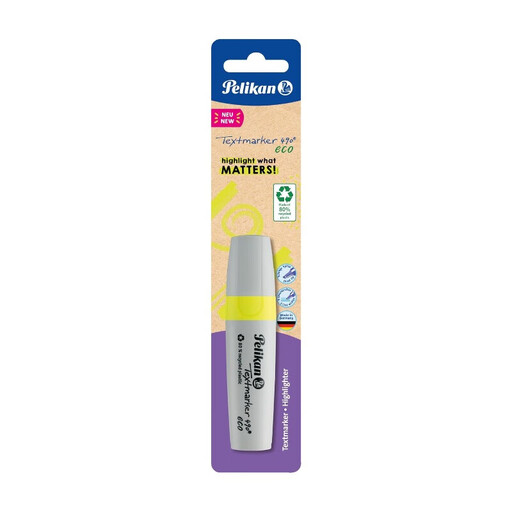
Why this product suits this profile: This classic highlighter handles everyday tasks at school, university and in the office. According to the product information, the chisel tip provides three line widths of 1, 2 and 5 mm.
The variable tip means you do not need two different markers for underlining and broad highlighting.
Neon yellow, water-based ink; 80% recycled material according to the product description; grip recess for comfortable handling.
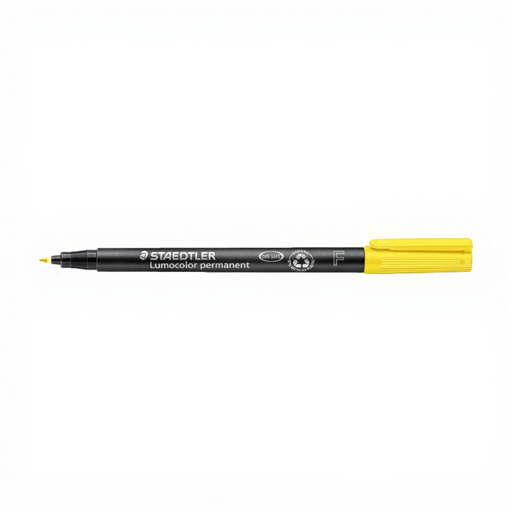
Why this product suits this profile: The fine 0.6 mm tip is designed for permanent, controlled lettering on a range of materials. This can be useful in offices, laboratories and for technical labelling.
The clear ‘Permanent’ designation reduces the risk of accidentally buying an erasable film marker for permanent labels.
Yellow permanent ink; fine synthetic tip of approximately 0.6 mm; refillable and quick-drying according to the product information.
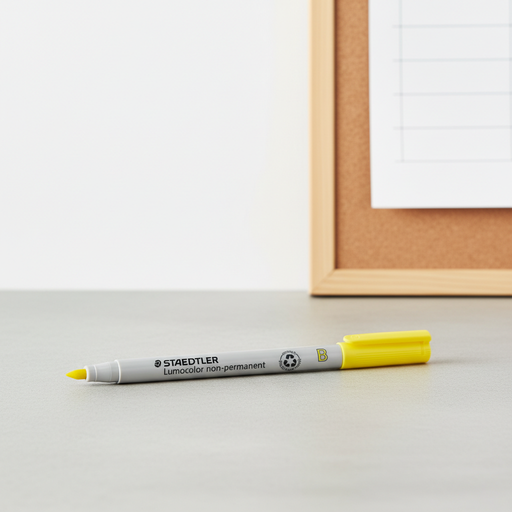
Why this product suits this profile: The broad chisel tip is suitable for presentation and moderation teams, as well as for temporary markings on suitable films.
The Non-Permanent designation prevents an erasable presentation marking from being made with a permanent marker.
Water-soluble ink; line widths of approximately 1.0 and 2.5 mm; can be used with refill station 487 15 according to the product information.
We have put together a complete, regularly updated list of products that fully meet these strict selection criteria and the safety regulations applicable in the EU.
For longer passages of text, consider the STAEDTLER Triplus Textsurfer Yellow and the STAEDTLER Triplus Textsurfer Bright Yellow. Both are described as having a soft round tip and a stated line width of approximately 1 to 4 mm. The triangular shape can support a controlled grip during longer study sessions.
If you prefer to work without liquid ink, you can choose the STAEDTLER Textsurfer Dry Highlighter Pencil. According to the product description, this yellow wax pencil has a 4 mm lead and is designed for paper, faxes and carbon copies. On thin paper, a dry highlighter can be an alternative to ink that bleeds through.
For overhead films, a designated yellow film marker or yellow OHP marker is a sensible choice. If the labelling needs to be removed later, choose a non-permanent model with water-soluble ink. Before the presentation, it is advisable to carry out a quick test on the film being used.
Its lifespan depends on use, storage and whether the cap is closed properly. Refillable models can be topped up when the ink supply starts to run low. Highlighters should be stored horizontally or as specified by the manufacturer, and carefully capped after use.
No. Visibility depends on the colour, surface and print of the paper. Neon yellow highlighter ink is usually highly visible on white paper, but may look different on coloured or heavily printed paper. For important documents, it is best to test it first.