
Lieferung heute & morgen

Qualitätsgarantie

Willkommens-Angebote freischalten: KOSTENLOSE Lieferung | Bis zu 80 % RABATT | Kostenlose 30-Tage-JoyPlus-Testphase
App herunterladen
Yellow markers and highlighters may look similar at first glance, but they differ considerably in terms of ink, line width and intended use. If you choose based on colour intensity alone, you could end up buying a marker that cannot be wiped off transparencies, bleeds through thin paper or writes too broadly for fine labelling.
As a Joybuy Product Recommendation Officer, I filter the relevant product data according to practical buying criteria. This makes it easier to decide whether a yellow highlighter, a yellow permanent marker, a yellow non-permanent marker or a classic yellow fibre-tip pen is right for your needs.
Neon and fluorescent inks stand out strongly. However, a broad tip can partly cover very small text. For individual words, correction notes or technical labelling, a fine-tip marker or a yellow fineliner is therefore more suitable than a classic highlighter.
A water-based highlighter cannot be wiped off every surface. It may be removable from transparencies and smooth, non-absorbent surfaces, while the colour can still soak into paper, card or textiles. Suitability should therefore always be assessed according to the surface and intended use.
Descriptions such as “universal tip” say little about actual use. Specifications such as 0.4 mm, 0.6 mm, 1.0 mm or 1–4 mm are more informative. A chisel tip is generally suitable for different line widths, while a fine tip enables controlled lines for labelling.
A chisel tip can produce narrow and broad lines depending on the angle. For example, the Pelikan Textmarker 490/B is described as offering marking widths of approximately 1, 2 and 5 mm. According to the product information, rounded tips such as those on the STAEDTLER triplus textsurfer enable lines of approximately 1 to 4 mm.
For fine notes, models with 0.4 mm or 0.6 mm tips are a sensible choice. A 1.0 mm tip sits between precise labelling and clearly visible marking. For flipcharts and presentations, however, 2–5 mm is more practical.
The surface should be established before buying:
Refillability also affects ongoing costs. According to the product data, several STAEDTLER Lumocolor models are compatible with suitable refill stations. This extends their useful life, but requires the relevant refill station to be compatible with the model.
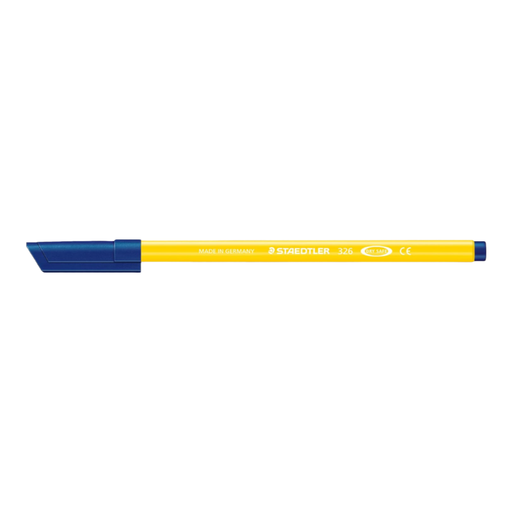
Why this product suits this profile: The pack of 10 washable fibre-tip pens, with a line width of approximately 1.0 mm, is suitable for school, craft projects and colour-coded notes on paper.
The clear information about washability and line width helps prevent accidentally buying a permanent marker for children’s activities or paper-based work.
Water-based, washable design; pack of 10 yellow fibre-tip pens.
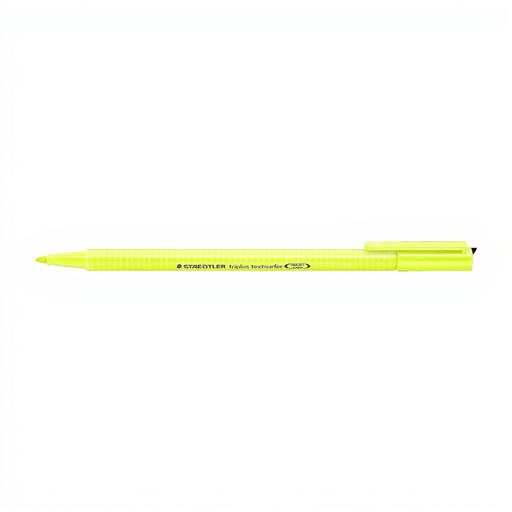
Why this product suits this profile: The triangular shape and soft rounded tip, with an approximate width of 1–4 mm, allow controlled underlining and broader highlighting.
The specific width information provides clear guidance rather than promising an imprecise “universal tip”.
Ergonomic triangular barrel; water-based ink and a variable line of approximately 1–4 mm.
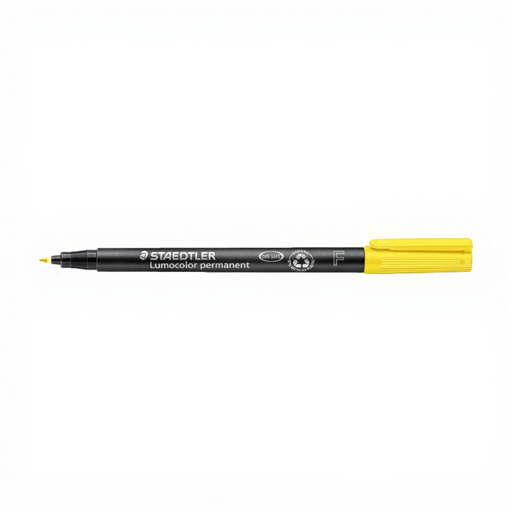
Why this product suits this profile: The permanent yellow ink and fine 0.6 mm tip are designed for durable, precise labelling on a range of surfaces.
The permanent designation prevents confusion with a wipe-clean marker. Before using it on valuable items, test it on an inconspicuous area.
Fine 0.6 mm tip; according to the product information, refillable with the STAEDTLER Refill Station 487 17.
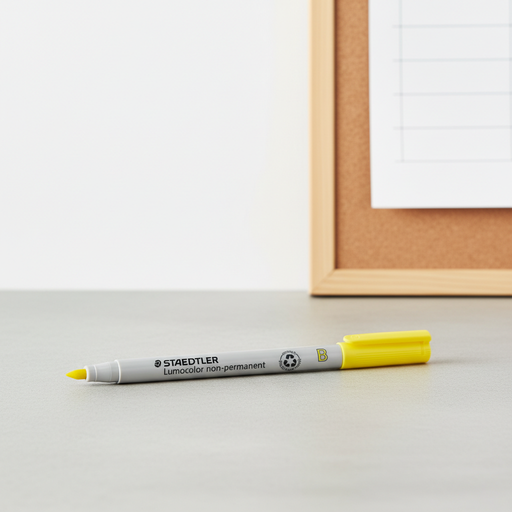
Why this product suits this profile: The water-soluble ink and broad chisel tip are suitable for transparencies, presentations and temporary marking on appropriate smooth surfaces.
The product name clearly indicates its temporary nature and the two approximate line widths.
Water-soluble ink; line widths of approximately 1.0 and 2.5 mm; refillable according to the product information.
We have put together a complete, regularly updated list of products that fully meet these strict selection criteria and the safety regulations applicable in the EU.
This depends on the paper thickness, amount of ink and printing method. For thin paper, choose products whose descriptions expressly mention reduced show-through or use on fax and carbonless copy paper. Before making a larger purchase, it is advisable to test the product on the specific paper you use.
A yellow permanent marker is intended for permanent marking and may be difficult to remove from porous surfaces. A yellow non-permanent marker often contains water-soluble ink and can be removed from suitable transparencies or smooth surfaces with a damp cloth. The two variants should not be confused based on colour alone.
Its service life depends on line width, writing surface, pressure and storage. A refillable marker can be refilled once the ink supply starts to run low, provided the designated refill station is compatible. Closing the cap regularly and storing the marker appropriately reduces the risk of it drying out.