Hosts serving individual portions
You want to portion the yoghurt into sealable jars at home, so you’re comparing the number and capacity of the containers supplied.


For a bring-and-share, first decide whether you need individual jars for your guests or a larger container to portion out at the venue. A timer with automatic shut-off can make overnight planning easier, but it won’t replace chilling the yoghurt afterwards or keeping it cool during transport.
You want to portion the yoghurt into sealable jars at home, so you’re comparing the number and capacity of the containers supplied.
You want to start fermentation before bed and need to plan when the programme will finish, as well as the chilling time afterwards.
You’re making yoghurt for others and need to plan storage, the journey and serving so the finished yoghurt stays chilled.
A good fit if: You want to prepare individual portions and schedule the programme to finish overnight. The Steba JM 2 is supplied with twelve 0.2 l jars; the Rommelsbacher JG 40 comes with eight 150 ml jars. The manufacturers specify automatic shut-off for both models.
Keep in mind: Even with automatic shut-off, the yoghurt still needs to go in the fridge afterwards and stay chilled during the journey.
A good fit if: You’re looking for a straightforward machine with individual jars. The manufacturer lists seven 160 ml jars for the Clatronic JM 3344. The Severin JG 3518 comes with seven 150 ml jars; an editorial review by vergleich.org does not list a timer for this model.
Keep in mind: If you choose a model without a timer, you’ll need to plan when the programme ends yourself.
A good fit if: You’d rather bring the yoghurt in a larger container and portion it out at the venue. The Rommelsbacher JG 80 is supplied with two 1.2 l containers, four 125 ml cups and four programmes.
Keep in mind: The two large containers are accessories, not a combined quantity for a single batch; only four small cups are included.
Check the number of guests against the containers actually supplied, and plan fermentation, fridge time and departure as separate steps.
| Priority | What to check before buying | Who is this particularly important for? |
|---|---|---|
| Individual portions that fit the occasion | Match the number of guests and preferred portion size to the number and capacity of the jars. | If I want to bring a jar for every guest, the number and capacity of the jars matter more than a large total volume. Around 31% of consumers prioritise individual portions. |
| Overnight timing | Check the run time and shut-off function for the specific model, and allow time for chilling in the fridge. | If you start the machine at night, you’ll want to plan when the programme finishes without forgetting to chill the yoghurt afterwards. Around 25% of consumers make timing their main priority. |
| Keeping it chilled during the journey | Check in advance that the containers will fit in your fridge and in a cool bag or other chilled transport. | If I’m bringing yoghurt, I need to keep it chilled after fermentation and while travelling. The German Federal Institute for Risk Assessment highlights the risks of inadequate chilling during storage and transport. Around 25% of consumers particularly value keeping yoghurt chilled throughout the journey. |
| Flexibility with containers and recipes | Compare the supplied containers, optional jars and programmes using the full model number. | If I want to use the yoghurt maker for different quantities or recipes later, I’ll need suitable containers and programmes. Around 19% of consumers prioritise this longer-term versatility. |
The end of the machine’s programme doesn’t mean the chilling stage is over. The Verbraucherzentrale recommends chilling homemade yoghurt until it is eaten; the German Federal Institute for Risk Assessment also highlights the need for adequate chilling during storage and transport.
Plan the end of the programme, time in the fridge and departure as separate steps.
You’ll need time and space in the fridge after fermentation, as well as a suitable way to keep the yoghurt cool during the journey.
A machine with large containers may work well if everyone will help themselves, but it won’t necessarily provide lots of small jars for guests. The Rommelsbacher JG 80 comes with four small cups; the JG 40 comes with eight jars.
Compare the number of guests with the number and capacity of the jars to suit how you plan to serve the yoghurt.
If the supplied containers aren’t enough, you may need to buy additional suitable portion jars and allow time to transfer the yoghurt.
An optional jar set doesn’t prove that more jars will fit in the yoghurt maker at the same time.
Check accessory compatibility separately from the capacity of a single batch.
The JM 2 is designed for anyone who wants to prepare lots of individual portions and set the programme to finish at a specific time.
The JG 40 and JG 80 differ in the jars, containers and preparation programmes they offer.
The JM 3344 is a straightforward yoghurt maker supplied with seven individual jars.
The JG 3518 is a version with seven smaller portion jars, so it’s important to check the exact model number.
The CR 4519 comes with seven slightly larger portion jars.
This selection includes yoghurt makers with individual jars and machines with larger containers for portioning at the venue.
 No image available
The two large containers are ideal if you’re planning to portion the yoghurt out at the venue.
The product name lists containers with capacities of 2000 ml and 1400 ml.
 No image available
Nine jars give you the option of preparing several portions separately.
The product name lists a 1.6 L SUS304 inner pot and nine borosilicate glass jars.
 No image available
The eight jars are a good option if you want to prepare several individual portions.
The product name lists a total capacity of 1440 ml, a digital temperature control and a 48-hour timer.
 No image available
The stated 1.5 l capacity may suit a larger batch that you can portion out afterwards.
The product name lists a capacity of 1.5 l and 20 W.
 No image available
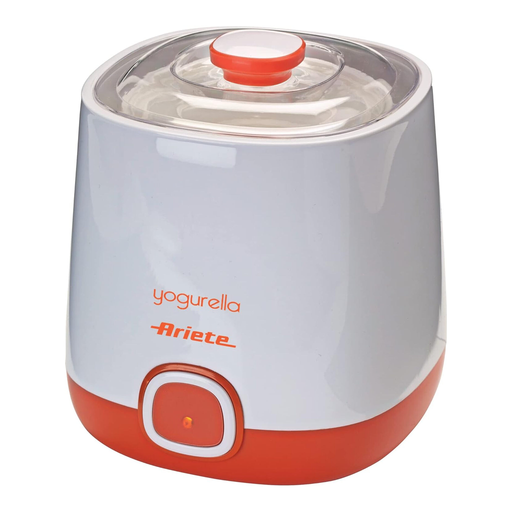
The 1-litre container is a good option if you want to prepare a larger batch of yoghurt and portion it out later.
The product name lists a 1-litre capacity and 20 W.
No, allow time for the yoghurt to chill in the fridge after fermentation. The Verbraucherzentrale recommends chilling homemade yoghurt until it is eaten; the German Federal Institute for Risk Assessment highlights the need for adequate chilling during storage and transport. A shut-off timer does not chill the yoghurt.
Wash your hands and clean all parts of the machine that come into contact with the ingredients. In its yoghurt-making guide, the Verbraucherzentrale recommends briefly bringing pasteurised whole milk to the boil first; UHT milk can be used straight away. For raw milk, the German Federal Institute for Risk Assessment recommends boiling it before making homemade yoghurt.
Not necessarily: extra jars don’t automatically mean there’s space for more jars in the machine. Clatronic lists an optional set of six jars for the JM 3344; Steba lists extra jars for the JM 2. Check the supplied accessories and the capacity of a single batch for the specific model.
Article 1(2)(b) of Regulation (EC) No 852/2004 excludes domestic preparation, handling or storage for private domestic consumption from its scope. The consolidated version on EUR-Lex is dated 24 March 2021. This does not mean that sales or organised public distribution are automatically exempt; each such event needs to be considered separately.