Breakfast planners
You make yoghurt ahead of time and want to schedule the setting and chilling so it’s ready for breakfast.


For a breakfast you can prepare in advance, choose a container size and batch quantity that suit what you actually eat and can fit in your fridge. If you want the appliance to finish the setting cycle automatically, look for a timer and automatic shut-off; you’ll still need to allow time for chilling afterwards. A non-electric insulated yoghurt maker doesn’t need to be plugged in, but you’ll need hot water to get started and it won’t switch off automatically.
You make yoghurt ahead of time and want to schedule the setting and chilling so it’s ready for breakfast.
You want to seal and chill several breakfasts in separate containers, rather than decanting from one storage container in the morning.
You’re choosing between a larger batch, containers in different sizes and making yoghurt without an electric appliance.
Plan backwards from when you want breakfast: allow for the setting time and subsequent chilling first, then consider the containers and appliance features.
| Buying priority | What to check | Who it matters to |
|---|---|---|
| Setting time and chilling | Check whether the specific model has a timer and automatic shut-off; allow time for setting and chilling before breakfast. | If I prepare a batch in advance, the setting time and subsequent chilling need to fit my morning routine. Around 36% of consumers put a predictable routine first. |
| Individual portions | Compare the number and capacity of the jars, their lids and the space available in your fridge. | If I want to prepare several breakfasts separately, sealable individual containers are practical. Around 29% of consumers prioritise separate portions. |
| Batch size | Check how much you can make in one cycle, rather than counting all the interchangeable containers supplied. | If I’m making yoghurt for several breakfasts or to share, the quantity needs to suit how much I’ll use and the space in my fridge. Around 21% of consumers focus above all on finding the right batch size. |
| Design | Consider whether an electric appliance, an insulated yoghurt maker or jars you already own best fit your routine. | If I want to manage without an electric yoghurt maker, heating the water needed to get started must also fit into my routine. Around 14% of consumers favour a non-electric or simple design. |
A timer ends the appliance’s programme, but it doesn’t chill the yoghurt. You’ll need to make time for chilling afterwards, too.
Before you start, allow for the setting time specified in the recipe and the subsequent chilling time.
The Rommelsbacher JG 80 comes with two 1.2 l containers; the manufacturer states that you can make up to 1.2 l per cycle.
Compare the quantity you can make per cycle, not just the total capacity of the accessories.
If you need to make a larger quantity, you may need to run additional cycles and find more space for the containers.
According to the manufacturer, the non-electric My.Yo insulated yoghurt maker uses heat from hot water.
Compare the whole process with using an electric appliance and, if suitable, with jars you already own.
You’ll need to heat the water separately, so allow for the energy and extra effort involved.
The Joybuy listing for the Ariete 621 states 20 W, while Ariete’s data sheet for the Yogurella 0621/10 states 40 W. This doesn’t prove that both specifications refer to the same appliance version.
Check the full model number and technical specifications for the exact version.
The JG 40 and JG 80 cater for different container needs: small portion jars, or a combination of portion pots and large interchangeable containers.
The JM 2 comes with twelve sealable glass jars, making it suitable for households that want to prepare a larger quantity in individual containers.
The JG 3510 is a straightforward electric option for buyers who can keep track of when the cycle needs to end.
This non-electric insulated yoghurt maker is designed for a 1 l batch and has no electric heater.
According to Ariete, the Yogurella 0621/10 is a container-based solution for making traditional and strained yoghurt.
The Joybuy products below include electric appliances with individual jars or larger containers, to suit different batch sizes you may want to prepare in advance.
 No image available
An option if you want to prepare batches in containers of different sizes.
The product listing states that it comes with 2,000 ml and 1,400 ml glass containers, as well as eight programmes.
 No image available
The nine individual jars are a good option if you want to prepare several portions separately.
The product listing specifies a 1.6 l SUS304 inner pot, nine borosilicate glass jars, temperature control, a timer and an OLED display.
 No image available
An option if you want to prepare several individual portions and set the timer in advance.
The product listing specifies eight jars with a total capacity of 1,440 ml, digital temperature control and a 48-hour timer.
 No image available
The larger container may suit you if you’d rather make one batch than use lots of individual jars.
The product listing specifies a 1.5 l capacity, 20 W and a filter.
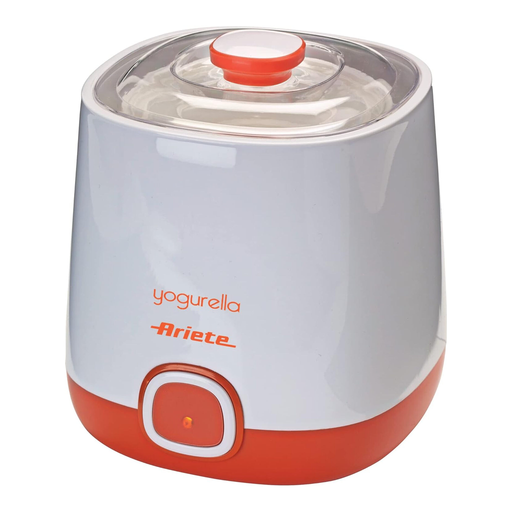 No image available
A single-container option for making a batch, if 1 litre suits the quantity you have in mind.
The product listing states 1 l and 20 W; Ariete’s data sheet for the Yogurella 0621/10 states 40 W. This doesn’t confirm that they’re the same appliance version, so check the model number and power rating before buying.
Not necessarily: the setting time depends on the recipe and appliance, and the yoghurt also needs time in the fridge before breakfast. A timer only ends the appliance’s programme; it doesn’t chill the yoghurt.
No. The German Consumer Advice Centre describes how to make yoghurt with milk, a yoghurt starter and screw-top jars, without specialist equipment. Follow your recipe for treating the milk and leaving the mixture to stand, and allow time for chilling afterwards. If you’re using an appliance, follow its instructions as well.
The German Federal Institute for Risk Assessment warns that untreated raw milk may contain pathogens and recommends boiling it before consumption. This also applies to homemade yoghurt that isn’t heated again afterwards. People who are particularly vulnerable should not consume unboiled raw milk. This advice concerns the ingredient, not any protective function of the yoghurt maker.
Put finished yoghurt in the fridge. The German Consumer Advice Centre recommends storing yoghurt on the middle shelf at 5 to 7 °C and advises against eating a product with visible mould. A shelf-life recommendation for commercially sold, unopened products cannot be applied to homemade yoghurt across the board.
For market surveillance, the German Federal Network Agency lists requirements including CE marking, product and manufacturer identification, and instructions in German with any necessary warnings. Check these details for the exact electric model. A CE mark alone doesn’t guarantee the quality of the yoghurt it makes.