People short on worktop space
When worktop space is limited, the appliance’s dimensions matter, as does the space needed for the cable, containers and accessories.


If you’re short on worktop space, start by checking the appliance’s width and depth against the space available. For an unattended overnight cycle, it’s also important to look for a timer with an automatic shut-off. A single container is better suited to making a larger batch, while portion jars make it easier to divide the yoghurt up – both options need room in the fridge once the yoghurt is ready. The automatic shut-off ends the cycle, but it doesn’t replace chilling the yoghurt afterwards.
When worktop space is limited, the appliance’s dimensions matter, as does the space needed for the cable, containers and accessories.
If you start a batch in the evening, check whether the specific model has a suitable timer and automatic shut-off. Chilling the yoghurt afterwards is still a separate step.
Individual jars are easy to handle portion by portion; a larger container is another option for making a batch. Either way, you’ll need room in the fridge for the finished yoghurt.
First, decide whether you want to set a timer for an overnight cycle. Then check the appliance’s footprint and container shape against the space available on your worktop and in your fridge.
| Buying consideration | What to look for | Who is it most important to? |
|---|---|---|
| Worktop space and storage | Compare the appliance’s width and depth, and allow room for the cable and containers. | If I have limited worktop space, I also need to leave room for the cable and containers; around 34% of consumers prioritise the appliance’s footprint. |
| Overnight timer | Check the timer range and automatic shut-off for the exact model, and remember to allow time to chill the yoghurt after the cycle. | If I start it in the evening, I want to be able to set when the cycle ends rather than having to stop it myself; around 33% of consumers prioritise timer controls. |
| Portions or a larger batch | Compare the number and stated capacity of the containers with your needs and the space available in your fridge. | If I want to store individual portions straight away or make a larger batch, the right container shape matters; around 20% of consumers put planning quantities first. |
| Programmes or strainer | Check whether the specific model includes the preparation settings you want or a strainer for draining. | If I want to make types of yoghurt beyond plain yoghurt, or strained yoghurt, I’ll need the right features; around 13% of consumers prioritise this flexibility. |
Automatic shut-off ends the appliance’s cycle, but it doesn’t chill the finished yoghurt. The Verbraucherzentrale recommends storing it in the fridge after preparation.
If you’re running a cycle overnight, plan when you’ll chill the containers afterwards.
Containers and accessories also need space on the worktop, when you’re cleaning them and later in the fridge.
Compare the appliance’s dimensions and the exact items included with the space available in both places.
The Ariete models 0617 and 0621 differ in their containers and dimensions.
Check the full model number and compare the features you want with the details for that exact version.
The JG 80 and JG 40 models cater for different container and space requirements.
The Yogurella 0621 and 0617 models differ in features including container shape and footprint.
The JM 3 combines portion jars with adjustable temperature and a timer.
The JG 3521 is a portion-jar model with automatic programmes.
The selection below includes models with several glass containers, portion jars or one larger container. The features listed for each specific model are what matter.
 No image available
An option if you’d like to choose between two container sizes for different batch sizes.
Includes two glass containers, with capacities of 2,000 ml and 1,400 ml.
 No image available
If you’d like to use individual jars as well as a larger inner pot, the product title lists both types of container.
The title lists a 1.6-l inner pot, nine borosilicate glass jars, temperature control, a timer and an OLED display.
 No image available
The jars are a good option if you want to make yoghurt in individual portions.
The product title lists eight jars with a total capacity of 1,440 ml, digital temperature control, a 48-hour timer and automatic shut-off.
 No image available
The stated capacity may be useful when planning a larger batch.
The product title lists a 1.5-l capacity, 20 W, a strainer and dimensions of 19.5 × 17.5 × 21.4 cm.
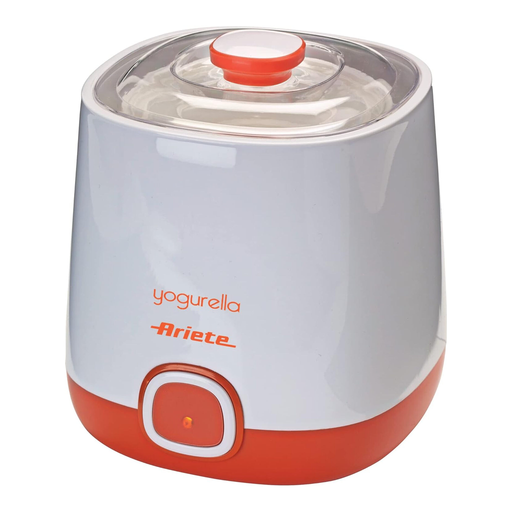 No image available
The 1-l container is an option if you’re planning to make a batch rather than use individual portion jars.
The product title lists a capacity of 1 l and a power rating of 20 W.
It depends on whether you can stop the cycle yourself and how limited your worktop space is. If you don’t want to monitor the cycle, look for a timer with automatic shut-off listed for the specific model. If every centimetre counts, compare the manufacturer’s dimensions first. Even after automatic shut-off, the finished yoghurt still needs to be chilled.
Put the containers in the fridge once the yoghurt is ready. The Verbraucherzentrale describes a method in which the jars are left undisturbed for around twelve hours and then chilled. Wash your hands, work surfaces and utensils thoroughly, and also follow the instructions for the appliance and the culture you’re using.
For a fault, contact the seller about your statutory rights; a voluntary guarantee is a separate matter. The Verbraucherzentrale points out that the seller, not the manufacturer, is responsible for putting faults right. If you’re offered an additional guarantee, check its terms and conditions.
Electric yoghurt makers sold in the EU must meet the applicable requirements for electrical appliances. According to the European Union, the CE mark is a declaration by the manufacturer, not an independent quality mark. EU rules on food-contact materials apply to containers and other parts intended to come into contact with yoghurt. Check the details for the specific model, including its electrical specifications and the materials used for its containers.