Which option is right for you?

Taking individual portions with you

You want to portion the yoghurt into sealable containers before setting off, and then need space in the fridge for all the jars. The German Federal Institute for Risk Assessment points out that keeping food sufficiently chilled is important during storage and transport, too.

Planning breakfast ahead

You want to start a batch in good time and set the appliance to finish, without overlooking the chilling time afterwards. Rommelsbacher lists a timer with automatic shut-off for the JG 40; the consumer advice centre describes chilling the jars after preparation as a separate step.

Hosting with different portion sizes

Sometimes you serve individual breakfast pots, and other times you put yoghurt out for everyone to help themselves. For the Rommelsbacher JG 80, the manufacturer lists small ceramic pots and larger glass containers. Check the instructions to see which containers can actually be used for your batch.

What should you look for when choosing?

Electric yoghurt maker with portion jars

Suitable if: you want to portion the yoghurt into individual jars before taking it with you.

The trade-off: More jars mean more space is needed for chilling and cleaning; an automatic shut-off won’t chill the yoghurt.

Electric yoghurt maker with a large container or a choice of containers

Suitable if: you want to portion the yoghurt at a shared meal or switch container format to suit the occasion. Rommelsbacher lists ceramic pots and glass containers for the JG 80.

The trade-off: With a large container, you may not portion the yoghurt until you arrive. Don’t assume that different containers can all be used together for one batch.

Non-electric insulated yoghurt maker

Suitable if: you don’t want to use a plug-in appliance during fermentation and one batch in a single container is enough. My.Yo lists a 1 l capacity for its non-electric model.

The trade-off: Insulation isn’t the same as electric temperature control. Follow the instructions when making your yoghurt, and factor in the chilling time afterwards.

Make yoghurt without a dedicated yoghurt maker

Suitable if: you only make yoghurt occasionally and want to try it without buying another appliance. A consumer advice centre guide describes making a batch in screw-top jars.

The trade-off: The consumer advice centre gives a standing time of around twelve hours for this method; that isn’t a guaranteed appliance cycle or a controlled temperature.

What you need What to check before buying Who it matters most to
Portioning and taking yoghurt with you chilled Number of jars, capacity per jar, lids, space for chilling and a suitable way to keep the yoghurt cool during transport. If I want to portion everything at home and take it with me without decanting, I look for suitable jars and enough space to chill them. Around 33 % of consumers put ready-to-go portions first.
Having yoghurt ready for breakfast Programme duration, automatic shut-off and instructions; work backwards from breakfast, allowing separate time for fermentation and chilling. If I need the yoghurt for a particular breakfast, I plan for the appliance cycle and chilling time one after the other. Around 27 % of consumers prioritise their breakfast schedule.
Choosing the right batch size Capacity of the containers you’ll actually use, number of portions needed and available fridge space; don’t add together the capacities of alternative containers without checking. If I want to make the right amount for breakfast or a shared meal, I base my plans on the usable container capacity. Around 20 % of consumers put batch size first.
Different recipe bases Programmes, temperature settings and precise instructions for the milk or plant-based alternative you’re using, as well as suitable starter cultures. If I want to try different recipe bases, I first check whether the instructions cover them specifically. Around 13 % of consumers prioritise making different kinds of yoghurt.
Making yoghurt without electricity How to prepare the heat, container format and timings through to chilling afterwards. If I don’t want to run an electric appliance during fermentation, a non-electric method matters more to me than a timer or electrical controls. Around 7 % of consumers put this first.

Common planning mistakes

  • Assuming the timer finishing means the yoghurt is chilled and ready to serve

    Automatic shut-off ends the appliance cycle, but you still need to allow time for chilling. If you’re making yoghurt for breakfast or a bring-and-share gathering, remember to factor that in.

    Set two separate times: when fermentation ends and when chilling begins.

    Chilling takes extra time and fridge space.

  • Adding together the capacity of every container supplied to calculate one batch

    Rommelsbacher lists small pots and larger containers as included with the JG 80. That doesn’t mean you can use all the containers in the appliance at the same time.

    Plan your quantities around the container arrangement described in the instructions.

    Depending on how much yoghurt you need, you may have to make another batch or use extra containers.

  • Automatically choosing an electric appliance for occasional use

    The consumer advice centre describes making yoghurt in screw-top jars without a yoghurt maker; a non-electric insulated yoghurt maker is another option.

    Compare the effort involved in making yoghurt without an appliance with the features you actually need, such as temperature control or a timer.

    An extra appliance and its containers need storage space.

Brands to consider

Steba

The Steba JM 2 is an electric yoghurt maker supplied with plenty of portion-sized jars.

  • Steba lists twelve 0.2 l jars for the JM 2, with a total capacity of 2.4 l, and an automatic timer shut-off.
  • These specifications apply to this model; twelve jars need space for chilling and cleaning.

Rommelsbacher

The JG 40 and JG 80 offer different container formats for individual portions or sharing.

  • Rommelsbacher lists eight 150 ml jars and automatic shut-off for the JG 40. For the JG 80, the manufacturer lists four 125 ml ceramic pots and two 1.2 l glass containers.
  • This doesn’t confirm that all the containers can be used at the same time with the JG 80. According to the manufacturer, the natural yoghurt programme is set to 42 °C.

Severin

The JG 3518 comes with smaller jars, while the JG 3521 offers automatic programmes according to the manufacturer.

  • Severin lists seven 150 ml jars with leak-proof lids for the JG 3518. For the JG 3521, the manufacturer lists five automatic programmes.
  • Manufacturer claims about vegan or lactose-free options aren’t independent proof that every recipe will work.

My.Yo

According to the manufacturer, this non-electric yoghurt maker uses insulation to make yoghurt in a single container.

  • My.Yo lists a 1 l capacity for the model; no electric appliance is needed during fermentation.
  • This model doesn’t offer the automatic timer shut-off found on some electric appliances.

Gastroback

The Design Ice Cream Maker Advanced Control 42900 combines an ice cream maker with a yoghurt programme.

  • Gastroback lists a yoghurt programme and a 1.5 l container capacity for this model.
  • If you only want to make breakfast yoghurt, you don’t need the extra ice cream-making function for this task.

Joybuy products for different container formats

The Joybuy options below include electric yoghurt makers with portion jars or larger containers. Before use, check the information about the parts that come into contact with food, and allow enough time for chilling and keeping the yoghurt cool during transport afterwards.

FOHERE yoghurt maker with two XXL glass containers, 2,000 ml and 1,400 ml

FOHERE yoghurt maker with 2 XXL glass containers (2,000 ml and 1,400 ml)

The two large containers are a good fit if you want to make a batch to portion out at a shared meal; allow extra time to transfer the yoghurt if you want ready-portioned servings.

The product description lists eight modes, adjustable timing and an end-of-programme signal.

View at Joybuy

Fosmet yoghurt maker with a 1.6-litre inner pot and nine borosilicate glass jars

Fosmet yoghurt maker, 1.6-litre inner pot, 9 borosilicate glass jars

The nine small jars are useful if you want to prepare several portions in one batch.

The product description lists nine 100 ml jars, temperature control, a programmable timer and automatic shut-off. The inner pot is listed as 1.6 l.

View at Joybuy

FOHERE yoghurt maker with eight jars and a total capacity of 1,440 ml

FOHERE yoghurt maker with 8 jars (1,440 ml total)

Eight jars are a handy option if you want to prepare several portions and chill them individually after making the yoghurt.

The product details list digital temperature control, a timer of up to 48 hours and automatic shut-off.

View at Joybuy

Yoghurt maker with a 1.5 l capacity and strainer for Greek yoghurt

Yoghurt maker, 1.5 l, 20 W, with strainer for Greek yoghurt

The larger container format may suit you if you want to make yoghurt for several people in one container and serve it for everyone to share.

The product name lists a 1.5 l capacity, 20 W and suitability for 3–5 people. A strainer for Greek yoghurt is also included in the details.

View at Joybuy
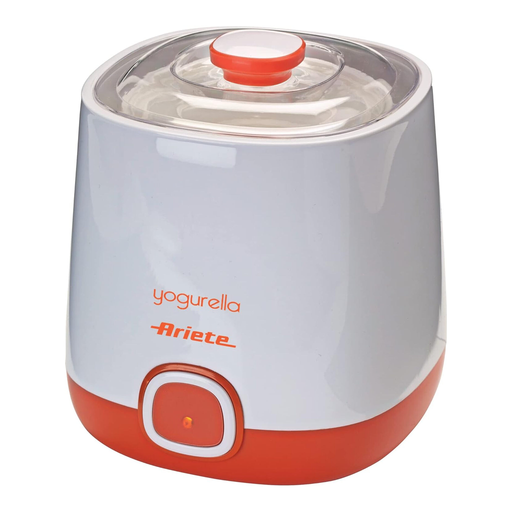
Ariete 621 Yogurella-621 yoghurt maker with a 1 l capacity

Ariete 621 Yogurella-621, 1 l, 20 W

A 1 l container is one option if you want to make a larger batch to portion out and share.

The product name lists a 1 l capacity and 20 W. The product description also lists a filter for Greek yoghurt and an adjustable timer.

View at Joybuy

Frequently asked questions

When should I start making homemade yoghurt for breakfast?

Work backwards from breakfast: first allow for the preparation time given in the appliance instructions, then factor in time in the fridge. A consumer advice centre guide to making yoghurt without an appliance gives a standing time of around twelve hours; don’t assume this applies to an electric model.

How can I keep yoghurt cool enough for a bring-and-share gathering?

Use clean hands and containers, chill the finished yoghurt and keep it sufficiently cool during transport, too. The German Federal Institute for Risk Assessment points out that inadequate temperatures during storage and transport can allow harmful germs to survive and multiply.

Can I use raw milk directly in a yoghurt maker?

Don’t use raw milk without boiling it first if the yoghurt won’t be heated sufficiently afterwards. The German Federal Institute for Risk Assessment gives homemade yoghurt as an example of a food for which raw milk must be boiled before preparation.

What should I bear in mind about food contact and electrical appliances?

For every type of appliance, check the information about parts intended to come into contact with food. For electrical appliances, CE marking is required only where relevant harmonised EU rules say it is; it’s a declaration by the manufacturer, not a quality mark awarded by a central EU testing body. CE marking requirements for electrical appliances don’t apply to a non-electric container.

Are replacement jars and an appliance fault covered by the same promise?

No. Check separately whether suitable replacement containers are available. Your statutory rights if a product is faulty are against the seller; any additional guarantee is voluntary and subject to its own terms.