First, decide whether you’d prefer to chill your weekly batch in individual jars or serve it from one large container. Individual jars make it easier to have separate breakfast portions ready to go, while a large container suits a batch that everyone can share. A simple switch may be all you need for plain yoghurt; a timer is useful if you want the machine to stop after a set time. If you’re using raw milk, making sure it’s been treated safely before you start is a separate step that no machine programme can replace.
Which option is right for you?
If you’re making a batch for the week
If you’d like to make a suitable batch of plain yoghurt after a trip to the market, check how much the containers hold and whether you’ll need to transfer the yoghurt to another vessel. Product information from Rommelsbacher, Severin and Luvele lists a range of container sizes and configurations.
If you’re preparing breakfast portions
Individual jars with lids can be handy if you want to store ready-to-eat portions separately in the fridge. Severin and Rommelsbacher both list portion jars as included with their respective models.
If you want to keep things simple to start with
If you only plan to make plain yoghurt for now, extra programmes may not be a deciding factor. The consumer advice centre also describes how to make yoghurt in screw-top jars without a yoghurt maker.
What should you look for when buying?
Individual jars
A good fit if: you want to chill your weekly batch straight away in individual breakfast portions. Severin lists seven 150 ml jars for the JG 3510, while Rommelsbacher lists eight 150 ml jars for the JG 40.
Consider: you’ll have more jars and lids to wash and store.
Large container
A good fit if: you’d like to serve a batch from one container. Rommelsbacher lists two 1.2-litre glass containers for the JG 80; Luvele’s Pure Plus comes with a 2-litre glass container.
Consider: check that the container and machine will fit in your fridge and in the space where you plan to use it.
| What to consider |
What to check before buying |
Who this matters most to |
| Batch size |
Match the usable container capacity and the space in your fridge to how much yoghurt you need for the week. |
If I want to make a suitable batch for the week without unnecessary decanting, I look at the capacity and the fridge space available. Around 36% of consumers put batch size first. |
| Portioning |
Compare the number and capacity of the included containers, and check whether they have lids. |
If I want to keep individual breakfast portions chilled and ready to eat, suitable individual jars are important. Around 29% of consumers prioritise portioning. |
| Controls and timer |
Check whether the specific model has a timer and automatic shut-off. |
If I don’t want to keep track of the running time myself, a timer matters to me. Around 21% of consumers pay particular attention to the controls and shut-off function. |
| Milk preparation and storage |
Check the type of milk and the preparation instructions; plan to use easy-to-clean containers and chill the yoghurt afterwards. |
If I’m using milk from the market, I want to know how it has been treated and how to store the finished yoghurt. Around 14% of consumers prioritise milk preparation and clean storage. |
Common buying mistakes
-
Assuming milk from the market is ready to drink
Buying milk at a market doesn’t tell you how it has been treated. The German Federal Institute for Risk Assessment advises heating raw milk before consumption; the heat used during yoghurt-making does not replace this treatment.
Ask whether the milk is raw, pasteurised or UHT, and follow suitable preparation instructions.
-
Assuming wattage tells you the energy used per batch
The rated power alone doesn’t show how much electricity a machine uses to make a batch of yoghurt.
To compare models, you need consumption measurements for batches of the same size, or you’ll need to measure the energy used yourself under comparable conditions.
-
Assuming similarly named models are identical
Ariete’s information for the Yogurella 0621/10 differs from the details of a Joybuy listing called “Ariete 621”, so you can’t assume they’re the same version.
Before buying, check the full model number, containers, electrical specifications and what’s included.
Key brands at a glance
Rommelsbacher
The JG 40 is designed for individual portions, while the JG 80 Jona combines small cups with larger glass containers.
- Rommelsbacher lists eight 150 ml portion jars for the JG 40. The JG 80 comes with four 125 ml ceramic cups and two 1.2-litre glass containers.
- The JG 80 has extra features that aren’t essential for making simple batches of plain yoghurt.
Severin
The JG 3510 is designed for making plain yoghurt in individual portion jars.
- Severin says the machine comes with seven 150 ml jars; the manufacturer also lists replacement jars as an accessory.
- The JG 3510’s specification sheet doesn’t list a timer. This applies to this model, not every machine in the range.
Luvele
The Pure Plus is a model with a large glass container and an adjustable run time.
- Luvele lists a 2-litre glass container, a digital 36-hour timer and a temperature range of 25 to 50 °C.
- These manufacturer’s specifications don’t prove independently measured temperature consistency or any health benefits of the yoghurt.
Ariete
The specification sheet for the Yogurella 0621/10 describes a container-style yoghurt maker with a filter for draining yoghurt.
- Ariete lists a power rating of 40 W and two 1-litre containers for the 0621/10.
- The model and container details differ for a Joybuy listing called “Ariete 621”. Check the exact version rather than assuming the 0621/10 specifications apply.
Joybuy products for your weekly batch
The models below include options for making yoghurt in larger containers as well as storing it in individual jars. What matters is choosing container sizes and features that suit the way you actually want to make plain yoghurt.
 No image available
FOHERE yoghurt maker with 2 large glass containers
An option if you’d like to make and store your weekly batch in larger containers.
Specifications list two glass containers, with capacities of 2000 ml and 1400 ml, as well as a sieve.
Joybuy
 No image available
Yoghurt maker with 1.6-litre inner container
The combination of an inner container and small jars gives you a choice of container sizes for making yoghurt.
Specifications list a 1.6-litre SUS304 inner container, nine 100 ml borosilicate glass jars, adjustable temperature and run time, and automatic shut-off.
Joybuy
 No image available
FOHERE yoghurt maker with 8 jars
An option if you’d like to divide your yoghurt into individual containers while it’s being made.
Specifications list eight jars with a total capacity of 1440 ml, digital temperature control and a timer of up to 48 hours.
Joybuy
 No image available
Yoghurt maker, 1.5 l, 20 W
The container is designed for making a batch in one vessel, if you’d rather not use several portion jars.
The product name specifies 1.5 litres and 20 W; a lid and sieve are also listed.
Joybuy
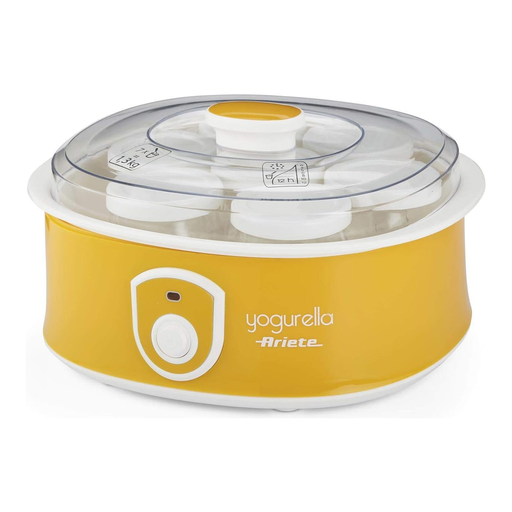 No image available
Ariete yoghurt maker, 1.3 l, refurbished (A)
The version with several individual jars may suit you if you want to divide your batch into portions straight away.
Product information lists a 1.3-litre capacity, seven portion jars and a power rating of 20 W. This version is marked as refurbished.
Joybuy
Frequently asked questions
Can I put milk from the market straight into the yoghurt maker?
Don’t judge by where you bought the milk; check how it has been treated. The German Federal Institute for Risk Assessment advises heating raw milk before consumption; making yoghurt doesn’t automatically make untreated raw milk safe. A recipe from the consumer advice centre also distinguishes between pasteurised whole milk, which should be brought briefly to the boil first, and UHT milk, which can be used straight away.
Where should I store homemade yoghurt?
Keep it in the fridge after making it. The consumer advice centre recommends storing dairy products such as yoghurt on the middle shelf of the fridge at 5 to 7 °C.
What should I look for in replacement jars?
Choose replacement jars that are compatible with your exact model. For the Severin JG 3510, the manufacturer lists accessory EG 3513; check that the jars are intended for your machine before buying.


