Start by choosing a maker based on how much yoghurt you need. Then decide whether you want to give each guest their own jar or serve everyone from one container at the breakfast table. An automatic shut-off makes it easier to plan the timing, but it doesn’t replace chilling the yoghurt afterwards or using clean containers. Extra programmes are most useful if you also want to make other recipes.
Which yoghurt maker is right for you?
Hosting a large breakfast
If you’re serving several guests, compare the quantity you need and the portion size with the maker’s capacity per batch and the number of jars supplied. Rommelsbacher lists eight 150 ml jars for the JG 40; Steba specifies twelve 200 ml jars for the JM 2.
Hosting breakfast at a set time
If you want to serve the yoghurt at a particular time, plan for fermentation and chilling separately. The Rommelsbacher JG 40 and Steba JM 2 have a timer with automatic shut-off, according to their manufacturers. The Severin JG 3510 does not have a timer, according to its manufacturer.
Hosting guests who prefer different portion sizes
Decide whether to give guests pre-filled jars or let them help themselves from a larger container at the table. The Rommelsbacher JG 80 comes with two 1.2-litre glass containers and four 125 ml ceramic cups. According to the manufacturer, the two large containers do not make up a single 2.4-litre batch.
What should you look for when buying?
First, work out how much you’ll need for your guests and how you want to serve it. Then plan when the yoghurt needs to be ready, as well as allowing time and space for chilling.
| What matters when buying |
What to check |
Who will find this most important? |
| Quantity and number of portions |
Compare the number of guests and the amount you want per person with the capacity per batch, and the number and volume of the jars. |
If I’m planning for several guests, I want to consider the total quantity and the number of suitable jars together. Around 36% of consumers put having enough yoghurt and enough portions first. |
| End of fermentation and chilling |
Check the preparation time and shut-off function for the specific model in its instructions, then allow time for chilling. |
If breakfast starts at a set time, I plan for fermentation and chilling as two separate steps. Around 29% of consumers prioritise being able to plan when fermentation will finish. |
| Filling and cleaning |
Check the containers and lids, the cleaning instructions and whether there’s room in the fridge for the finished portions. |
If I want to prepare the portions in advance, I consider how many containers I’ll need to fill, chill and clean. Around 21% of consumers prioritise how easy the containers are to handle. |
| Recipe variety |
Check that the available programmes and fixed temperatures suit the recipes you plan to make. |
If I want to make recipes other than natural yoghurt, I check which programmes are available and what conditions they require. Around 14% of consumers prioritise being able to make additional types of recipes. |
Which buying and planning mistakes should you avoid?
-
Assuming container capacity equals the amount made per batch
The Rommelsbacher JG 80 comes with two 1.2-litre containers, but the manufacturer specifies up to 1,200 g of yoghurt per batch. So you shouldn’t simply add the container capacities together and assume it can make a 2.4-litre batch.
Compare the stated batch size with what you need, and don’t automatically count spare or replacement containers towards the total.
If one batch isn’t enough, you may need to make another or have extra serving containers.
-
Confusing automatic shut-off with chilling
On models with a timer, it switches off the maker but doesn’t chill the yoghurt. The German Federal Institute for Risk Assessment stresses that perishable foods must be kept sufficiently chilled.
Plan for fermentation and chilling afterwards as two separate steps.
-
Comparing litres alone
A large total capacity doesn’t tell you how many individual portions you can serve. For example, the Rommelsbacher JG 80 comes with four small cups, while the Steba JM 2 includes twelve jars.
Before buying, decide whether each guest should have their own jar or whether you’d rather serve yoghurt from a larger container at the breakfast table.
Which brands are worth considering?
Rommelsbacher
The JG 40 and JG 80 suit different ways of serving: individual jars, or a combination of large containers and small cups.
- Rommelsbacher says the JG 40 has eight 150 ml jars and a timer with automatic shut-off. For the JG 80, the manufacturer specifies up to 1,200 g of yoghurt per batch.
- The two 1.2-litre containers supplied with the JG 80 don’t mean it can make a single 2.4-litre batch. The programme temperatures on this model are fixed and can’t be selected freely.
Steba
The JM 2 is an option if you want to prepare several individual portions for breakfast.
- According to Steba, it comes with twelve 200 ml jars, with a total capacity of 2.4 litres. The manufacturer also specifies a timer with automatic shut-off.
- A large number of individual containers takes up fridge space and each one needs to be cleaned separately.
Severin
When comparing Severin models, make sure you check the model number.
- Severin lists seven 150 ml jars for the JG 3518.
- The manufacturer doesn’t list a timer for the JG 3510. Don’t assume that details about this model also apply to other Severin makers.
Clatronic
The JM 3344 is designed to make one batch in several small individual jars.
- Clatronic says it comes with seven jars, each with a screw-top lid and a capacity of 160 ml. Additional compatible jars are available.
- The product description mentions an illuminated on/off switch, but doesn’t confirm that it has a shut-off timer.
Joybuy products for breakfast with guests
The Joybuy products below include models with large containers and models with individual portion jars. Compare the stated capacities and containers with the way you plan to serve your yoghurt.
 No image available
FOHERE yoghurt maker with two XXL glass containers (2000 ml and 1400 ml)
If you want to serve yoghurt in larger containers and portion it out at the breakfast table, this container style suits that way of serving.
The product name lists two XXL glass containers, with capacities of 2000 ml and 1400 ml.
View at Joybuy
 No image available
Fosmet yoghurt maker with 1.6-litre inner pot and nine borosilicate glass jars
If you want the choice of using an inner pot or pre-portioned jars, this model offers both types of container according to its product name.
It lists a 1.6 L SUS304 inner pot, nine borosilicate glass jars, temperature control, a timer and an OLED display.
View at Joybuy
 No image available
FOHERE yoghurt maker with eight jars (1440 ml)
If you want to prepare individual portions for your guests, having several jars makes it easier to fill them before breakfast.
The product name lists eight jars with a total capacity of 1440 ml, digital temperature control and a 48-hour timer with automatic shut-off.
View at Joybuy
 No image available
Yoghurt maker with 1.5-litre container and strainer
If you want to make one batch and portion it out afterwards, the stated container option is a single container rather than several individual jars.
The product name lists a 1.5 L capacity, 20 W, a container with a lid and a strainer for Greek yoghurt. It’s listed as suitable for 3–5 people.
View at Joybuy
 No image available
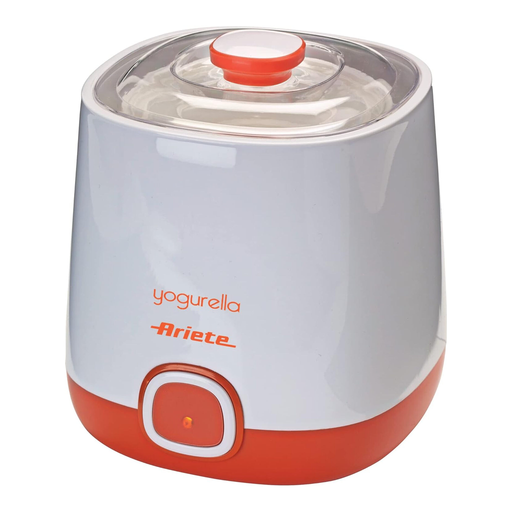
Ariete 621 yoghurt maker, 1 litre
If you want to compare a single container size with the quantity you’re planning for breakfast, the product name lists a capacity of one litre.
Other details in the product name: 20 W and white.
View at Joybuy
Frequently asked questions
When should I start making yoghurt for breakfast?
Work backwards from breakfast time, allowing for both the fermentation time specified in your maker’s instructions and the time it needs to chill in the fridge afterwards. Automatic shut-off only stops the maker; perishable foods still need to be kept sufficiently chilled.
How should I clean the containers before making a new batch?
Wash your hands and kitchen utensils thoroughly before you start. For the JG 80, Rommelsbacher recommends washing the jars and lids carefully and rinsing them with hot water before filling. You should also follow the instructions for your own appliance.
Can I use raw milk for guests?
The German Federal Institute for Risk Assessment warns that raw milk can contain pathogens. Children, pregnant women, older people and people who are ill in particular should not drink raw milk that hasn’t been boiled. When making yoghurt, also follow the milk guidance in your appliance’s instructions. A fermentation programme doesn’t prove that untreated raw milk has become safe.
What rights do I have if my appliance is faulty?
For a consumer purchase in the EU, you generally have at least two years of legal rights against the seller if a product is faulty, as explained by Your Europe. An additional manufacturer’s guarantee doesn’t replace these rights; check its separate terms and conditions.
Which CE rules apply to an electric yoghurt maker?
CE marking is only required if the relevant EU harmonisation rules apply to the specific product. The European Union’s Low Voltage Directive covers electrical equipment rated from 50 to 1,000 V AC, unless an exception applies. You can’t make a general claim about a particular appliance’s compliance without checking that specific model.


