For a family breakfast, your choice mainly depends on whether you want to prepare individual portions, serve yoghurt from one large container or use a maker without plugging it in. Individual jars make it easier to store separate portions, while a large container lets you divide up the yoghurt in the morning. If you’re preparing it the night before, check the timer and setting time too. A maker without electricity needs hot water and plenty of time.
Who is a yoghurt maker suitable for?
Families who prefer separate breakfast portions
If family members want to store their portions separately, check how many jars are included and how much each holds. Models such as Severin and Steba’s portion jars are useful examples of what to compare.
Families who share a supply of yoghurt
If everyone serves themselves different amounts from one container in the morning, compare the stated yoghurt capacity with how much your family actually eats at breakfast. Rommelsbacher and Steba also offer models with larger containers.
Households with specific preparation preferences
If you want to try plant-based or lactose-free recipes, check that the instructions and settings on the specific model suit your base and cultures. For example, Rommelsbacher lists preset programmes for different recipes for the JG 80.
What should you look for when buying?
Electric maker with individual jars
A good fit if: you want to store individual breakfast portions separately. The manufacturers list seven 150 ml jars for the Severin JG 3518 and eight 180 ml jars for the Steba JM 3.
The trade-off: the jars take up space in the fridge, so compare their number and capacity with what you need.
Electric maker with a large container
A good fit if: you want to serve everyone from one larger container in the morning. Rommelsbacher says the JG 80 comes with two 1.2-litre containers and four 125-ml cups; Steba lists a 2-litre yoghurt jar for the JM 4 FERMENT.
The trade-off: you’ll need to divide the yoghurt up when serving. The yoghurt jar and separate jar with sieve supplied with the Steba JM 4 FERMENT are different containers; they don’t make one 3.3-litre batch of yoghurt.
Yoghurt maker that doesn’t use electricity
A good fit if: you don’t want to plug the maker in where you plan to use it and a one-litre batch is enough for your household.
The trade-off: My.Yo says you’ll need about 750 ml of boiling water and 12–14 hours for the yoghurt to set. Heating the water also uses energy and needs to fit into your schedule.
| Priority |
What to check before buying |
Who is it important to? |
| Quantity and portioning |
Check the number and capacity of the yoghurt containers actually included; don’t add containers of different sizes together as if they make one batch. |
If I want to prepare a separate portion for each family member, individual jars matter; around 36% of consumers put portioning first. |
| Preparing the night before |
Check the timer, automatic shut-off and setting time specified for the recipe you’re making; allow time for chilling afterwards too. |
If I want the batch to be ready in time for breakfast, I need to factor the setting and chilling time into my schedule; around 29% of consumers prioritise this kind of timing. |
| Recipe flexibility |
Check that the cultures and instructions for the specific model are suitable for the milk or plant-based drink you plan to use. |
If I want to experiment with a plant-based or lactose-free base, I need suitable cultures and settings; around 21% of consumers prioritise recipe flexibility. |
| Using it without electricity |
Check the amount of water needed, how to handle it safely when hot, the setting time and the capacity against your own routine. |
If there’s no socket where I want to use it, a maker that doesn’t need to be plugged in could work, as long as hot water and the preparation time fit into my routine; around 14% of consumers prioritise using a maker without electricity. |
Common misconceptions
-
Adding the capacities of different containers together
The 2-litre yoghurt jar supplied with the Steba JM 4 FERMENT is separate from the 1.3-litre jar with sieve. According to the manufacturer, they don’t make a single 3.3-litre batch of yoghurt that can be prepared at the same time.
Compare the stated yoghurt capacity with the amount you need for breakfast.
If one batch isn’t enough for what you actually need, you may have to make another.
-
Assuming automatic shut-off means automatic chilling
An automatic shut-off ends the programme, but it doesn’t chill the finished yoghurt. The consumer advice centre recommends storing homemade yoghurt in the fridge afterwards.
Allow time to move it to the fridge as well as time for it to set.
-
Assuming ‘no electricity’ means ‘no energy needed’
According to the manufacturer, the electricity-free My.Yo maker needs about 750 ml of boiling water to make yoghurt, with a setting time of 12–14 hours.
Consider the whole process, including heating the water and allowing enough time, not just whether the maker needs plugging in.
Brands to consider
Severin
The JG 3518 is an electric maker with separate portion jars, making it suitable for family breakfasts.
- According to the manufacturer, the JG 3518 comes with seven 150 ml jars.
- This model doesn’t have a display; these details apply to the JG 3518, not every appliance from the brand.
Rommelsbacher
The JG 40 comes with portion jars, while the JG 80 combines larger glass containers with smaller cups.
- According to the manufacturer, the JG 40 comes with eight 150 ml jars and a timer that runs for up to 18 hours. The JG 80 comes with two 1.2-litre containers and four 125-ml cups.
- The programmes on the JG 80 are preset, so you can’t freely adjust the temperature.
Steba
The JM 3 is designed for individual jars, while the JM 4 FERMENT has a large yoghurt container and a separate jar with sieve.
- According to Steba, the JM 3 comes with eight 180 ml jars and a timer. The JM 4 FERMENT includes a 2-litre yoghurt jar and a separate 1.3-litre jar with sieve.
- The two JM 4 containers have different fittings and shouldn’t be counted as one batch of yoghurt.
My.Yo
A yoghurt maker that doesn’t use electricity, with a one-litre capacity for households happy to prepare a batch using hot water.
- According to My.Yo, making yoghurt takes about 750 ml of boiling water and 12–14 hours to set.
- It’s designed for a one-litre batch; whether that’s enough for a family breakfast depends on how much your household actually eats.
Yoghurt makers at Joybuy
The products below include yoghurt makers with individual jars, as well as models with a stated larger-container capacity. Compare the capacity and features with the amount of yoghurt you want to make for breakfast.
 No image available
FOHERE yoghurt maker with 2 XXL glass containers (2000 ml and 1400 ml)
If you prefer larger containers to lots of individual jars, the product name lists two XXL glass containers.
According to the product name: two glass containers with capacities of 2000 ml and 1400 ml.
View at Joybuy
 No image available
Fosmet yoghurt maker, 1,6 l, SUS304, with nine borosilicate glass jars
The combination of an inner container and individual jars gives you different options for making yoghurt.
According to the product name: 1,6-litre SUS304 inner container, nine borosilicate glass jars, temperature control, timer and OLED display.
View at Joybuy
 No image available
FOHERE yoghurt maker with 8 jars (1440 ml) and 48-hour timer
If you’re looking for individual jars and a way to plan the preparation time, the product name lists both features.
According to the product name: eight jars with a total capacity of 1440 ml, digital temperature control and a 48-hour timer.
View at Joybuy
 No image available
Yoghurt maker, 1,5 l, 20 W, with sieve
If you want to make one batch in a shared container, the product name lists a capacity of 1,5 litres.
According to the product name: 20 W, sieve and lid, dimensions 19,5 × 17,5 × 21,4 cm. The description says it’s suitable for 3–5 people; compare this with how much your household actually eats at breakfast.
View at Joybuy
 No image available
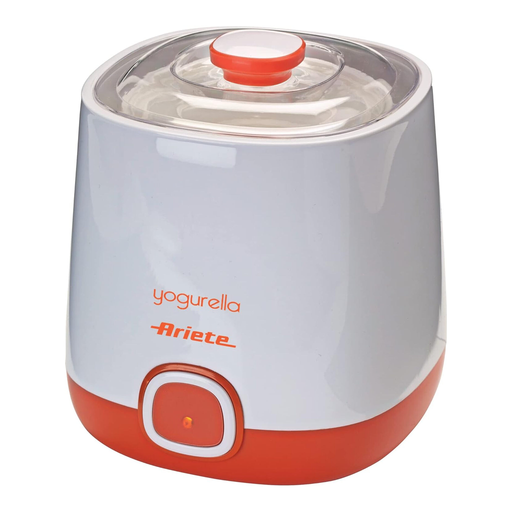
Ariete 621 yoghurt maker, 1 l, 20 W
A stated one-litre capacity is worth considering if you want to make one batch in a shared container rather than use individual portion jars.
According to the product name: 1 l capacity, 20 W and a white finish.
View at Joybuy
Frequently asked questions
When should I start making yoghurt for breakfast?
Allow for the setting time in your recipe and time to chill the yoghurt afterwards. My.Yo lists a setting time of 12–14 hours for its maker; the consumer advice centre recommends storing homemade yoghurt in the fridge afterwards. So the best time to start depends on the recipe and appliance you’re using.
How should I handle the containers before and after making yoghurt?
Use clean containers and follow the cleaning instructions for your appliance. Steba’s user manual recommends cleaning all parts thoroughly; once the yoghurt has set, it should be chilled.
What ongoing costs and consumer rights should I consider if something is faulty?
Remember to budget for ingredients and suitable cultures, and replacement containers if needed. If something is faulty, your statutory consumer rights with the seller are separate from any voluntary guarantee. The consumer advice centre notes that retailers are generally responsible for goods being free from defects at the time of purchase or delivery for two years.
Does an electric yoghurt maker have to carry a CE mark?
Whether CE marking is required depends on whether the relevant EU harmonisation rules require it for that particular product. The European Union explains that CE marking is only required for products where the applicable rules explicitly call for it.


